


Variable Refrigerant Flow Systems

Variable Refrigerant Flow Systems
YORK's Variable Refrigerant Flow (VRF) systems, part of Johnson Controls, offer advanced climate control solutions that enhance comfort and efficiency in buildings. These systems provide precise heating and cooling to different zones, optimizing energy use and reducing operational costs.
- Energy Efficiency: VRF systems can save up to 39% energy compared to conventional HVAC systems by modulating refrigerant flow based on demand.
- Flexibility: Modular design allows for customized configurations, including heat pump and heat recovery options, suitable for various building requirements.
- Quiet Operation: Ensures quiet comfort by delivering the exact amount of heating or cooling needed for each zone.
- Indoor Units: Available in ducted and non-ducted options, providing flexibility in installation and design.
- Outdoor Units: Include mini VRF, heat recovery, and heat pump models, catering to different voltage requirements and capacities.
- Controllers: A range of control options, from simple thermostats to advanced building automation systems, allows for precise management of indoor climates.
- Advanced Compressor Technology: Utilizes Hitachi's high-efficiency scroll compressors, offering high compression ratios and reliability.
- Design Freedom: Easily adapted for various applications, including historical renovations and buildings with multiple zones.
- Ease of Installation: Designed for quick installation with minimal maintenance requirements, reducing overall project costs.
- Suitable Buildings: Ideal for hotels, schools, medical offices, and other multi-zone buildings.
- Certifications: YORK VRF systems are Intertek ETL Listed and certified by the Air Conditioning, Heating & Refrigeration Institute, ensuring compliance with industry standards.
- Comprehensive Training: Johnson Controls offers extensive training programs to ensure efficient deployment and maintenance of VRF systems.
- Selection Software: Intuitive software aids in the accurate selection and design of VRF systems, enhancing project efficiency.
YORK VRF systems by Johnson Controls provide a reliable, efficient, and flexible solution for modern building climate control needs, backed by extensive support and advanced technology.
- Delivery and Inventory Management: Efficient logistics and inventory systems ensure timely delivery of equipment, preventing project delays.
- Product Information Access: A secure web portal, VRFPro.com, offers comprehensive product documentation and support, accessible via QR codes on product nameplates.
- System Configuration: YORK VRF systems can be customized with heat pump or heat recovery units, offering energy savings and scalability. Indoor units are available for both ducted and non-ducted applications.
- Training and Software: Comprehensive training modules and web-based system selection software facilitate effective equipment selection and system design.
- Architects and Designers: Flexible piping, compact footprints, and modular components allow for design freedom and easy system updates.
- Mechanical Contractors and Installers: Simplified installation processes, reliable product delivery, and easy maintenance access enhance efficiency and reduce costs.
- Building Owners: Features like rotational operation, backup functions, and noise reduction modes optimize efficiency, extend service life, and enhance occupant comfort.
- Available in various configurations including 1-way, 2-way, and 4-way cassettes, wall mounts, and ducted systems, designed for quiet operation and easy installation, with capacities ranging from 6,000 to 24,000 Btu/hr.
YORK VRF systems offer a comprehensive solution for building space conditioning, providing energy efficiency, flexibility, and enhanced comfort. The document encourages collaboration with Johnson Controls to explore the full range of YORK VRF systems and make informed decisions for HVAC projects.
For cooling, the indoor air inlet temperature is 80°F DB (26.7°C DB) and 67°F WB (19.4°C WB), while the outdoor air inlet temperature is 95°F DB (35.0°C DB). For heating, the indoor air inlet temperature is 70°F DB (21.1°C DB) and the outdoor air inlet temperature is 47°F DB (8.3°C DB).
- Compact design suitable for limited spaces and compatible with interior designs.
- Ideal for perimeter zone air conditioning.
- High-efficiency fan motors and multiple fan speed settings.
- Built-in condensate pumps for easy service and troubleshooting.
- These units have a slim-line design and are available in capacities ranging from 6,000 to 15,000 Btu/hr. They feature a nominal cooling capacity of up to 15,000 Btu/h and heating capacity up to 17,000 Btu/h. The units operate with a sound pressure level ranging from 29 to 48 dB.
- These units offer capacities from 18,000 to 48,000 Btu/hr and feature high-efficiency AC fan motors. They provide multiple fan speed settings and can handle up to .74 WG static pressure. The sound pressure level ranges from 38 to 51 dB.
- Available in capacities from 6,000 to 48,000 Btu/hr, these units feature high-efficiency DC fan motors and multiple fan speed settings. They can handle up to .32 WG static pressure and have a sound pressure level ranging from 26 to 46 dB.
- These units are designed for capacities from 6,000 to 18,000 Btu/hr and feature high-efficiency DC fan motors. They offer multiple fan speed settings and up to .20 WG static pressure.
- This system is designed to introduce and condition fresh air into a VRF system, enhancing indoor comfort and health. It has a capacity of 96,000 Btu/hr and features a high external static pressure up to 1.24 WG. The system integrates seamlessly with VRF heat pump system controls and piping.
- Power Supply: AC 1Phase, 208/230V, 60Hz.
- Refrigerant: R410A.
- Connections: Flare-Nut Connection with Flare Nuts or Brazed.
- Condensate Drain: VP25 with OD 1-1/4 in. (32 mm) and ID 31/32 in. (25 mm).
- Designed for cooling demand during mid-seasons and winter.
- Includes inputs for optional CO2 and enthalpy sensors for air quality control.
- Features a remote control switch for managing outside air damper opening.
- Available in 2.5, 3.0, and 4.0-ton capacities with nominal cooling and heating capacities ranging from 30,000 to 48,000 Btu/h and 34,000 to 54,000 Btu/h respectively.
- Utilizes R410A refrigerant and offers sound pressure levels between 32-40 dB.
- Available in capacities from 6 to 30 tons, supporting up to 64 indoor units.
- Heat pump units operate in cooling mode from 14°F to 118°F and in heating mode from -4°F to 59°F.
- Heat recovery units can simultaneously heat and cool spaces, with similar temperature ranges.
- Mini VRF systems offer 3, 4, and 5-ton capacities with inverter compressor technology.
- Refrigerant piping lengths up to 3,281 feet, with various maximum height differences between units.
- Efficiency ratings include EER, SEER, and COP values, indicating energy efficiency.
- Outdoor units feature advanced defrost cycle operation and power-saving demand control.
- 4-Position Air Handler with capacities from 1.5 to 5 tons, featuring rigid case construction and improved insulation design.
- Mini VRF systems provide quiet, personalized comfort with multiple indoor unit options for individual zone control.
- The sound pressure levels for cooling (night-shift) range from 60 to 69 dB(A), while heating levels are consistent at 67 to 69 dB(A) across different models.
- The units are equipped with high-pressure switches, over-current, and over-heat protection for inverters and compressors, ensuring safety and reliability.
- The refrigerant used is R410A, with varying charge amounts depending on the system size. Refrigeration oil type is FVC68D, with specific charge amounts per unit.
- Cooling efficiency is measured in EER and IEER, with values ranging from 9.50 to 15.30 Btu/Wh. Heating efficiency is indicated by COP, ranging from 2.05 to 4.14 W/W.
- The cooling operating range for indoor temperatures is 59°F to 73°F, and outdoor temperatures range from 14°F to 118°F. The heating range for indoor temperatures is 59°F to 80°F, with outdoor temperatures from -4°F to 59°F.
- The document details various system configurations, including single, twin, triple, and quad unit systems, with capacities ranging from 6 to 30 tons.
- The systems use inverter and fixed-speed compressors, with propeller fans for air circulation. Motor outputs and air flow rates are specified for each system.
- The document provides detailed dimensions and weights for each system, ensuring proper installation and handling.
- Information on piping sizes, connection ratios, and recommended indoor unit capacities is included to guide installation and system integration.
- These units can simultaneously heat and cool spaces, operating efficiently in a wide temperature range: as low as 14°F (-10°C) for cooling and -4°F (-20°C) for heating.
- Models include high-efficiency quad unit systems with nominal cooling capacities of 336,000 to 360,000 Btu/h and heating capacities of 378,000 to 405,000 Btu/h.
- Efficiency ratings show EERs of 9.50 to 10.50 and IEERs of 17.50 to 20.20.
- Refrigerant type used is R410A, with a defrost method utilizing a reversed refrigerant cycle.
- These units are capable of either heating or cooling, with an extended operating temperature range similar to the heat recovery units.
- Available in single, twin, and triple unit configurations, covering capacities from 6 to 30 tons.
- Nominal cooling capacities range from 72,000 to 240,000 Btu/h, while heating capacities range from 81,000 to 270,000 Btu/h.
- Efficiency ratings include EERs up to 15.60 and IEERs up to 25.20, with COPs for heating ranging from 2.36 to 4.21.
- Both systems utilize multi-pass cross-finned tube heat exchangers made from Cu-Al with anti-corrosion properties.
- Compressor types include inverter and fixed speed, with various motor outputs and start methods.
- Fan types are propeller fans with direct drive, and sound pressure levels vary slightly between cooling and heating modes.
- Protection devices include high-pressure switches, over-current, and over-heat protections for inverters and compressors.
- Connection ratios and maximum recommended indoor units per system are specified for optimal performance.
- Operating ranges for both cooling and heating are detailed, with specific indoor and outdoor temperature limits.
- Electrical requirements include power supply specifications, minimum circuit amps, and recommended fuse sizes.
- The document provides detailed specifications for YORK VRF systems, focusing on outdoor units with a power supply of 460V/3PH 60Hz. The systems are available in 18-30 ton configurations, with models such as YVAHP336B41LM and YVAHP360B41LM. Key specifications include nominal cooling and heating capacities, power input, current input, efficiency ratings, and operating ranges for both cooling and heating modes. The systems use R410A refrigerant and feature multi-pass cross-finned tube heat exchangers.
- The systems are equipped with various protection devices, including high-pressure switches, over-current protection for inverters and PCBs, and over-heat protection for compressors.
- The refrigerant type used is R410A, with specific charge amounts detailed for different models. The main refrigerant piping includes gas and liquid lines with specified dimensions.
- The document outlines efficiency ratings such as EER and IEER for cooling, and COP for heating. The cooling operating range is from 14°F to 118°F, while the heating range is from -4°F to 59°F.
- A variety of optional parts and accessories are available, including change-over boxes, piping kits, and various protective and functional accessories for both outdoor and indoor units.
- YORK VRF systems offer a range of control options, including wired and wireless zone controllers, centralized controllers, and adapters for integration with building management systems. Features include individual zone control, programmable scheduling, and graphical user interfaces.
- The document describes different types of zone controllers, such as wireless and wired options, each with specific features like error code diagnosis, adjustable fan speed, and programmable timers.
- Large LCD display for monitoring operating conditions and settings.
- Timer settings available in half-hour intervals up to 23 hours.
- Self-diagnosis function for detecting issues in indoor and outdoor units.
- Energy-saving features include temperature range limit, setback, occupancy-based operation, and set temperature auto reset.
- Individual function lockout for mode, temperature, and fan speed.
- Available in mini and large versions, controlling up to 64 groups of indoor units.
- Features include touchscreen interface, tenant billing, and color-coded graphics.
- External input terminal for central operation/stop, demand control, and emergency stop.
- Web-based interface for controlling VRF systems with up to five PCs or tablets.
- Advanced multi-zone control and scheduling capabilities.
- Supports up to 64 refrigerant systems and 160 indoor units.
- Manages up to 2,048 groups of systems with a maximum of 2,560 indoor units.
- Allows instructions from any point on a local communication network.
- BACnet and LONWorks adapters enable integration with systems like Metasys.
- Control and monitoring points include operation mode, fan speed, and temperature setpoint.
- Unique communication system for controlling multiple units from one point.
- Flexible wiring routes with no restrictions on order or number of branches.
- Supports up to 64 refrigerant groups and 160 indoor units per system.
- YORK VRF systems are Intertek ETL Listed and certified by the Air Conditioning, Heating & Refrigeration Institute.
Catalog excerpts

Variable Refrigerant Flow Systems
Open the catalog to page 1
JOHNSON CONTROLS | YORK® VRF SYSTEMS YORK® Variable Refrigerant Flow System Efficiency and comfort for your customers. New growth opportunities for your business. Building climate control is about comfort and efficiency – delivering just the right heating and cooling to every space using no more energy than necessary. YORK variable refrigerant flow (VRF) technology lets you do that for customers in innovative ways that present new growth opportunities for your business. VRF technology gives building owners, architects, consulting engineers, and mechanical contractors an innovative solution to...
Open the catalog to page 2
JOHNSON CONTROLS | YORK® VRF SYSTEMS IIIIMIIIIIIIIIIIIIIIIIIHIIII Illllllll 111111111111111111111 I llllllllllllllllllllllllllllll iriiNiiiiii Ui , ! III SIR IS I I ; • - Johnson Controls Joint Venture with Hitachi 2 Introducing YORK VRF 4-6 What is VRF? 7 Why Partner with Johnson Controls? 8-11 15 INDOOR UNITS Overview 16-17 38 OUTDOOR UNITS Overview 39-41 84 OPTIONAL PARTS & ACCESSORIES 1 IB EL BE S EB BE EE 8 BCCCfii
Open the catalog to page 3
JOHNSON CONTROLS | YORK® VRF SYSTEMS offices countries years of HVAC expertise YORK® VRF systems come to you from Johnson Controls-Hitachi Air Conditioning, a global joint venture of Johnson Controls, Hitachi, Ltd., and Hitachi Appliances, Inc. These VRF technologies provide exciting new options to help you approach each project with innovative solutions that are modular, flexible, and exceptionally efficient. Customers globally now can access the most diverse range of air conditioning products in the industry. VRF systems challenge traditional thinking about how to achieve the optimum in efficient...
Open the catalog to page 4
JOHNSON CONTROLS | YORK® VRF SYSTEMS Variable flow means constant comfort and efficiency In the HVAC world, the term “variable” connotes efficiency. Variable-speed chillers save energy and avoid the wear and tear of frequent cycling. Variable air volume systems improve air conditioning efficiency by modulating air delivery volumes within specific zones. The YORK® variable refrigerant flow systems achieve extremely high efficiencies by modulating the flow of refrigerant according to the exact demands of individual areas with innovative inverter-driven scroll compressor technology. Proven efficiency,...
Open the catalog to page 5
JOHNSON CONTROLS | YORK® VRF SYSTEMS laYORK s are modular and controlled solutions that include models with capability to simultaneously heat and cool different zones. The technology brings an array of advantages over conventional systems. • Save on energy. Systems essentially eliminate duct losses. In addition, variable-speed compressors in outdoor units provide extremely high part-load efficiency. • Keep people comfortable. Users can set individual temperature set points for multiple zones. Variable-speed compressors with wide capacity and precise modulation help maintain each zone's temperature...
Open the catalog to page 6
JOHNSON CONTROLS | YORK® VRF SYSTEMS Gain control flexibility Choose multiple applications Users can deploy from three basic control options. YORK VRF systems suit a wide range of buildings in new construction and retrofits. Prime candidates include: • ndoor fan coil units come I with a selection of thermostats (controllers), from simple units with on/off, setpoint, load and speed settings, to programmable units that enable scheduling. Wireless units are available to provide remote control of zone space conditions. • entral station controllers for C larger projects provide remote control and...
Open the catalog to page 7
JOHNSON CONTROLS | YORK® VRF SYSTEMS The YORK VRF Systems boast efficiencies up to: • 29.5 SCHE • 25.2 IEER Rated highest for energy efficiency YORK® systems rank impressively high in the ratings that matter most for VRF technology. The traditional measure of HVAC equipment, energy efficiency ratio (EER), measures system efficiency at full load. While this may be appropriate for equipment that operates in a traditional cycle (fully on or fully off), it is not appropriate for properly sized VRF systems, which spend the vast majority of time at part load, reaching full load only on the hottest...
Open the catalog to page 8
JOHNSON CONTROLS | YORK® VRF SYSTEMS A VRF system typically consists of one or more outdoor units from which refrigerant is piped to a series of indoor fan coil units serving individual zones within building spaces. The system conditions the spaces by delivering to the indoor fan coil units only the volume of refrigerant required to meet the heating or cooling needs of each zone (see Figure 1). There are two basic types of YORK VRF systems, ranging in capacity from 3-30 tons: • Heat pump VRF systems are two-pipe systems • Heat recovery VRF systems are three-pipe systems Heat pump VRF systems...
Open the catalog to page 9
JOHNSON CONTROLS | YORK® VRF SYSTEMS JOHNSON CONTROLS | YORK® VRF SYSTEMS every step: select, design, specify, install Your Johnson Controls account team supports you as no one else can, at every step of every project. Effective training, intuitive design and selection software, advanced logistics and delivery, and easily accessible documentation form a powerful support package that adds substantial value to YORK VRF systems. Get your team up to speed fast. Efficient performance, quality installations. Comprehensive training programs provide knowledge and skills necessary to effectively and efficiently...
Open the catalog to page 10
JOHNSON CONTROLS | YORK® VRF SYSTEMS Right-size systems with intuitive selection software The YORK VRF selection software intuitively guides you step by step through equipment selection, so you can quickly and accurately choose an appropriate and cost-effective equipment package for each project. Web-based program The Web-based program allows access from any computer or tablet. The software helps you: • Design accurate final system drawings including piping and wiring diagrams in an easy, quick, step-by-step process. • Accurately select systems using a System Sizing Analysis. The process starts...
Open the catalog to page 11All York catalogs and technical brochures
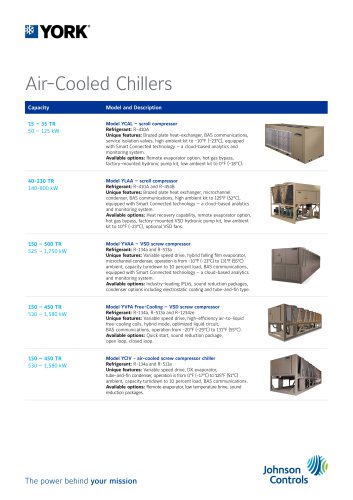 Air-Cooled Chillers
2 Pages
 DHX18NWB21S
1 Page
 DHMW09NDB21S
2 Pages
 YXV24 THRU 60
18 Pages
 YZH024 THRU 060
88 Pages
 YP9C*C
4 Pages
 York VRF GEN II
8 Pages
 ACOUSTIWEIR™
2 Pages
 VRF
VRF84 Pages
 YVAA
YVAA92 Pages
 SINGLE PIECE ECM AIR HANDLERS
12 Pages





- Boiler
- Indoor boiler
- Domestic boiler
- Residential heat pump
- Industrial air conditioner
- Air source heat pump
- Metal fan
- Outdoor heat pump
- Commercial fan
- White thermostat
- Mechanical ventilation unit
- Programmable thermostat
- Commercial air conditioning cabinet
- Heating thermostat
- Gas boiler
- Split air conditioning unit
- Ventilation controller
- Inverter heat pump