

Light for healthcare facilities
Light for healthcare facilities
The document emphasizes the importance of lighting in healthcare facilities, focusing on its impact on patient recovery and staff efficiency. It highlights Human Centric Lighting, which aligns artificial light with natural circadian rhythms to enhance healing and reduce hospital stays.
Healthcare lighting must adhere to specifications like mandatory brightness levels and glare-free environments. Standards vary for dental practices and nursing homes, but the focus is on individual needs to optimize treatment outcomes.
The document details lighting products and technologies such as XPECTRUM LEDs, Tunable White (TW), and the RECOVER System, which support patient recovery through natural light patterns.
Lighting solutions are tailored for specific areas like patient rooms, examination rooms, corridors, and therapy areas, each requiring different lighting scenes for functionality and comfort.
Lighting affects hormone levels, influencing sleep and recovery. Balanced room acoustics also support restful sleep and patient well-being.
Modern lighting systems use sensors to optimize energy efficiency by adjusting light levels based on occupancy and daylight availability. IoT sensors monitor environmental factors like humidity and air quality.
Customizable lighting solutions allow for tailored designs that meet specific architectural and aesthetic requirements, emphasizing user-friendly systems for ease of use.
The document underscores the significance of integrating advanced lighting technologies in healthcare settings to promote patient recovery, enhance staff performance, and ensure sustainable practices.
Patient Rooms: Lighting should prevent glare, provide at least 300 lux for reading, and align with circadian rhythms. DIN/TS 67600 recommends a cylindrical illuminance of at least 250 MEDI lux during the day.
Examination Rooms: Require 1000 lux with a CRI of Ra ≥ 90. Direct and indirect ceiling luminaires are recommended.
Corridors and Staircases: Require a minimum of 100 lux during the day, with dynamic control systems for brightness adjustments.
Recreation Rooms: Indirect lighting and dynamic daylight curves are recommended, with a daily light dose of 5,000 to 10,000 lux/h.
24-hour Nurses’ Station: Requires 500 lux at workstations, with glare control and high-quality luminaires.
Registration and Waiting Rooms: Should be inviting with high illuminance levels and dynamic lighting.
Therapy Rooms and Exercise Areas: Biodynamic lighting is recommended to support rehabilitation.
Lighting should create a harmonious environment with a mix of room and accent lighting. Therapy rooms require a minimum illuminance of 300 lux with a CRI of Ra ≥ 80.
Age-appropriate lighting is vital, with a minimum of 100 lux for general lighting, increasing to 1000 lux for residents over 90. Dynamic sequences support circadian rhythms.
High illuminance is required to facilitate social interaction, with biologically effective luminaires to mimic natural daylight.
Reception areas should be bright and welcoming, with consulting rooms requiring at least 500 lux and examination areas up to 1000 lux.
High color rendering and light quality are essential, with treatment areas needing 1000 lux and special luminaires providing 5000 to 10000 lux for operations.
Lighting that aligns with circadian rhythms can enhance cognitive and physical health, with HCL adapting to natural daylight patterns.
XAL's MASTER UNIT offers dynamic Tunable White light sequences, maximizing natural brightness and mimicking natural light.
Imitates natural light, impacting hormone systems with indoor light intensities of 1000-2000 lux, crucial for regulating the body's day-night rhythm.
Effective lighting design should mimic outdoor conditions, with high cylindrical illuminance and dynamic gradients in color temperature and illuminance.
Balanced room acoustics reduce stress, improve sleep, and enhance communication, supporting recovery and efficient healthcare operations.
Sensor-controlled luminaires adjust light output based on movement and ambient brightness, reducing energy costs and optimizing room conditions.
HCL systems mimic natural daylight patterns, creating a calming environment and enhancing comfort and well-being.
Flexible control systems allow for centralized management and remote adjustments, ensuring lighting meets diverse needs in healthcare facilities.
1. Smart Lighting in Healthcare: Smart sensors monitor movement and air conditions, aiding in cleaning schedules and climate control.
2. Requirements: Essential components include an Energy Monitoring Converter and methods to calculate current consumption.
3. Patient Room Lighting: Must meet specific standards with higher illuminance levels to aid recovery.
4. Specifications: Outlines lighting standards such as EN 12646-1, detailing minimum illuminance levels.
5. Recreation Room Lighting: HCL meets visual and biological needs with dynamic lighting control systems.
6. 24-hour Nurses’ Station Lighting: Accommodates office work and communication with adjustable lighting.
7. Contact Information: XAL GmbH provides contact details for further inquiries.
Catalog excerpts
Light for recovery Light for healthcare facilities
Open the catalog to page 1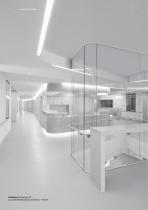
Healthcare facilities Geriatrics Simmering, AT – by Josef Weichenberger architects + Partner
Open the catalog to page 2
Light for recovery The extent to which light conditions and the human organism are connected is only gradually being explored. One thing is certain: Light is a significant health factor. Lighting in the healthcare sector fulfils a wide range of functions. To ensure the best possible treatment quality and reliable diagnostics, a wide range of standard specifications must be complied with, from the mandatory brightness on the examination couch to glare-free lighting at the staff workstation. Different regulations apply in dental practices than in nursing homes. However, it is always important to...
Open the catalog to page 3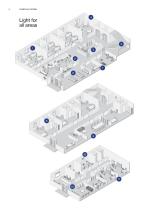
Healthcare facilities
Open the catalog to page 4
Registration & waiting room © 38 Therapy room & exercise area © 42 (^0 Reception, waiting area & treatment S 54 Biological light effect © 60 Acoustics for healthcare facilities © 62
Open the catalog to page 5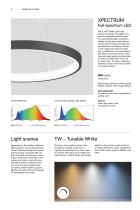
Healthcare facilities XPECTRUM Full-spectrum LED XAL's XPECTRUM LEDs' light spectrum is similar to daylight: It is healthy, biologically effective light. The reduced blue light component shields the eye from overexposure to short-wave, energy-rich light rays and therefore from fatigue. Thanks to the raised cyan levels, the light has an additional non-visual (melanopic) effect on hormone levels, which improves sleep quality and promotes recovery. Excellent IES TM 30 – 15 Rf = 98 and Rg = 101 colour rendering optimises visual comfort and creates a vivid environment. INO circle suspended Plasterboard...
Open the catalog to page 6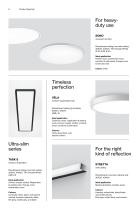
Product diversity For heavyduty use SONO recessed / surface Plasterboard ceiling / concrete ceiling 3000 K, 4000 K, TW (Tunable White) IP 40, IP 50, IP 54 Ideal application Patient room, examination room, corridors & staircases, therapy room & exercise area Colour: white Timeless perfection VELA surface / suspended / wall Plasterboard ceiling / grid ceiling 3000 K, 4000 K UGR ≤ 19 Ideal application Common rooms, registration & waiting room, 24-hour nurses’ station, common areas, corridors & staircases Colours white, grey, black, and special colours Ultra-slim series For the right kind of reflection...
Open the catalog to page 7
RECOVER Light distributions wall Wall mounting ambient examination reading nurse night Ideal application light light light light Patient room, residents’ rooms
Open the catalog to page 8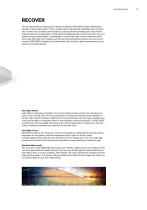
RECOVER The next generation of contemporary healthcare lighting, RECOVER has been developed to simulate a natural light pattern. This is achieved by the dynamically changing colour temperature. It varies from activating morning light to a sleep-promoting evening glow. The luminaire supports the natural regeneration of the patient by supporting the human biorhythm. The 4-in-1 system includes ambient light, a reading light, a nurse’s night light, and an examination light with a high CRI value which displays amorphous three-dimensional surfaces such as the skin correctly. RECOVER is designed to...
Open the catalog to page 9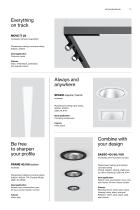
Everything on track MOVE IT 25 recessed / surface / suspended Plasterboard ceiling / concrete ceiling 3000 K, 4000 K Ideal application Common rooms Colours black, white/black, gold/black, and special colours Always and anywhere SPADO square / round recessed Plasterboard ceiling / grid ceiling 3000 K, 4000 K, UGR ≤ 19, IP 44 Ideal application Corridors & staircases Colours white, black Be free to sharpen your profile Combine with your design SASSO 40 / 60 / 100 recessed / semi-recessed / surface FRAME 40 / 60 system recessed Plasterboard ceiling / concrete ceiling 3000 K, 4000 K, TW (Tunable White)...
Open the catalog to page 10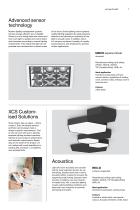
Advanced sensor technology Modern lighting management systems harness energy-efficient use of daylight. Sensors on the ceiling determine where and how much light is needed and control individual luminaires according to current lighting requirements. This means less light can be provided near windows than in darker areas of the room. Smart lighting control systems enable lighting regulation by using presence detectors and dimming or switching off the light in unused rooms. In addition, XAL's IoT sensors can detect humidity, air quality, sound pressure, and temperature, opening further applications....
Open the catalog to page 11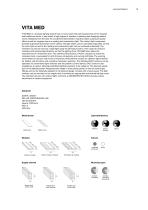
VITA MED VITA MED is a modular lighting system that not only meets the high requirements of the hospital and healthcare sector, it also offers a high degree of freedom in planning and designing patient rooms. Radiating from the bed, the combined indirect/direct modules enable a pleasant spatial effect as well as targeted use as a reading and examination light. The indirect light component provides a pleasant illumination of the ceiling. The light insets can be controlled separately, so that the room light as well as the reading and examination light can be combined individually. The luminaire...
Open the catalog to page 13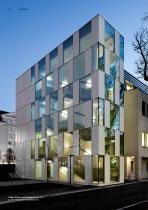
Kaiser-Franz-Josef-Spital Vienna, AT – by Nickl & Partner Architekten AG
Open the catalog to page 14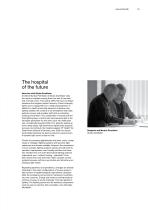
The hospital of the future Interview with Studio Zweithaler Architect Markus Pernthaler of Studio Zweithaler sees the trend in hospitals moving from four-bed to two-bed and one-bed rooms. This clearly shifts the focus to design measures that support patient recovery. Colour-changing light's use is undisputed from a medical perspective. In addition to health-promoting aspects in intensive care, lighting enables the creation of an atmosphere that helps patients recover and provides staff with an activating working environment. The combination of natural and artificial lighting plays a central role...
Open the catalog to page 15
@ Examination room @ Corridors & staircases @ Recreation rooms @ 24-hour nurses’ station @ Registration & waiting room S Therapy room & exercise area
Open the catalog to page 17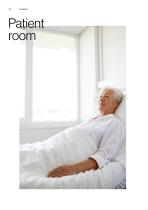
Patient room
Open the catalog to page 18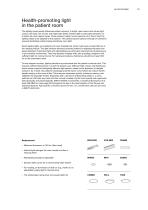
Health-promoting light in the patient room The lighting mood greatly influences patient recovery. In bright, open rooms with natural light colours, the body can recover and regenerate better. Indirect light is particularly pleasant, as it makes the room appear larger. Since people in patient rooms spend a lot of time in bed, the lighting needs to be adapted to this position. The positioning and optical coverage of luminaires prevents bedridden patients being dazzled by room light. Small reading lights are mandatory for each hospital bed, which must reach at least 300 lux at the reading position....
Open the catalog to page 19All XAL catalogs and technical brochures
 Getting well with light
40 Pages
 Flexible lighting for well-being
32 Pages
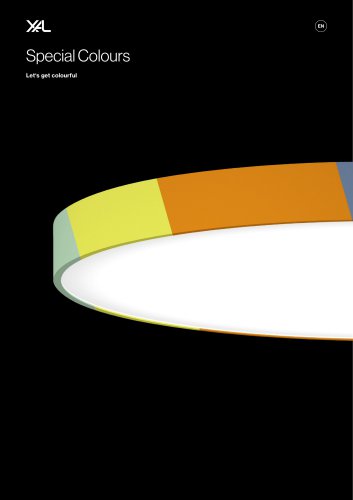 Special colours - Colour details
13 Pages
 Smart Services
16 Pages
 XAL Light Stories 01
96 Pages
 XAL 26
152 Pages
 Sustainable_lighting
52 Pages
 Retail lighting
90 Pages

Archived catalogs
 Light for healthcare facilities
76 Pages
 Acoustics and light
184 Pages
 XAL 24 News
116 Pages
 XAL 23 News
136 Pages
 VITA MED
32 Pages

