

Light for healthcare facilities
Light for healthcare facilities
The document emphasizes the importance of lighting in healthcare facilities, focusing on its impact on patient recovery and staff efficiency. It highlights Human Centric Lighting, which aligns artificial light with natural circadian rhythms to enhance patient well-being.
Healthcare lighting must meet specific standards, including brightness levels and glare-free lighting. Standards vary for dental practices and nursing homes, tailored to individual needs to optimize outcomes.
The document describes solutions like XPECTRUM LEDs, Tunable White (TW) systems, and advanced sensor technology for energy-efficient lighting management.
Lighting is customized for different areas, such as patient rooms, examination rooms, and corridors, to support navigation and create a pleasant environment.
Light affects hormone levels, promoting recovery and stabilizing sleep patterns. Acoustic lighting solutions enhance both lighting and sound conditions.
Modern systems offer dynamic light sequences and user-friendly controls, emphasizing sustainability and ease of maintenance.
Insights from architects and healthcare providers highlight the shift towards personalized lighting solutions, integrating natural and artificial lighting.
Effective lighting is essential for patient recovery and staff efficiency, advocating for adaptable and sustainable solutions aligned with natural rhythms.
EN 12464-1 specifies illuminance levels for examination rooms and corridors. Indirect lighting is preferred for its relaxing effect, while direct lighting ensures optimal conditions.
Corridors require specific lux levels, with adjustments for energy efficiency at night. DIN SPEC 67600 recommends specific melanopic and day-equivalent illuminance levels.
Lighting should create a cozy atmosphere with circadian light sequences to maintain internal clocks, using full-spectrum LEDs for natural wavelength composition.
Requires specific illuminance levels with dynamic color curves to simulate daylight, enhancing the working environment.
High illuminance levels create a welcoming atmosphere, with warm light colors enhancing well-being.
Require a mix of room and accent lighting, supporting circadian rhythms for patient recovery.
Lighting should accommodate age-related visual impairments, ensuring comfort and safety.
Older patients require higher illuminance levels, with correction factors ensuring similar visual performance as younger individuals.
Requires high illuminance to accommodate older residents, with circadian lighting systems improving well-being.
Different areas require specific lighting solutions, with emphasis on glare control and high illuminance for orientation and communication.
Requires high color rendering and light quality, with specific lux levels for treatment and operating areas.
Lighting should align with circadian rhythms, influencing hormones and promoting health.
Older adults require more light, with a combination of artificial and daylight necessary for maintaining activity and sleep quality.
Focuses on Human Centric Lighting designs, emphasizing dynamic systems with high color rendering.
Balanced acoustics aid recovery and reduce stress, with modern products enhancing patient comfort.
Systems should be functional and adaptable, with sensor-controlled luminaires increasing comfort and reducing energy costs.
Smart sensor technology provides insights into patient recovery and facility efficiency, with requirements including energy monitoring and patient activity tracking.
Specifications include meeting EN 12646-1 standards, with detailed calculations for necessary vertical illuminance.
Focuses on Human Centric Lighting designs for visual tasks and biological needs, particularly for elderly residents.
References EN 12646-1 standards, specifying minimum illuminance levels and glare limitation.
DIN SPEC 67600 specifies minimum MEDI lux levels, with conversion to visual lux considering melanopic effect.
Provides correction factors for different ages, indicating necessary vertical illuminance.
Includes HCL to meet visual and emotional needs, with dynamic lighting control systems.
Lighting design accommodates office work and communication, with adjustable lighting for night-time conditions.
Lists various lighting products and specifications, including luminaire types and power consumption.
XAL GmbH provides contact details for further inquiries, emphasizing their role in lighting design projects.
Catalog excerpts
Light for recovery Light for healthcare facilities
Open the catalog to page 1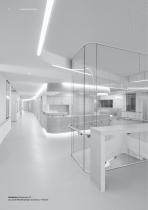
Healthcare facilities Geriatrics Simmering, AT – by Josef Weichenberger architects + Partner
Open the catalog to page 2
Light for recovery The extent to which light conditions and the human organism are connected is only gradually being explored. One thing is certain: Light is a significant health factor. Lighting in the healthcare sector fulfils a wide range of functions. To ensure the best possible treatment quality and reliable diagnostics, a wide range of standard specifications must be complied with, from the mandatory brightness on the examination couch to glare-free lighting at the staff workstation. Different regulations apply in dental practices than in nursing homes. However, it is always important to...
Open the catalog to page 3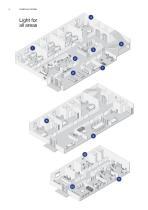
Healthcare facilities
Open the catalog to page 4
Registration & waiting room ©I36 Therapy room & exercise area ©I40 Medical practices also (^0 Reception, waiting area & treatment Q 52 Biological light effect ®l6o Acoustics for healthcare facilities ©l62
Open the catalog to page 5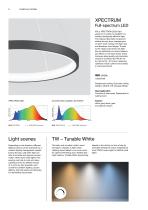
Healthcare facilities XPECTRUM Full-spectrum LED XAL's XPECTRUM LEDs' light spectrum is similar to daylight: It is healthy, biologically effective light. The reduced blue light component shields the eye from overexposure to short-wave, energy-rich light rays and therefore from fatigue. Thanks to the raised cyan levels, the light has an additional non-visual (melanopic) effect on hormone levels, which improves sleep quality and promotes recovery. Excellent IES TM 30 – 15 Rf = 98 and Rg = 101 colour rendering optimises visual comfort and creates a vivid environment. INO circle suspended Plasterboard...
Open the catalog to page 6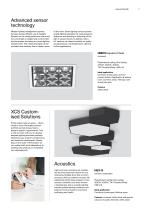
Advanced sensor technology Modern lighting management systems harness energy-efficient use of daylight. Sensors on the ceiling determine where and how much light is needed and control individual luminaires according to current lighting requirements. This means less light can be provided near windows than in darker areas of the room. Smart lighting control systems enable lighting regulation by using presence detectors and dimming or switching off the light in unused rooms. In addition, XAL's IoT sensors can detect humidity, air quality, sound pressure, and temperature, opening further applications....
Open the catalog to page 7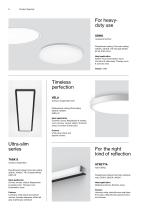
Product diversity For heavyduty use SONO recessed / surface Plasterboard ceiling / Concrete ceiling 3000 K, 4000 K, TW (Tunable White) IIP 40, IP 50, IP 54 Ideal application Patient room, Examination room, Corridors & staircases, Therapy room & exercise area Colour: white Timeless perfection VELA surface / suspended / wall Plasterboard ceiling / Grid ceiling 3000 K, 4000 K, UGR ≤ 19 Ideal application Common rooms, Registration & waiting room, 24-hour nurses’ station, Common areas, Corridors & staircases Colours white, grey, black and special colours Ultra-slim series For the right kind of reflection...
Open the catalog to page 8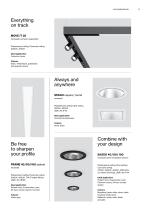
Everything on track MOVE IT 25 recessed / surface / suspended Plasterboard ceiling / Concrete ceiling 3000 K, 4000 K Ideal application Common rooms Colours black, white/black, gold/black and special colours Always and anywhere SPADO square / round recessed Plasterboard ceiling / Grid ceiling 3000 K, 4000 K UGR ≤ 19, IP 44 Ideal application Corridors & staircases Colours white, black Be free to sharpen your profile Combine with your design SASSO 40 / 60 / 100 recessed / semi-recessed / surface FRAME 40 / 60 / 100 system recessed Plasterboard ceiling / Concrete ceiling 3000 K, 4000 K, TW (Tunable...
Open the catalog to page 9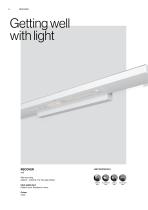
RECOVER Light distributions wall Wall mounting ambient examination reading nurse night Ideal application light light light light Patient room, Residents’ rooms
Open the catalog to page 10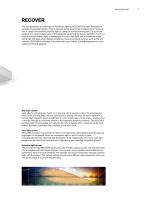
RECOVER The next generation of contemporary healthcare lighting, RECOVER has been developed to simulate a natural light pattern. This is achieved by the dynamically changing colour temperature. It varies from activating morning light to a sleep-promoting evening glow. The luminaire supports the natural regeneration of the patient by supporting the human biorhythm. The 4-in-1 system includes ambient light, a reading light, a nurse’s night light, and an examination light with a high CRI value which displays amorphous three-dimensional surfaces such as the skin correctly. RECOVER is designed to...
Open the catalog to page 11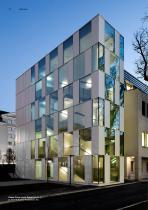
Kaiser-Franz-Josef-Spital Vienna, AT – by Nickl & Partner Architekten AG
Open the catalog to page 12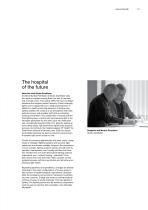
The hospital of the future Interview with Studio Zweithaler Architect Markus Pernthaler of Studio Zweithaler sees the trend in hospitals moving from four-bed to two-bed and one-bed rooms. This clearly shifts the focus to design measures that support patient recovery. Colour-changing light's use is undisputed from a medical perspective. In addition to health-promoting aspects in intensive care, lighting enables the creation of an atmosphere that helps patients recover and provides staff with an activating working environment. The combination of natural and artificial lighting plays a central role...
Open the catalog to page 13
@ Examination room @ Corridors & staircases @ Recreation rooms @ 24-hour nurses’ station @ Registration & waiting room S Therapy room & exercise area
Open the catalog to page 15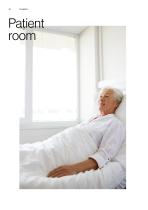
Patient room
Open the catalog to page 16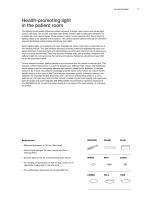
Health-promoting light in the patient room The lighting mood greatly influences patient recovery. In bright, open rooms with natural light colours, the body can recover and regenerate better. Indirect light is particularly pleasant, as it makes the room appear larger. Since people in patient rooms spend a lot of time in bed, the lighting needs to be adapted to this position. The positioning and optical coverage of luminaires prevents bedridden patients being dazzled by room light. Small reading lights are mandatory for each hospital bed, which must reach at least 300 lux at the reading position....
Open the catalog to page 17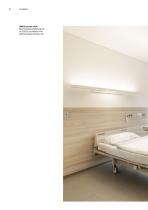
EMCO private clinic Bad Dürrnberg/Salzburg, AT – by FLEOS architektur with lighting design by Das Licht
Open the catalog to page 18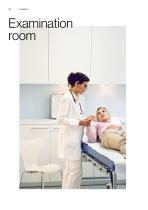
Examination room
Open the catalog to page 20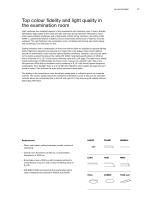
Top colour fidelity and light quality in the examination room Light combines two essential aspects in the examination and treatment room. A warm, friendly atmosphere helps patients feel calm and safe and relax during treatment. Physicians, meanwhile, need sufficient brightness and a high quality of light during treatment. According to EN 12464-1, a general illuminance of 500 lux and an examination illuminance of 1000 lux must be achieved. The right lighting in the examination room, combined with homely and clearly designed furnishings, form the basis for this. Ceiling luminaires with a combination...
Open the catalog to page 21All XAL catalogs and technical brochures
 Acoustics and light
184 Pages
 XAL 24 News
116 Pages
 XAL 23 News
136 Pages
 VITA MED
32 Pages
 Sustainable_lighting
52 Pages
 Retail lighting
90 Pages

