
- Catalogs
- WWL Houses
- Active for more comfort: The Passive House


Active for more comfort: The Passive House
Active for more comfort: The Passive House
The Passive House is a globally recognized standard for sustainable architecture, originating from Germany. It significantly reduces energy consumption for heating and cooling by over 80% compared to traditional buildings. This standard is adaptable to various climates, emphasizing passive cooling in warmer regions.
- High thermal insulation
- Triple low-e glazed windows with insulated frames
- Thermal-bridge-free construction
- Airtight building envelope
- Efficient heat recovery ventilation
- Reduces CO2 emissions and energy consumption
- Consistent indoor climate and fresh air
- Low heating costs
- Environmental benefits and renewable energy integration
- Eligibility for funding and subsidies
Passive Houses can be implemented globally, suitable for both new constructions and modernizing existing buildings to enhance energy efficiency.
The Passive House standard is a cost-effective, sustainable building solution supported by scientific research and practical applications.
Passive Houses are airtight to prevent air infiltration, using a ventilation system to maintain healthy indoor air quality without traditional window ventilation.
Windows act as passive solar panels, typically triple-glazed to maximize solar gains and minimize heat loss.
Ventilation systems include efficient heat recovery, providing fresh air and energy savings of 75% to 90%.
Passive Houses may have additional costs of 3% to 8% but are offset by reduced energy costs and financial assistance.
The International Passive House Association and the Passive House Institute provide resources and certification to ensure standards are met.
Minimizing thermal bridges is crucial for energy efficiency. Airtight construction is achieved through careful planning and materials like plaster and composite boards.
Maximizing passive solar heat gain through strategic placement and orientation of glazed areas.
Older buildings can be upgraded with Passive House components, reducing energy consumption and increasing property value.
Optimal insulation thickness for central European climates is about 220 mm, with future-oriented thicknesses of 320 mm.
Passive Houses offer significant energy savings, with initial investments offset by energy savings and subsidies.
Additional costs for Passive House features are approximately 10% for small buildings, decreasing for larger structures.
Lower total costs over time due to reduced energy consumption, making Passive Houses a secure investment.
Occupants report consistent comfort and energy savings.
Investing in a Passive House offers financial savings, increased comfort, and environmental benefits.
Details on Passive House projects in France, USA, Austria, and Japan, highlighting design, construction, and energy efficiency features.
Projects demonstrate the application of passive house principles in diverse climates and settings.
Projects highlight the importance of airtight construction and efficient energy use in reducing environmental impact.
Passive House design is effective for sustainable and energy-efficient buildings, serving as models for future construction.
Catalog excerpts

© Passive House Institute and Passivhaus Dienstleistung GmbH presented by: Active for more comfort: The Passive House Information for property developers, contractors and clients
Open the catalog to page 1
© Passive House Institute and Passivhaus Dienstleistung GmbH Company information First edition 2010 Print run: 25,000 Publisher International Passive House Association Rheinstraße 44 | 46 D-64283 Darmstadt Tel.: +49 (0) 6151 | 82699-55 Fax: +49 (0) 6151 | 82699-34 [email protected] www.passivehouse-international.org Editing and copyright for basic and detailed information Passive House Institute Darmstadt (PHI) www.passiv.de Editing and copyright for object documentation and object register, production and advertising Passivhaus Dienstleistung GmbH (Passive House Services) Rheinstraße...
Open the catalog to page 2
© Passive House Institute and Passivhaus Dienstleistung GmbH BASIC INFORMATION The Passive House... What‘s that? Let the facts convince you! A Passive House is... You have questions? Here are the answers! Turning the idea into reality DETAILED INFORMATION From the vision to the Passive House Thermal bridge free and airtight Passive House windows – Maximum comfort Comfort ventilation for clean air and a pleasant room climate Old buildings can become Passive Houses, too! The Passive House – An attractive investment Quality is top priority. | Passive House user experiences PASSIVE HOUSE PROJECTS...
Open the catalog to page 3
© Passive House Institute and Passivhaus Dienstleistung GmbH
Open the catalog to page 4
BASIC INFORMATION © Passive House Institute and Passivhaus Dienstleistung GmbH 04 The Passive House... What‘s that? 06 Let the facts convince you! A Passive House is... 08 You have questions? Here are the answers! 12 Turning the idea into reality
Open the catalog to page 5
© Passive House Institute and Passivhaus Dienstleistung GmbH The Passive House... What‘s that? More living comfort, less energy A Passive House combines high-level comfort with very low energy consumption. Passive components like thermal windows, insulation and heat recovery are the key elements. Each Passive House is an active contribution to climate protection. On the outside, Passive Houses are no different from conventional buildings, because the term “Passive House” describes a standard and not a specific construction method. The Passive House concept is a low-energy building standard that...
Open the catalog to page 6
© Passive House Institute and Passivhaus Dienstleistung GmbH 1.5 litre/m² heating energy per year! In facts and figures, for the homeowner this means: A Passive House uses no more than about 1.5 litres of heating oil or 1.5 m³ of natural gas (equivalent to15 kWh) per year and square metre of living space. This means a saving of more than 90% in relation to the average consumption in existing buildings. In comparison, a new construction built according to legal standards in Germany still requires six to ten litres of oil per square metre of living space. ”The heat losses of the building are reduced...
Open the catalog to page 7
© Passive House Institute and Passivhaus Dienstleistung GmbH BASIC INFORMATION Let the facts convince you! A Passive House is... ... comfortable. As if covered with a down sleeping bag, a Passive House is enclosed in a very well-insulated thermal envelope to ensure that the heat stays in the house. This means: - Evenly warm surfaces in the room - Uniform and constant indoor climate - No fluctuations in temperature and no draughts The comfort ventilation continuously provides clean, pleasantly warm and fresh indoor air. ... sustainable. - High energy efficiency radically reduces CO² emissions....
Open the catalog to page 8
© Passive House Institute and Passivhaus Dienstleistung GmbH ... energy-efficient and provides a good quality of life. ... uncomplicated. The Passive House doesn´t require anything out of the ordinary from its occupants. On the contrary, by its very design it provides consistently pleasant indoor and surface temperatures. There aren’t any draughts anywhere, and there is no need to worry about airing the rooms. And all this requires no complicated technology. User friendliness is built in, so you can benefit from the extra time you gain! ... distinct. The Passive House standard is not a building...
Open the catalog to page 9
© Passive House Institute and Passivhaus Dienstleistung GmbH BASIC INFORMATION You have questions? Here are the answers! What is passive about a Passive House? The heating system. A Passive House doesn’t need to be heated actively, because it essentially uses passive heat gains to heat itself. This way, only a minimal amount of additional heat needs to be supplied. This concept is based on excellent thermal insulation and a highly efficient heat recovery system. The heat stays inside and doesn‘t need to be provided by an active system. The “passive” principle is well known in engineering; it...
Open the catalog to page 10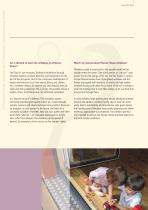
© Passive House Institute and Passivhaus Dienstleistung GmbH Am I allowed to open the windows in a Passive House? Yes! But it‘s not necessary. Traditional ventilation through windows requires constant attention and intervention on the part of the occupants. Due to the continuous development of odours and moisture (e.g. from towels, plants, wet clothes, etc.), windows need to be opened and shut regulary, even at night and during absences. This is simply not possible and as a matter of fact, most homes are not sufficiently ventilated. In a Passive House it‘s different. The ventilation system constantly...
Open the catalog to page 11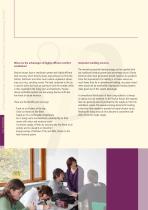
© Passive House Institute and Passivhaus Dienstleistung GmbH BASIC INFORMATION What are the advantages of highly efficient comfort ventilation? Passive Houses have a ventilation system with highly efficient heat recovery, which directly draws away exhaust air from the kitchen, bathroom and other rooms where unpleasant odours may occur (e.g. smoking rooms). The heat contained in this air is used to warm the fresh air coming in from the outside, which is then supplied to the living room and bedrooms. Passive House ventilation systems are low-energy devices and have low levels of sound emission....
Open the catalog to page 12Archived catalogs
 LARA
LARA128 Pages