Application Brochures - Curtain Injection
Application Brochures - Curtain Injection
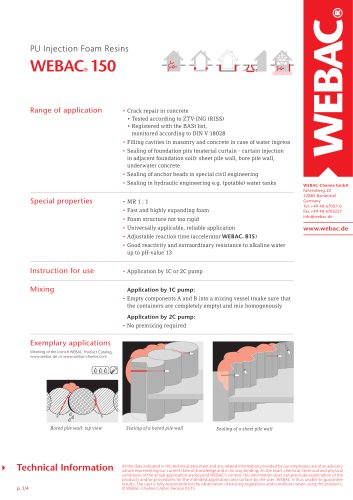
This document outlines the use of curtain injection for post-construction surface sealing of structural components in ground contact. WEBAC injection gels are employed to seal components exposed to moisture without excavation by creating a gel curtain behind the structure, preventing water penetration.
Prior to injection, a thorough analysis of the building and subsoil is essential to evaluate moisture levels, soil composition, and salt contamination. This assessment informs the feasibility of sealing, drill hole spacing, and material usage. Professional planning is particularly important for traffic structures to identify moisture penetration causes and restoration options.
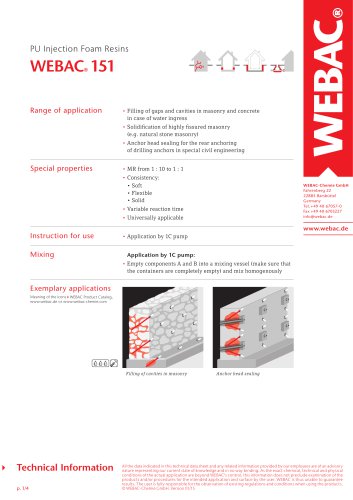
- Acrylic Gel WEBAC® 240: Suitable for sealing surfaces in foundation soil, damaged sheet and foil sealings, and leaking expansion joints.
- Injection Gels: These polyacrylate-based materials form a waterproof, elastic gel resistant to salt solutions, acids, and bases.
- Injection Pumps: The WEBAC® IP 2K-F1 pump is used for acrylate gels, featuring a mixing head and flush pump.
- Injection Packers: Available in mechanical and hammer-in types for injecting gels into structural components.
Components A and B are mixed in specific ratios, with Component B dissolved in water beforehand. Regular equipment cleaning is necessary to prevent clogging.
The process involves drilling through the structure and injecting a gel curtain behind it to reduce subsoil permeability and allow drying. Drill holes are staggered, and injection continues until material emerges from adjacent holes, with a consumption rate of 20-60 kg/m².
Curtain injection with WEBAC gels offers a durable and environmentally resistant solution for sealing structural components in ground contact.
Gel injections with acrylate gels efficiently seal defective building and expansion joints, forming a gel curtain in adjacent soil to absorb joint movements. This method is suitable for repairing internal joint tapes and sealing 'waterproof concrete tanking' if initial sealings are faulty.
Drill holes are placed strategically to position channels behind internal joint tapes, with material injected into adjacent soil. Consumption depends on joint volume and soil structure.
After injection, packers are removed, and gel is cleared from drill holes, which are then sealed with mineral building material. Adequate ventilation and dehumidifiers may be used to prevent condensation and aid drying. Salt deposits should be removed mechanically or with restoration render systems.
Secondary injections may be necessary if new water routes form, a common practice in gel technology.
Packers and drill holes should be positioned at standard distances of 30–50 cm. A schematic diagram illustrates the post-construction expansion joint sealing process.
Catalog excerpts

Curtain Injection
Open the catalog to page 1
Curtain Injection
Open the catalog to page 2
Contents This brochure deals with the post-construction surface sealing of structural components in ground contact by means of curtain injection. WEBAC injection gels are suitable for the post-construction sealing of inaccessible structural components in ground contact exposed to moisture without digging. A sealing effect is obtained by putting into place a gel curtain behind the structure to be protected by means of pressure injection. The gel curtain durably prevents water and moisture from penetrating the building structure. NOTE Please observe all existing regulations and the instructions...
Open the catalog to page 3
Sealing with Injection Gels Buildings can be severely damaged by pressing water, fluctuations in the ground water level and surface water. Damaged masonry Leaks in structural components in ground contact such as e.g. masonry can be caused by lacking or inadequately designed external sealants, aging processes of existing sealants, fluctuating ground water levels or movements within the structural component. Water penetrates through cavities, joints and defective building sealants and soaks the building structure. Climatic fluctuations, especially alternating frost and thaw, lead to further damage...
Open the catalog to page 4
Damage Diagnosis Building State Analysis Prior to the injection procedure, an analysis of the condition of the building and the subsoil is required. The resulting information on the moisture status, the adjacent soil layers and the salt contamination serve to determine the feasibility of the sealing measure, the spacing of the drill holes and the material consumption to be expected. Tasks of professional planning Especially during the reconstruction of traffic structures, careful and qualified planning by a professional planner is required. The planner must be able to prove on the basis of his...
Open the catalog to page 5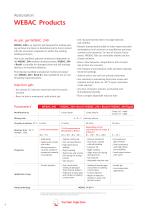
WEBAC Products Acrylic gel WEBAC 240 • Are characterized by their very high elasticity WEBAC 240 is an injection gel designed for making sealing surfaces (curtains) in foundation soil in direct contact with the structural component or within the existing building structure. • Remain dimensionally stable in water-vapor saturated atmospheres (soil moisture or equilibrium moisture content in the masonry). In case of climatic fluctuations, WEBAC Gels can reversibly absorb and discharge moisture Due to the modified, polymer-reinforced components in the WEBAC 240 modular modular system, WEBAC 240 +...
Open the catalog to page 6
WEBAC Products Injec ion pumps t The air-operated, 2C pump WEBAC IP 2K-F1 is used for the application of acrylate gels. The two injection material components are introduced to the mixing head via separate hoses. The actual mixing process takes place here with a static mixer. ® A separate flush pump serves to clean the mix ing head with water. A compressor with an air volume of 300–400 l/min is required for operating the pump. WEBAC IP 2K-F1 pump is also available with a measuring unit for monitoring the flow rate and the pressure limit. The respective data can be evaluated and documented by...
Open the catalog to page 7
Mixing of the Components Component A Coloring of injection gels • The containers of component A are provided according • WEBAC injection gels can be colored with WEBAC to the required mixing ratio • Empty the smaller A2 container (and the A3 container, if applicable) completely into the larger A1 container • Mix immediately while pouring until homogeneous F200 to monitor the water displacement, the water‘s mixing with the gel, the material distribution and to detect any gel leakage • To color the injection gel, mix the injection gel with approx. 1 % of the blue colorant WEBAC F200 (referring...
Open the catalog to page 8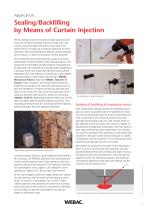
Sealing/Backfilling by Means of Curtain Injection When sealing structures by means of gel injections, the structure is drilled through from the inside and a gel curtain is put into place behind the structure to be protected by carrying out a pressure injection (curtain injection). This new sealing level reduces the permeability of the subsoil, so that the structure can dry properly. The evaluation of the building state analysis provides information on the feasibility of the sealing measure, the spacing of the drill holes and the material consumption to be expected. The drill holes are usually...
Open the catalog to page 9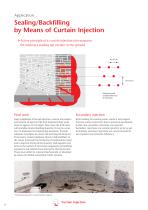
Sealing/Backfilling by Means of Curtain Injection Active principle of a curtain injection into masonry for making a sealing gel curtain in the ground Positioning and standard distances of drill holes Final work Secondary injection Upon completion of the gel injection, remove the packers and remove all gel from the drill holes/drill hole walls down to approx. 10 cm depth. Then close the drill holes with suitable mineral building material. It may be necessary to implement accompanying measures. Provide adequate ventilation to ensure the exchange of damp air. If necessary, install condenser dryers...
Open the catalog to page 10
Brochure Curtain Injection 02/15 © WEBAC-Chemie GmbH
Open the catalog to page 11
WEBAC-Chemie GmbH Fahrenberg 22 22885 Barsbuettel/Hamburg, Germany Tel. +49 40 67057-0 · Fax +49 40 6703227 [email protected] · www.webac.de www.webac-grouts.com
Open the catalog to page 12