


Panton Chair Factsheet

Panton Chair Factsheet
Introduction: The Panton Chair, designed by Verner Panton in 1960, is a significant piece in furniture design history. It was the first chair to be made entirely from plastic in a single piece, developed for mass production with Vitra.
Production History: Since its introduction in 1967, the chair has undergone various production phases. It wasn't until 1999 that the chair could be produced as originally intended, using durable, dyed-through plastic with a matte finish.
Design and Comfort: The chair's comfort is attributed to its cantilever structure, anthropomorphic shape, and slightly flexible material. It is versatile for both indoor and outdoor use, either individually or in groups.
Awards and Recognition: The Panton Chair has received numerous international design awards and is featured in many prominent museum collections, becoming an icon of the twentieth century due to its expressive shape.
Materials and Durability: The chair is made from dyed-through polypropylene with a matte finish, suitable for outdoor use. Special additives are included to retard color fading from UV radiation, though prolonged sunlight exposure may still alter the color.
Dimensions: The chair's dimensions are 500mm (19¾”), 610mm (24”), 452mm (17¾”), 830mm (32¾”), 406mm (16”), and 410mm (16¼”).
Color Options: Available in basic dark, white, ice grey, tangerine, classic red, and chartreuse.
Additional Information: For more details or to find a Vitra partner, visit www.vitra.com.
Catalog excerpts
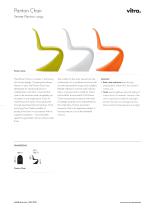
Panton Chair Verner Panton, 1999 Panton Chair The Panton Chair is a classic in the history of furniture design. Conceived by Verner Panton in 1960, the Panton Chair was developed for serial production in collaboration with Vitra. It was the rst chair to be manufactured completely out of plastic in one single piece. Since its market launch in 1967, it has advanced through several production phases. Only since 1999 has it been possible to produce the chair in accordance with its original conception – out of durable, dyed-through plastic with a lustrous matte nish. The comfort of this chair results from the combination of a cantilever structure with an anthropomorphic shape and a slightly exible material. It can be used individually or in groups and is suited for indoor and outdoor environments. The Panton Chair has received numerous international design awards and is represented in the collections of many prominent museums. Due to its expressive shape, it has become an icon of the twentieth century. Materials ∏ Back, seat and base: dyed-through polypropylene. Matte nish. Also suited for outdoor use. ∏ Note: special additives retard the fading of colours due to UV radiation. However, if the chair is exposed to sunlight for prolonged periods, the colour may change over time. We recommend limited exposure to sunlight. Panton Chair
Open the catalog to page 1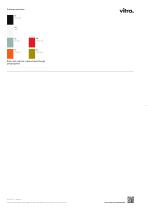
Surfaces and colors 01 basic dark Back, seat and foot: made of dyed through polypropylene Article. No. 09149102 Vitra can be found around the globe. To nd a Vitra partner in your area, go to www.vitra.com.
Open the catalog to page 2All Vitra USA catalogs and technical brochures
 Table Solvay Factsheet
2 Pages
 Sphere Table Factsheet
1 Page
 HAL Table Factsheet
2 Pages
 Compas Direction Factsheet
2 Pages
 A-Table Factsheet
1 Page
 Kast Factsheet
2 Pages
 Corniches Factsheets
2 Pages
 Visiona Stool Factsheet
2 Pages
 Hocker Factsheet
1 Page
 Bovist Factsheet
1 Page
 Low Table Set Factsheet
1 Page
 Cone Table Factsheet
1 Page
 Wall Clocks Factsheet
4 Pages
 Panton Junior Factsheet
2 Pages
 Alcove Plume Factsheet
4 Pages
 Freeform Sofa Factsheet
2 Pages
 Heart Cone Chair Factsheet
2 Pages
 Fauteuil de Salon Factsheet
2 Pages
 C1 Factsheet
2 Pages
 Amoebe Factsheet
2 Pages
 Elephant Stool Factsheet
1 Page
 Plate Table Factsheet
1 Page
 Metal Side Table Factsheet
2 Pages
 Cork Family Factsheet
1 Page
 Algue Factsheet
1 Page
 Suita Product Folder
22 Pages
 Flower Factsheet
1 Page
 Waver Factsheet
2 Pages
 Slow Chair Factsheet
2 Pages
 MVS Chaise Factsheet
1 Page
 Repos Factsheet
2 Pages
 Grand Repos Factsheet
2 Pages
 Gueridon Factsheet
1 Page
 EM Table Factsheet
2 Pages
 Bistro Table Factsheet
2 Pages
 Vegetal Factsheet
2 Pages
 Tip Ton Factsheet
2 Pages
 SIM Factsheet
2 Pages
 .05 Factsheet
2 Pages
 Meda Gate Factsheet
12 Pages

Archived catalogs
 .04 Traverse Factsheet
2 Pages
 Airline Factsheet
2 Pages
 ArchiMeda Factsheet
4 Pages
 Storage Factsheet
20 Pages
 MedaMorph Factsheet
12 Pages
 Map Table Factsheet
16 Pages
 Click Factsheet
4 Pages
 Tom Vac Factsheet
2 Pages
 Softshell Chair Factsheet
2 Pages
 Organic Chair Factsheet
2 Pages
 Jill Factsheet
2 Pages
 HAL Factsheets
4 Pages
 Basel Chair Factsheet
2 Pages
 .03 Factsheet
2 Pages
 WorKit Factsheet
20 Pages
 Tyde Factsheet
12 Pages
 Level 34 Factsheet
12 Pages
 Kuubo Factsheet
8 Pages
 Ad Hoc Factsheet
20 Pages
 Ad Hoc Executive Factsheet
2 Pages
 Cloverleaf Factsheet
4 Pages
 Joyn Factsheet
20 Pages
 Pivot Factsheet
2 Pages
 Physix Factsheet
2 Pages
 MedaPal Factsheet
2 Pages
 Headline Factsheet
2 Pages
 Visavis Factsheet
2 Pages
 Visasoft Factsheet
2 Pages
 Visavis2 Visaroll2 Factsheet
2 Pages
 Unix Chair Factsheet
2 Pages
 Skape Product Fact Sheet
2 Pages
 MedaSlim Factsheet
2 Pages
 ID Chair Concept Factsheet
28 Pages
 .03 High Factsheet
2 Pages
 Alcove factsheet
16 Pages
 AC4 Product FactSheet
2 Pages


