


Vestas Sound Power Optimisation

Vestas Sound Power Optimisation
Vestas employs industry-leading siting methods as the initial step in sound power optimisation. This involves using a DNV-certified siting process and advanced tools like Computational Fluid Dynamics (CFD) modelling to optimise wind turbine layouts according to sound power levels and requirements.
Vestas wind turbines feature multiple Sound Optimised Modes tailored to meet market-specific requirements. These modes, combined with application variables such as time, wind speed, and direction, create a customised sound mitigation strategy. The goal is to maintain optimal performance by adjusting operational parameters only when necessary.
Sound Optimised Modes and application variables can be applied individually or together to meet specific site conditions. An example configuration includes a sound level of 98 dB(A) during specific times and conditions, such as from 20:00 to 06:00 on workdays, with wind speeds from 10.5 to 17.6 m/s and wind directions from 28 to 136 degrees.
The primary source of sound emission in wind turbines is aerodynamic noise. Vestas reduces this through technologies like OptiTip®, aerodynamically optimised blades, and Serrated Trailing Edge technology. OptiTip® adjusts blade pitch angles to maintain optimal sound levels, while the aerodynamic blade design and Serrated Trailing Edge technology reduce turbulence and noise.
This technology reduces aerodynamic noise by mixing airflows along the blade's trailing edge, achieving a sound power reduction of 1-3 dB(A) without affecting power generation. It is available for all Vestas turbines within the 2 and 4 MW platforms.
The technology significantly reduces sound power levels, as demonstrated in the V136-3.45 MW® turbine with a 3.6 MW Power Optimised Mode. The actual performance varies based on site-specific conditions.
Catalog excerpts
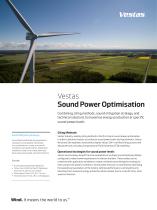
Vestas Sound Power Optimisation Combining siting methods, sound mitigation strategy, and technical solutions to maximise energy production at specific sound power levels Sound Mitigation Strategy: Sound Optimised Mode and application variables can be applied individually or in combination to meet site specific conditions and requirements. Application variables include, time of day, week day, date range, wind speed, and wind direction. Example • Sound Optimised Mode: 98 Db(A) • Time: From 20:00 to 06:00, Workdays only, from 3 April to 31 October • Wind speed: From 10.5 to 17.6 m/s • Wind direction: From 28 to 136 degrees Siting Methods Vestas’ industry-leading siting methods is the first step in sound power optimisation. In order to optimise layouts according to sound power levels and requirements, Vestas Wind and Site engineers consistently deploy Vestas’ DNV-certified siting process and advanced tools, including Computational Fluid Dynamics (CFD) modelling. Operational strategies for sound power levels Vestas’ wind turbines benefit from the availability of multiple Sound Optimised Modes configured to meet known requirements in relevant markets. These modes can be combined with application variables to create a tailored sound mitigation strategy to meet unique site specific conditions. Sound power emission is controlled by optimising the operational parameters of the turbine. Optimal performance is achieved by only deviating from maximum energy production when needed, due to a specific time, wind speed or
Open the catalog to page 1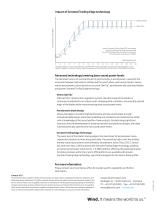
Impact of Serrated Trailing Edge technology Without STEs Sound Power Level dB(A) With STEs Vestas’ Serrated Trailing Edge (STE) technology mixes the airflows, securing optimal airflow around the blade profile, resulting in a reduction of sound power level by up to 3 dB(A). Example based on V136-3.45 MW® with 3.6 MW Power Optimised Mode. Actual performance depends on site specific conditions. Serrated Trailing Edge technology is a standard option for all Vestas 4 MW platform turbines. Advanced technology lowering base sound power levels The dominant source of sound emission by wind turbines is...
Open the catalog to page 2All Vestas catalogs and technical brochures
Archived catalogs
 Vestas_HWO
2 Pages
 Vestas_Track_Record_Brochure
12 Pages
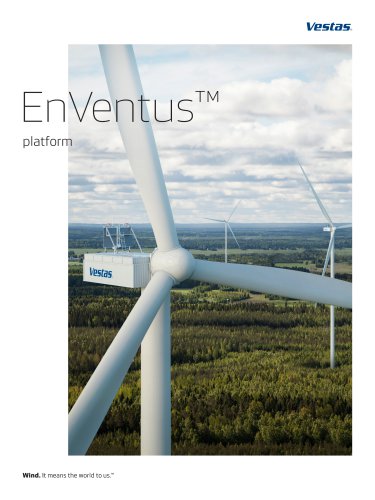
 EnVentus_Platform_Brochure
16 Pages
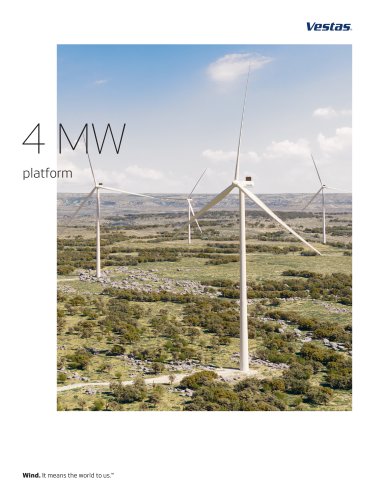
 4MW_Platform_Brochure
28 Pages
 2MW_Platform_Brochure_
16 Pages
 Vestas Multibrand Services
16 Pages
 EnVentus™ platform +145 GW
16 Pages
 PowerPlus®
12 Pages
 Fire Prevention Systems
2 Pages
 Vestas InteliLight®
2 Pages
 2 MW
2 MW16 Pages
 Multibrand Services
16 Pages
 Blade Services
12 Pages
 Gearbox Services
4 Pages
 Generator Services
4 Pages
 EnVentus™ Platform 100 GW
12 Pages
 SiteHunt®
8 Pages
 4W PLATFORM
20 Pages
 Vestas PowerPlus™
4 Pages
 GeneratorCare™
4 Pages
 V90-3.0 MW®
12 Pages
 2 MW Platform
12 Pages
 3 MW PLATFORM
16 Pages
 Electrical Predesign
12 Pages
 SiteDesign®
8 Pages
 VestasOnline® SCADA
8 Pages
 Vestas ForecastingTM
8 Pages
 Fire Protection
2 Pages
 Aviation Obstruction Lights
2 Pages
 Yaw Power Back Up
2 Pages
 De-icing System
2 Pages
 Vestas PowerPlus?
4 Pages
 3 MW V112-3.0 MW/V126-3.0MW
20 Pages
 SiteHunt
8 Pages
 Vestas Customer Portal
8 Pages
 MW PLATFORM
16 Pages
 Power Plant Solutions
14 Pages
 This is for you
74 Pages
 AOM 5000
8 Pages
 AOM 4000
8 Pages
 AOM 1000-3000
8 Pages
 AOM service concept
20 Pages
 Vestas 2MW Gridstreamer?
20 Pages
 Vestas V90-3.0 MW
12 Pages
 Vestas V100-2.6 MW
12 Pages
 Vestas V164-8.0 MW
8 Pages
 Vestas V112-3.0 MW Offshore
16 Pages
 2017 Shadow Detection System
2 Pages
 2012 Shadow Detection System
2 Pages


