
- Catalogs
- Ventive Limited
- Acoustic design of schools

Acoustic design of schools
Acoustic design of schools
- Nursery schools, colleges, and sixth-form colleges are exempt from Building Regulation E4.
- School Premises Regulations apply to all schools, including special schools and pupil referral units.
- Temporary buildings must comply with Building Regulations if they remain in place for more than 28 days.
- Local planning authorities may impose conditions related to noise and acoustics.
- Compliance with BREEAM standards may be required for planning approval.
- Operational noise from classroom equipment should be considered to comply with regulations.
- Schools must prepare accessibility strategies for disabled pupils, including acoustic improvements.
- Acoustic design should consider the needs of pupils with hearing impairments and other special needs.
- Special school accommodations should involve acousticians and audiologists in the design process.
- APS may be adopted for new buildings if justified by educational or environmental needs.
- APS should not be lower than refurbishment standards unless justified.
- Documentation of APS should be available to school stakeholders.
- Performance standards for indoor ambient noise levels, sound insulation, and reverberation time are specified.
- Acoustic testing is recommended to ensure compliance with design intent.
- Guidance on acoustic requirements is provided in the 'Acoustic Design of Schools: a Design Guide'.
- Surface spread of flame rating for acoustic linings must comply with Building Regulations.
- Durability and robustness of materials should be considered in acoustic design.
- Ventilation performance guidance supersedes previous standards and will be revised accordingly.
The document specifies sound insulation for ventilators using the weighted element-normalised level difference, Dn,e,w, measured according to BS EN ISO 10140-2:2010 and rated by BS EN ISO 717-1. Minimum permissible airborne sound insulation standards are provided for walls with and without ventilators, with specific dB values for different types of student spaces.
Acoustic Performance Standards:
Tables 4a and 4b outline the minimum sound insulation requirements for various educational spaces, both with and without ventilators. For example, secondary school music rooms require a minimum Rw of 45 dB for new builds without ventilators.
Impact Sound Insulation of Floors:
The objective is to control impact sound transmission through floors. Maximum permissible impact sound pressure levels, L’nT,w, are specified for different room types, measured according to BS EN ISO 140-7 and rated by BS EN ISO 717-2.
Reverberation in Teaching and Study Spaces:
The document sets objectives for suitable reverberation times (RTs) to ensure clear communication in educational settings. Table 6 provides maximum mid-frequency reverberation time requirements for various room types, with specific values for new builds and refurbishments.
Reverberation and Acoustic Absorption in Sports Halls and Swimming Pools:
Reverberation times are specified for sports halls based on floor area, with a maximum Tmf of 2 seconds for larger halls.
Sound Absorption in Corridors and Stairwells:
The document outlines the need for sound absorption in corridors and stairwells to prevent interference with adjacent teaching activities, using methods from Approved Document E.
Open Plan Teaching and Learning:
Open plan spaces require careful consideration of indoor ambient noise levels and reverberation. The document recommends incorporating speech transmission index (STI) criteria into design briefs and obtaining specialist acoustic advice to ensure compliance with standards.
The document outlines the importance of Speech Transmission Index (STI) values in educational settings, particularly for students with special hearing or communication needs. It references the 'Acoustic design of schools: a design guide' for detailed specifications. The document emphasizes compliance with Building Regulations and School Premises Regulations, requiring STI calculations for open plan teaching areas to ensure adequate acoustic absorption and intelligibility performance.
STI should be calculated using a computer prediction model in accordance with EN 60268-16. The model should simulate impulse responses and account for background noise levels. Compliance involves demonstrating how open plan spaces meet criteria through layout plans, activity management plans, and 3D acoustic models. The school client body must approve these plans, and it is recommended to seek advice from an acoustic technical adviser.
In certain cases, alternative performance standards may be necessary for specific areas due to educational, environmental, or health and safety reasons. A specialist acoustic consultant must provide a report detailing non-compliance areas and proposed standards, with confirmation from the school client body.
Pre-completion testing should be conducted by a specialist acoustic consultant following the 'Good Practice Guide – Acoustic Testing of Schools'. Although not required by Building Regulations, it is recommended for contractual purposes.
The document lists various references, including 'Acoustics of Schools: a design guide', Building Bulletin 93, and several British and ISO standards on acoustics. It also provides information on useful resources and external organizations like the Association of Noise Consultants and the Institute of Acoustics.
Catalog excerpts
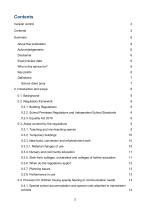
About this publication 6 School client body 7 0.2.2. School Premises Regulations and Independent School Standards 9 0.3. Areas covered by the regulations 9 0.3.1. Teaching and non-teaching spaces 9 0.3.3. New-build, conversion and refurbishment work 10 0.3.4. Nursery and community education 11 0.3.5. Sixth-form colleges, universities and colleges of further education 11 0.3.6. When do the regulations apply? 12 0.4. Provision for children having special hearing or communication needs 13 0.4.1. Special school accommodation and special units attached to mainstream schools 14
Open the catalog to page 3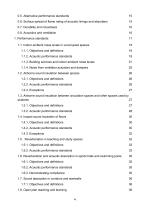
0.5. Alternative performance standards 0.6. Surface spread of flame rating of acoustic linings and absorbers 15 1.1. Indoor ambient noise levels in unoccupied spaces 18 1.1.2. Acoustic performance standards 18 1.1.3. Building services and indoor ambient noise levels 21 1.1.4. Noise from ventilator actuators and dampers 25 1.2. Airborne sound insulation between spaces 26 1.2.2. Acoustic performance standards 26 1.3. Airborne sound insulation between circulation spaces and other spaces used by 1.3.2. Acoustic performance standards 28 1.4. Impact sound insulation of floors 30 1.4.2. Acoustic performance...
Open the catalog to page 4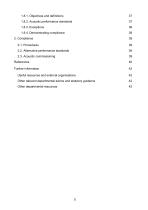
1.8.2. Acoustic performance standards 37 2.2. Alternative performance standards 39 Useful resources and external organisations 42 Other relevant departmental advice and statutory guidance 42 Other departmental resources 42
Open the catalog to page 5
Summary About this publication This document supersedes section 1 of ‘Building Bulletin 93’ (BB93) published in 2003. It sets out minimum performance standards for the acoustics of school buildings, and describes the normal means of demonstrating compliance with the Building Regulations. It also provides guidance in support of the School Premises Regulations (2012) and the Independent School Standards (2013). Acknowledgements The Department for Education (DfE) would like to thank the Schools Committee of the Association of Noise Consultants and the Institute of Acoustics for their help in drafting...
Open the catalog to page 6
Definitions School client body The school client body consists of both the commissioning authority and the school entity. The school entity has day to day control of the school and may be represented by the headteacher or a governor. The commissioning authority is the authority that commissions the work: central government, a local authority or the school itself.
Open the catalog to page 7
0. Introduction and scope 0.1. Background This document should be read in conjunction with ‘Acoustics of schools: a design guide’ Ref.1 , published by the Association of Noise Consultants and the Institute of Acoustics, which contains supporting information and additional design considerations. References to the guide are made throughout this document. On publication, the guide will supersede sections 2 to 7 of Building Bulletin 93 (2003) Ref.2. Section 1 of this document sets out the acoustic performance standards. The normal way of satisfying Requirement E4 of the Building Regulations Ref.3,...
Open the catalog to page 8
0.2.2. School Premises Regulations and Independent School Standards The School Premises Regulations and Independent School Standards applies to both new and existing school buildings and contain a similar statement to that in Requirement E4 of the Building Regulations: “The acoustic conditions and sound insulation of each room or other space must be suitable, having regard to the nature of the activities which normally take place therein.” In addition to the design and construction standards covered by the Building Regulations, the School Premises Regulations and Independent School Standards...
Open the catalog to page 9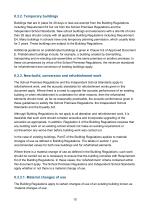
0.3.2. Temporary buildings Buildings that are in place for 28 days or less are exempt from the Building Regulations including Requirement E4 but not from the School Premises Regulations and the Independent School Standards. New school buildings and extensions with a site life of more than 28 days should comply with all applicable Building Regulations including Requirement E4. Many buildings in schools have only temporary planning permission, which usually lasts for 2 years. These buildings are subject to the Building Regulations. Additional guidance on prefabricated buildings is given in Clause...
Open the catalog to page 10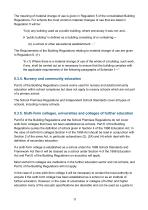
The meaning of material change of use is given in Regulation 5 of the consolidated Building Regulations. For schools the most common material changes of use that are listed in Regulation 5 will be: “5.(e) any building used as a public building, where previously it was not; and... A “public building” is defined as a building consisting of or containing— (b) a school or other educational establishment ...” The Requirements of the Building Regulations relating to material change of use are given in Regulation 6.-(1): “6.-(1) Where there is a material change of use of the whole of a building, such...
Open the catalog to page 11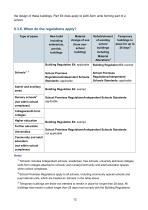
the design of these buildings. Part E4 does apply to sixth-form units forming part of a school. ‘Schools’ includes independent schools, academies, free schools, university technical colleges, sixth-form colleges attached to schools, and nursery/community and adult education spaces within school complexes. School Premises Regulations apply to all schools, including community special schools and pupil referral units, which are treated as ‘schools’ in the table above. Temporary buildings are those not intended to remain in place for longer than 28 days. All buildings that remain in place longer...
Open the catalog to page 12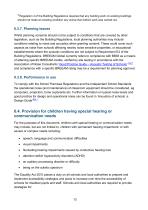
Regulation 4 of the Building Regulations requires that any building work on existing buildings should not make an existing condition any worse than before work was carried out. 0.3.7. Planning issues Whilst planning consents should not be subject to conditions that are covered by other legislation, such as the Building Regulations, local planning authorities may include conditions relating to noise and acoustics when granting consent. These could cover such aspects as noise from schools affecting nearby noise sensitive properties, or educational establishments where the acoustic conditions are...
Open the catalog to page 13All Ventive Limited catalogs and technical brochures
 OPERATION & MAINTENANCE
7 Pages
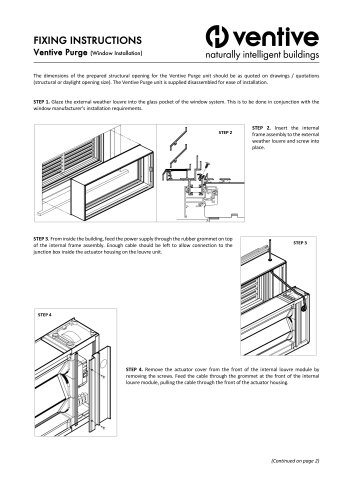 Window Installation
2 Pages
 ACOUSTIC
7 Pages
 Home-B
2 Pages
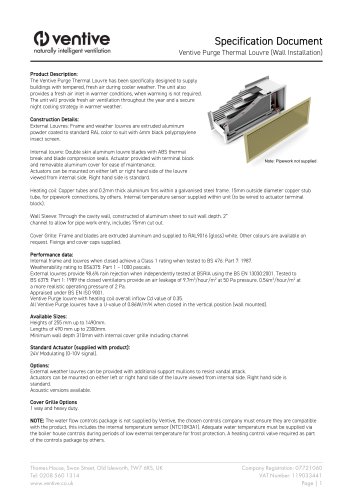 Purge Thermal Louvre
2 Pages
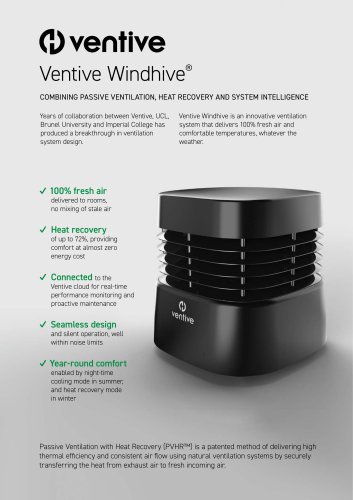 Windhive®
2 Pages
- Industrial heat pump
- Residential heat pump
- Mechanical ventilation unit
- Smart heat pump
- Monobloc heat pump
- Reversible heat pump
- Hot water heat pump
- Dual-flow mechanical ventilation unit
- Industrial air exhaust
- Ventilation system
- Residential ventilation system
- Centrifugal roof extractor
- Decentralized ventilation system
- Home ventilation system
- Exhaust air heat pump
- Commercial roof extractor
- Bathroom ventilation system