


Drywall steel-framed-systems-catalog

Drywall steel-framed-systems-catalog
- Systems: Describes various partition systems including single-layer, double-layer, and multi-layer partitions, highlighting their fire and sound resistance capabilities. Specialized systems like chase walls, resilient channel partitions, and curved partitions are also covered.
- Specifications: Details specifications for SHEETROCK Brand Gypsum Panels and other materials, including fire ratings and sound transmission class (STC) ratings. It outlines the use of different core types like FIRECODE and ULTRACODE for enhanced fire resistance.
- Good Design Practices: Offers recommendations for avoiding moisture and temperature extremes, proper frame spacing, and considerations for ceiling design to ensure optimal performance.
- Construction Details: Includes tables and diagrams detailing screw locations, spacing, and the structural properties of steel studs and runners. Metric conversions for various dimensions and materials are provided.
- Limitations: Highlights the importance of avoiding exposure to moisture and extreme temperatures, and addresses potential issues with building movement and noise.
- Fire Resistance: Systems offer fire ratings up to 4 hours for partitions and 3 hours for ceilings.
- Sound Isolation: STC ratings up to 62 for multi-layer partitions, with THERMAFIBER SAFB enhancing sound control.
- Economical and Lightweight: Drywall assemblies are cost-effective and reduce dead load, saving floor area.
- Metric Conversion: Provides soft and hard metric conversions for product dimensions, ensuring compatibility with international standards.
The document outlines specifications for drywall and steel framed systems, focusing on limiting heights for various wall partitions. It includes tables detailing the maximum allowable heights based on deflection and bending stress criteria for different stud widths and gauges.
1. Chase Walls: Constructed with double rows of steel studs and gypsum panel cross braces, providing vertical shafts for pipe enclosures. Fire-resistance ratings can be achieved with specific gypsum panels.
2. Resilient Channel Partitions: Use RC-1 Resilient Channels to enhance sound attenuation and privacy. The channels decouple the gypsum panels from the framing, improving sound isolation.
3. Curved Partitions: Gypsum panels can be applied dry or wet to achieve desired curvature, with specific guidelines for bending radii.
The document references UL Design standards for fire resistance and sound isolation, emphasizing the importance of using specified components and installation procedures to achieve desired ratings.
1. Request actual physical and structural property data from local manufacturers as properties may vary.
2. Avoid exposure to excessive moisture and extreme temperatures to maintain the integrity of the systems.
3. Consult local code authorities for specific limiting criteria.
- Limiting heights for chase walls and resilient channel assemblies are provided, with criteria based on deflection (d) and bending stress (f).
- Minimum bending radii for dry and wetted gypsum panels are specified, with guidelines for stud spacing and water requirements for bending.
- Structural stud sizes and configurations are detailed for tall walls, with recommendations for wind load resistance.
- The document emphasizes the importance of adhering to specified installation procedures and using recommended materials to achieve fire resistance and sound isolation.
- It highlights the need for proper application of acoustical sealants and the strategic placement of THERMAFIBER SAFB for optimal sound control.
- Limitations include avoiding ceramic tile on single-layer panels on the resilient channel side and considering the impact of wind pressure on high-rise buildings.
1. Tile Installation: Before installing tiles, seal cut panel edges around openings with thinned tile adhesive. Use an approved adhesive to install tiles down to the top edge of the shower floor or tub, overlapping the lip or return. Fill all tile joints with grout and apply caulking between the tile and shower floor or tub.
2. Chase Wall Erection: Align floor and ceiling runners and attach them to concrete slabs, suspended ceilings, or wood framing using appropriate fasteners. Position steel studs vertically in runners and anchor them with metal lock fasteners or screws. Use gypsum panels or steel studs for cross bracing.
3. Framing Erection for Curved Partitions: Cut runners for arcs and bend them to the specified radius. Secure studs to runners and space them equally along the arc. Install gypsum panels to cover the curved surface, ensuring the outside panel is longer than the inside panel.
4. High-Performance Sound Control Systems: Attach steel runners to structural elements and position studs vertically. Use resilient channels and sound attenuation blankets for sound control. Apply gypsum panels with gaps at the floor, ceiling, and intersections.
5. Drywall Soffit Erection: Attach steel runners to concrete slabs, suspended ceilings, or wood framing. Fasten vertical face panels and use steel studs for braced furring.
6. Grillage Erection: Install hanger wires and carrying channels for ceiling space. Use metal furring channels and provide cross reinforcing at openings.
7. Fireproofing Systems: Various UL designs specify the use of SHEETROCK Brand Gypsum Panels for fire protection of columns and beams. Attach panels to steel studs and apply multiple layers for different fire ratings.
8. Wall Furring Installation: Attach metal furring channels to masonry or concrete surfaces. Apply gypsum panels with staggered joints and use Z-Furring Channels for insulation.
Key Recommendations:
- Ensure proper sealing and adhesive application for tile installations.
- Follow specified spacing and fastening techniques for structural elements.
- Use appropriate materials and methods for sound control and fireproofing.
- Maintain proper alignment and spacing for all framing and panel installations.
Catalog excerpts
SA923 09250 framed systems drywall-steel
Open the catalog to page 1
Section Pages Contents Systems 3-28 Partitions 3 Chase Wall 8 Resilient Channel Partitions 9 Curved Partitions 9 High Performance Sound Control 11 Tall Walls 12 Wall Furring 13 Shelf-Wall System 15 Column and Beam Fire Protection 16 Soffits 16 Floor/Ceilings 16 Curtain Walls 17 Construction Selector 19 Details 28-38 Partitions 29 Fixture Attachment 31 Door Frames and Control Joints 32 High Performance Sound Control 33 Wall Furring 34 Ceilings 36 Column Fireproofing 37 Curtain Walls 38 Specifications 39-51 Good Design Practices 39 Architectural Specifications 43 NOTICE: Steel studs, runners and...
Open the catalog to page 2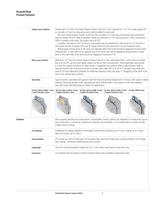
Double-Layer Partitions Double-layer 1/2 SHEETROCK Brand Gypsum Panels, FIRECODE C Core, attached to 2-1/2 min. studs spaced 24 o.c. provide a 2-hour fire rating plus sound control suitable for party walls. SHEETROCK Brand Gypsum Panels, ULTRACODE Core, provide a 4-hr. fire rating with double-layer construction when UL Design U419 or U490 is specified. Panels are attached to 2-1/2 steel studs and 2 thick THERMAFIBER SAFB is installed in the cavity. The system has a 56 STC. In addition, two layers of 3/4 ULTRACODE Core panels may be substituted for three layers of 1/2 FIRECODE C Core panels in...
Open the catalog to page 3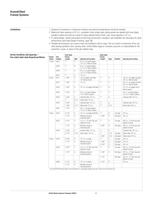
Limitations 1 Exposure to excessive or continuous moisture and extreme temperatures should be avoided. 2 Maximum frame spacing is 24 o.c.; exception: when single-layer ceiling panels are applied with long edges parallel to joists and used as a base for spray-applied texture finish, max. frame spacing is 16 o.c. 3 In ceiling design, certain precautions concerning construction, insulation, and ventilation are necessary for good performance (see Good Design Practices, page 39). 4 Variable wind pressure can cause a high-rise building to drift or sway. This can result in movement of the nonload- bearing...
Open the catalog to page 4
Metric Conversion The table below provides metric equivalents for the dimensions of U.S. Gypsum Company products. “Soft” conversions merely apply a conversion factor that translates feet and inches (according to which the products were manufactured) into metric units; “hard” metric measurements are given for products actually manufactured in metric sizes. Metric Equivalents Dimension Conversion Type(1) Ft./In. mm(2) SHEETROCK Gypsum Panels Thickness Soft 1/4 6 3/8 10 1/2 13 5/8 16 3/4 19 1 25 Width Hard 24 600 48 1200 Length Hard 8 2400 10 3000 12 3600 Steel Stud Framing Thickness (gauge) Soft...
Open the catalog to page 5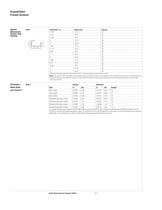
Typical table 1 Stud width—in. Depth (mm) Stud ga. dimensions 1-5/8 41.3 25 interior stud 2-1/2 63.5 25 framing 3-5/8 92.1 25 4 101.6 25 6 152.4 25 1-5/8 41.3 22 2-1/2 63.5 22 3-5/8 92.1 22 4 101.6 22 6 152.4 22 1-5/8 41.3 20 2-1/2 63.5 20 3-5/8 92.1 20 4 101.6 20 6 152.4 20 (1) Net area excluding coating, through section at hole. (2) Average shipping weight including coating. Notice: The typical limiting height tables on the following pages are based primarily on the suggested minimum physical and structural properties (Ix and Sx). The physical and structural properties may vary by region and...
Open the catalog to page 6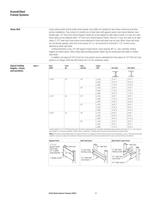
United States Gypsum Company SA923 8 Chase Wall Chase walls provide vertical shafts where greater core widths are needed for pipe chase enclosures and other service installations. They consist of a double row of steel studs with gypsum panel cross braces between rows. Double-layer 1/2 SHEETROCK Brand Gypsum Panels are screw-applied on both sides of studs. A 2-hour fire-resistance rating can be obtained when 1/2 SHEETROCK Brand Gypsum Panels, FIRECODE C Core, are used. As an alternative, 2-1/2 steel stud cross braces screw-attached to chase wall studs may be used. When chase wall studs are not...
Open the catalog to page 8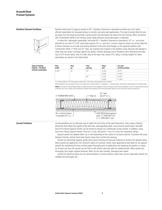
United States Gypsum Company SA923 9 Resilient Channel Partitions Resilient attachment of gypsum panels to RC-1 Resilient Channels or equivalent provides low-cost, highly efficient assemblies for increased privacy in corridor and party wall applications. The steel channels float the panels away from the studs and provide a spring action that decouples the board from the framing. When combined with THERMAFIBER SAFB in the framing cavity, highly effective sound attenuation is obtained. In these thin, lightweight assemblies, horizontal RC-1 Resilient Channels (or equivalent), 24 o.c., are screwattached...
Open the catalog to page 9
United States Gypsum Company SA923 10 Minimum bending radii Panel applied with long dimension Panel applied with long dimension of dry gypsum panel Panel thickness perpendicular to framing parallel to framing in. mm ft. m ft. m 1/4 6.4 3 .9 6 4.6 3/8 9.5 6 1.8 9 7.6 1/2 12.7 12(1) 3.6 — — 5/8 15.9 18 5.5 — — (1) Bending two 1/4 pieces successively permits radii shown for 1/4 gypsum panels. Minimum bending radii Inside Outside No. of studs on Approximate Ounces of water of wetted gypsum panel(1) Panel length length arc including stud spacing Maximum required thickness Radius of arc(2) of arc(2)...
Open the catalog to page 10
High Performance Sound Control Horizontal RC-1 Resilient Channels (or equivalent) are screw-attached 24 o.c. to the narrow flange side of SJ steel studs which also are spaced 24 o.c. SHEETROCK Brand Gypsum Panels, FIRECODE C Core, are screw-attached directly to the studs on one side and to the resilient channels on the other side. THERMAFIBER SAFB are friction-fitted in the partition cavity. The SAFB are pressed against the direct-applied gypsum panel, leaving a minimum 1/2 space between the resilient channel and the SAFB. Install resilient channels according to manufacturer’s recommendations....
Open the catalog to page 11
United States Gypsum Company SA923 12 Typical Limiting Heights— Wind load/deflection Structural Studs Stud Stud 5 psf 10 psf 15 psf width(1) gauge L/240 L/360 L/240 L/360 L/240 L/360 3-1/2 20 149 130 119 103 103 90 18 163 143 130 113 113 100 16 176 153 140 123 123 109 14 189 166 150 133 133 116 4 20 159 140 129 113 113 99 18 173 153 140 123 123 109 16 189 166 150 133 133 116 14 200 179 163 143 143 126 6 20 220 193 179 156 156 136 18 240 213 193 170 170 149 16 260 230 210 186 186 160 14 280 249 226 199 199 173 8 18 306 269 246 216 216 189 16 330 293 266 233 233 206 14 356 313 286 250 250 220 (1)...
Open the catalog to page 12All USG catalogs and technical brochures
 Transportation
14 Pages
 Healthcare
7 Pages
 Workspace
11 Pages
 Education
17 Pages
Archived catalogs
 USG DUROCK™ BRAND
6 Pages
 USG FIBEROCK® BRAND
4 Pages
 USG DUROCK™ BRAND
3 Pages
 USG PANZ® METAL PANELS
2 Pages
 USG CELEBRATION™ CANOPIES
2 Pages
 USG Ceiling Solutions
300 Pages
 Drywall-Wood Framed Systems
24 Pages
 System catalog
12 Pages
 USG Performance Flooring
24 Pages
 USG Tile and Flooring
19 Pages
 USG Durock™ Brand Fast Track
2 Pages
 USG Securock® Brand Roofing
40 Pages
 USG EcoFix™
2 Pages
 USG Moisture Control Brochure
12 Pages
 USG True™ Wood Finishes
1 Page
 USG Hydrocal® FGR Design Freedom
12 Pages
 USG Calcium Sulfate Filler
8 Pages
 USG Airtrol® Geobinder
4 Pages
 USG Floor Prep
12 Pages
 acoustics brochure
6 Pages
 WALL PREP
28 Pages
 ROOFING
28 Pages
 WALLBOARD
15 Pages
 USG CEILING CATALOG
232 Pages
 Frost? Frost
2 Pages
 Clean Room? ClimaPlus?
2 Pages
 Aspen
Aspen2 Pages
 Glacier
2 Pages
 USG Ceiling Systems - SC2000
228 Pages
 DUROCK Shower System Catalog
12 Pages
 Plaster Systems Brochure
72 Pages
 Drywall Suspension System
60 Pages
 Suspension systems
4 Pages
 CEILING SYSTEMS
196 Pages
 Retail Ceilings Systems Catalog
32 Pages
 Ceiling Systems Catalog Supplement
108 Pages
 USG Ceiling Systems Catalog
330 Pages
 USG Acoustical Assemblies Brochure
40 Pages
 DONN Suspension Systems
4 Pages


- Acoustic panel
- Building coating
- Commercial acoustic panel
- Indoor coating
- Wall coating
- Rectangular acoustic panel
- Decorative acoustic panel
- Office acoustic panel
- Indoor ceiling
- Acoustic suspended ceiling
- Ceiling acoustic panel
- Outdoor coating
- Roofing
- Interior acoustic panel
- Home acoustic panel
- Metal suspended ceiling
- Panel suspended ceiling
- Decorative suspended ceiling