


acoustics brochure

acoustics brochure
- Healthcare Facilities: Compliance with HIPAA and 2014 FGI Guidelines ensures patient privacy.
- Classrooms: ANSI S12.60 standards enhance learning and communication through improved acoustical performance.
- Multifamily Residential Buildings: IBC Section 1207 mandates a minimum of 50 STC and 50 IIC to reduce noise between units.
- Green Building Construction: USGBC LEED® credits are available for acoustical performance, ensuring that designs do not compromise acoustics.
- Noise Reduction Coefficient (NRC): Indicates sound absorption, reducing reverberation.
- Ceiling Attenuation Class (CAC): Measures sound containment between rooms.
- Ensure compliance with HIPAA for patient privacy.
- Follow the 2014 FGI Guidelines for Healthcare Facilities.
- Adhere to ANSI S12.60 standards for acoustical performance to enhance learning and communication.
- Comply with IBC Section 1207 to minimize noise transmission between units, achieving at least 50 STC and 50 IIC.
- Earn USGBC LEED® IEQ credits for acoustical performance.
- Ensure "green" building designs address acoustics, including HVAC noise, exterior noise, reverberation time, NRC, STC, and IIC requirements.
Design Philosophy: Effective design prioritizes functionality and compliance with standards, beyond mere aesthetics.
Catalog excerpts

CODE REQUIREMENTS AND GUIDELINES When it comes to acoustics, it’s hard to keep up with the ever-expanding code requirements and guidelines. This listing may just help. HUMAN HEARING IS FAR FROM SIMPLE We hear poorly at low (bass) and high (treble) frequencies and it also varies based on our age. In addition, human hearing is non-linear in our perception of loudness. Every sound has a particular frequency, measured in hertz (Hz) and amplitude, which is measured in decibels (dB*). These parameters of sound are processed in distinct ways. Two people may hear the same sound in very different ways. *The dB is a logarithmic unit of measure used to compensate for this effect. Because the scale is logarithmic, an increase of a few dB represents a very large change in perceived volume. Every increase of 10dB on the scale is equivalent to doubling in loudness. As an example, the difference between 20dB and 100dB is similar to the difference between a whisper and a rock ‘n’ roll concert. COMMON SOUND LEVEL (dB) EXAMPLES dB Loud concert Crowd noise Very loud, harmful Loud music Freeway traffic Office setting Home setting Whisper Subtle breathing Very faint Classrooms • ANSI S12.60 Acoustical Performance Criteria, Design Requirements, and Guidelines for Schools • Improve learning and communication GREAT DESIGN IS A LOT MORE THAN GREAT AESTHETIC. Multifamily Residential Buildings • International Building Code (IBC), Section 1207 • Reduce exterior noise and sound transmitted between units • Minimum 50 STC and 50 IIC “Green” Building Construction • USGBC LEED® Indoor Environmental Quality (IEQ) credits for Acoustical Performance • Ensure “green” building designs do not compromise acoustics • HVAC noise, exterior noise, reverberation time, NRC, STC and IIC requirements Barely audible Healthcare Facilities • Health Insurance Portability and Accountability Act (HIPAA) for patient privacy • 2014 FGI Guidelines for Healthcare Facilities HEAR AND EXPERIENCE THE DIFFERENCE. HEAR AND EXPERIENCE THE DIFFERENCE. HEAR AND EXPERIENCE THE DIFFERENCE. AC3319/6-15 © 2015 USG Corporation and/or its affiliates. All rights reserved. The trademarks USG, ECLIPSE, F-FISSURED, FROST, HALCYON, MARS, MILLENNIA, RADAR, SANDRIFT, the USG logo, the design elements and colors, and related marks are trademarks of USG Corporation or its affiliates. SECOND COVER BACK COVER OUTSIDE COVER FOLDS OV
Open the catalog to page 1
CODE REQUIREMENTS AND GUIDELINES When it comes to acoustics, it’s hard to keep up with the ever-expanding code requirements and guidelines. This listing may just help. HUMAN HEARING IS FAR FROM SIMPLE We hear poorly at low (bass) and high (treble) frequencies and it also varies based on our age. In addition, human hearing is non-linear in our perception of loudness. Every sound has a particular frequency, measured in hertz (Hz) and amplitude, which is measured in decibels (dB*). These parameters of sound are processed in distinct ways. Two people may hear the same sound in very different ways....
Open the catalog to page 2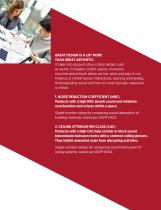
GREAT DESIGN IS A LOT MORE THAN GREAT AESTHETIC. It takes into account other critical details, such as sound, in theaters, public spaces, museums, churches and schools where we live, work and play. It can enhance or inhibit human interactions, learning and healing. Understanding sound and how it’s most typically measured is critical. When walls don’t extend all the way from the floor to the deck above, noise can travel through the ceiling plenum from one room to another. To reduce the noise intrusion between rooms, use an acoustical ceiling panel that has a high CAC or a value that closely matches...
Open the catalog to page 3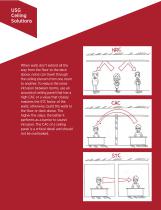
GREAT DESIGN IS A LOT MORE THAN GREAT AESTHETIC. It takes into account other critical details, such as sound, in theaters, public spaces, museums, churches and schools where we live, work and play. It can enhance or inhibit human interactions, learning and healing. Understanding sound and how it’s most typically measured is critical. When walls don’t extend all the way from the floor to the deck above, noise can travel through the ceiling plenum from one room to another. To reduce the noise intrusion between rooms, use an acoustical ceiling panel that has a high CAC or a value that closely matches...
Open the catalog to page 4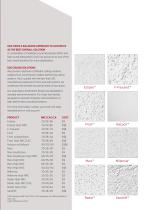
GREAT DESIGN IS A LOT MORE THAN GREAT AESTHETIC. It takes into account other critical details, such as sound, in theaters, public spaces, museums, churches and schools where we live, work and play. It can enhance or inhibit human interactions, learning and healing. Understanding sound and how it’s most typically measured is critical. When walls don’t extend all the way from the floor to the deck above, noise can travel through the ceiling plenum from one room to another. To reduce the noise intrusion between rooms, use an acoustical ceiling panel that has a high CAC or a value that closely matches...
Open the catalog to page 5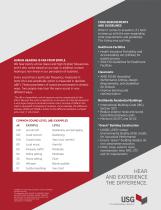
CODE REQUIREMENTS AND GUIDELINES When it comes to acoustics, it’s hard to keep up with the ever-expanding code requirements and guidelines. This listing may just help. HUMAN HEARING IS FAR FROM SIMPLE We hear poorly at low (bass) and high (treble) frequencies and it also varies based on our age. In addition, human hearing is non-linear in our perception of loudness. Every sound has a particular frequency, measured in hertz (Hz) and amplitude, which is measured in decibels (dB*). These parameters of sound are processed in distinct ways. Two people may hear the same sound in very different ways....
Open the catalog to page 6All USG catalogs and technical brochures
 Transportation
14 Pages
 Healthcare
7 Pages
 Workspace
11 Pages
 Education
17 Pages
Archived catalogs
 USG DUROCK™ BRAND
6 Pages
 USG FIBEROCK® BRAND
4 Pages
 USG DUROCK™ BRAND
3 Pages
 USG PANZ® METAL PANELS
2 Pages
 USG CELEBRATION™ CANOPIES
2 Pages
 USG Ceiling Solutions
300 Pages
 Drywall-Wood Framed Systems
24 Pages
 System catalog
12 Pages
 USG Performance Flooring
24 Pages
 USG Tile and Flooring
19 Pages
 USG Durock™ Brand Fast Track
2 Pages
 USG Securock® Brand Roofing
40 Pages
 USG EcoFix™
2 Pages
 USG Moisture Control Brochure
12 Pages
 USG True™ Wood Finishes
1 Page
 USG Hydrocal® FGR Design Freedom
12 Pages
 USG Calcium Sulfate Filler
8 Pages
 USG Airtrol® Geobinder
4 Pages
 USG Floor Prep
12 Pages
 WALL PREP
28 Pages
 ROOFING
28 Pages
 WALLBOARD
15 Pages
 USG CEILING CATALOG
232 Pages
 Frost? Frost
2 Pages
 Clean Room? ClimaPlus?
2 Pages
 Aspen
Aspen2 Pages
 Glacier
2 Pages
 USG Ceiling Systems - SC2000
228 Pages
 DUROCK Shower System Catalog
12 Pages
 Plaster Systems Brochure
72 Pages
 Drywall Suspension System
60 Pages
 Suspension systems
4 Pages
 CEILING SYSTEMS
196 Pages
 Retail Ceilings Systems Catalog
32 Pages
 Ceiling Systems Catalog Supplement
108 Pages
 USG Ceiling Systems Catalog
330 Pages
 USG Acoustical Assemblies Brochure
40 Pages
 DONN Suspension Systems
4 Pages


- Industrial plaster
- Acoustic panel
- Building coating
- Commercial acoustic panel
- Industrial suspended ceiling
- Indoor coating
- Wall coating
- Rectangular acoustic panel
- Decorative acoustic panel
- Office acoustic panel
- Indoor ceiling
- Acoustic suspended ceiling
- Ceiling acoustic panel
- Outdoor coating
- Roofing
- Interior acoustic panel
- Home acoustic panel
- Metal suspended ceiling
- Panel suspended ceiling
- Decorative suspended ceiling