

UPM ProFi Piazza

UPM ProFi Piazza
UPM ProFi Piazza is an innovative composite material made in Germany, combining plastic and engineered fibers from self-adhesive label by-products. It is lignin-free, offering better color durability than traditional wood-plastic composites (WPC) and contains no harmful chemicals. The material is resistant to oil spills and stains due to its closed surface.
Specifications
- Dimensions: 25 mm x 140 mm; available in lengths of 4 m and 5 m.
- Linear Mass: Piazza One - 3.3 kg/m, Piazza Pro - 4.0 kg/m.
- Bending Strength: Piazza One - 11 N/mm², Piazza Pro - 19 N/mm².
- Friction (wet/dry): > 36 (EN 15676).
- Thermal Expansion Coefficient: 4.0 x 10⁻⁵ 1/°C.
- Fire Class: E (EN 13501-1).
- Slip Resistance: R 10 (DIN 51130:2014-02).
- Water Absorption (24 h): < 2.5%.
- Swelling, thickness (24 h): < 1%.
- Flexural Modulus: Piazza One - 1100 N/mm², Piazza Pro - 1250 N/mm².
Thermal Expansion
UPM ProFi Piazza expands and contracts with temperature changes. For example, a 4 m board will expand around 6 mm when the temperature increases from 20°C to 60°C.
Surface and Maintenance
Superficial marks may occur from dragging heavy objects but do not affect structural performance. The material is virtually lignin-free, preventing typical greying. Colors may fade slightly over time, especially in high UV areas. Regular cleaning with water and a brush is recommended to maintain appearance.
Environmental Impact
UPM ProFi Piazza is made from approximately 75% recycled content, is non-toxic, PVC-free, and recyclable. It reduces landfill and waste incineration by utilizing label surplus material. The product does not require paint or stains, eliminating associated pollutants.
Conclusion
UPM ProFi Piazza offers a sustainable, durable, and low-maintenance decking solution with enhanced color durability and environmental benefits.
Catalog excerpts
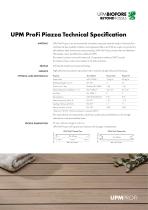
UPM ProFi Piazza Technical Specification MATERIAL PROFILE SURFACE PHYSICAL AND MECHANICAL UPM ProFi Piazza is an environmentally innovative composite material made in Germany that combines the best qualities of plastic and engineered fibers which fall as surplus by-products in self-adhesive label manufacture and processing. UPM ProFi Piazza is lignin free and therefore offers better colour durability than traditional WPC. The material contains no harmful chemicals. Compared to traditional WPC boards, the closed surface is also more resistant to oil spills and stains. Solid profile made by extrusion technology High performance polymer cap surface with a natural looking hardwood embossing. Property Test method Linear Mass Bending Strength, N/mm² Thermal Expansion Coefficient, 1/°C Fire Class Slip resistance Flexural modulus, N/mm² *Based on CEN/TS 15534 wood plastic composites (WPC). The values above are characteristic values from quality tests and therefore not for strength calculations in the serviceability state. 25 mm x 140 mm; length 4 m & 5 m UPM ProFi Piazza will expand and contract with changes in temperature. UPM ProFi Piazza One 25 x 140 mm PROFILE DIMENSIONS
Open the catalog to page 1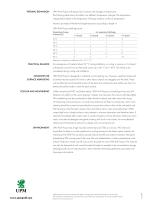
THERMAL EXPANSION UPM ProFi Piazza will expand and contract with changes in temperature. The following table shows this effect over different temperature changes. The temperature change listed relates to the temperature of Piazza material, not the air temperature. Numeric example of the thermal length expansion according to length of UPM ProFi Piazza decking board: Temperature change of board (∆T) 10°C Based on an expansion coefficient of 4 x 10 -5 1/°C. At a temperature of material about 20 °C during installation or cutting, in summer a 4 m board will expand around 6 mm as the board warms up...
Open the catalog to page 2All UPM catalogs and technical brochures
 UPM ProFi® Deck
2 Pages
 UPM ProFi® PRODUCT LIST 2020
17 Pages
 UPM ProFi®
12 Pages
 UPM ProFi
36 Pages
 UPM ProFi® Patio
2 Pages
 UPM ProFi DECKINGS
2 Pages
 UPM PROFI® TERRA
2 Pages
 UPM ProFiLifecycle S2-25
2 Pages
 UPM ProFiLifecycle S1-21
2 Pages

Archived catalogs
 UPM ProFi Deck & Environment
2 Pages
 UPM ProFi Piazza 2019
2 Pages
 UPM ProFi® Terra 127
2 Pages
 BEST IN CLASS OUTDOOR LIVING
12 Pages
 UPM ProFi Quick Facts
2 Pages


- Industrial veneer
- Glue
- Industrial wood veneer
- Plywood panel
- Interior veneer
- Wood plywood panel
- Commercial plywood panel
- Construction plywood panel
- Wood look plywood panel
- Wood glue
- Building plywood panel
- FSC certified plywood panel
- Home plywood panel
- Smooth plywood panel
- Multilayer plywood panel
- Furniture plywood panel
- High-resistance plywood panel
- Lightweight plywood panel
- Formwork panel
- Interior glue