
- Catalogs
- Unilin Panels
- Antivlam Class 0

Antivlam Class 0
Antivlam Class 0
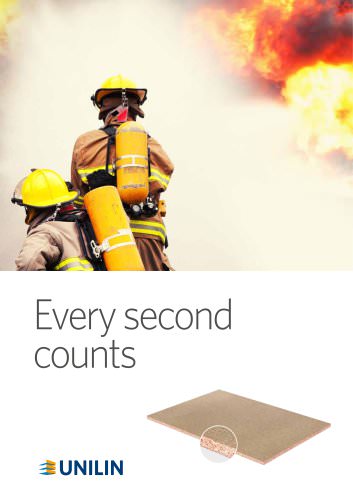
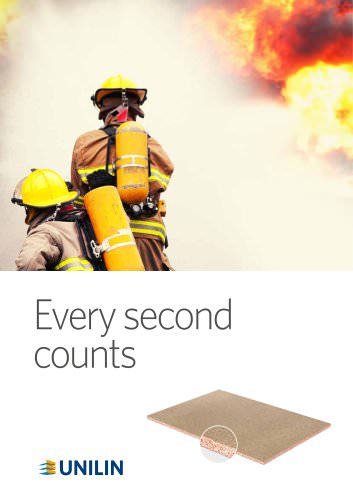
The document emphasizes the importance of fire-retardant materials in construction, focusing on UNILIN's fire-retardant chipboard and MDF panels. It highlights the critical role these materials play in slowing fire spread and aiding emergency services.
A fire requires fuel, oxygen, and a heat source. Common causes include equipment malfunction, electrical short circuits, and kitchen accidents. The document provides statistics on fire incidents and their consequences.
Fire spreads through radiation, conduction, and convection. The document explains these mechanisms and stresses controlling combustible materials to enhance fire safety.
The document outlines four phases: Incipient, Growth, Fully-developed, and Decay, suggesting strategies for fire prevention at each stage, such as using fire-resistant materials and compartmentalizing spaces.
Materials react differently to fire; for example, wood forms a protective charcoal layer, while steel loses strength at high temperatures. A table compares the fire resistance of various materials.
UNILIN panels comply with European standards like the Construction Products Regulation (CPR) and EN 13986. The Euroclass system classifies materials based on fire reaction and resistance.
Fire-resistance tests assess construction elements under fire conditions, focusing on load-bearing capacity, integrity, and insulation. The European classification system EN 13501-1 is introduced.
UNILIN offers panels with a Euroclass B certificate, increasing burning time, limiting flame spread, and reducing smoke development, suitable for public buildings, homes, and other structures.
The document underscores the importance of fire-retardant materials in construction for safety and regulatory compliance, highlighting UNILIN's effective solutions for reducing fire risks.
The document details UNILIN's fire-retardant panel products, specifications, applications, and certifications, focusing on fire safety.
- Antivlam: Fire-retardant chipboard for dry environments, compliant with Euroclass B-s1, d0 and Class 0 British Standard.
- HydroFlam: Fire-retardant and moisture-resistant construction board for structural applications.
- FibroFlam: Fire-retardant MDF board for industrial processing and interior applications.
- Door Cores: Includes FD90 with 90-minute fire resistance, Air 400 with 60-minute resistance, and Air 400 Light with 30-minute resistance.
Products are suitable for exhibition spaces, structural applications, interior decorations, and load-bearing floors, and can be finished with melamine, lacquer, laminate, or veneer.
UNILIN's panels are tested by European institutions and hold certifications like Certifire and Wheelmark for Antivlam Class 0, crucial for shipping and boating industries.
UNILIN is committed to sustainable forest management, offering products with PEFC and FSC® labels.
UNILIN's products are CE labeled and regularly checked by national and international bodies, ensuring global suitability for public buildings.
Established in 1960, UNILIN has grown internationally through continuous investment in design, technology, and R&D, focusing on creativity and innovation.
Catalog excerpts

Every second
Open the catalog to page 1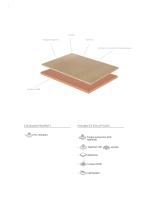
Sanded Tongue and groove Antivlam or HydroFlam chipboard panel STANDARD PROPERTY - Fire retardant POSSIBLE EXTRA OPTIONS Tongue and groove joint (optional) Lacquer finish
Open the catalog to page 2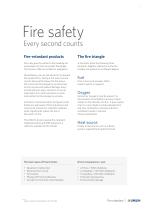
Fire safety Every second counts Fire-retardant products Not a day goes by without a fire breaking out somewhere. No one can predict the danger. The cause is often an accident or negligence. A fire starts when the following three e lements, together referred to as the fire t riangle, are resent to a sufficient degree. p Nevertheless, we can and should try to prevent the spread of fire. During a fire, every second counts, because the slower the fire grows, the more time the emergency services have to limit injuries and material damage. Every minute and even every second is of crucial importance...
Open the catalog to page 3
What is a fire? Start and spread Fuel, oxygen and heat source If one of these elements is missing, there is no risk of fire. Sufficient oxygen will always be present in the air, however. Heat sources, meanwhile, are mainly created by accident and are therefore more difficult to control. This leaves only one element under our control: the combustible material. We can s ignificantly improve fire safety through the use of fire- etardant materials. r Spread of the fire As soon as a fire starts, it can spread in three ways: 1. Through radiation Large flames can spread the fire to materials a couple...
Open the catalog to page 4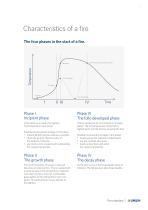
Characteristics of a fire The four phases in the start of a fire. The fire has consumed all its fuel Fire starts Phase I Incipient phase Phase III The fully-developed phase A fire starts as a result of an ignition. The temperature rises slowly. The fire remains at its most intense for a longer period. The temperature also remains at its highest point until the fire has consumed its fuel. Possible fire prevention strategy in this phase: • prevent ignition sources wherever possible. • check the ignition characteristics of the products/materials. • use construction products with outstanding fire-resistant...
Open the catalog to page 5
Material properties Wood protects itself! Fire behaviour It is important to know how construction materials will behave in the event of a fire. Will they ignite easily? Will they contribute to the spread of a fire? Will they create large amounts of smoke and gas? But there are other questions too. How will the material respond to increased temperatures? Will it deform, bend (like steel), split (like plaster) or melt (like plastic)? Wood When a wood construction falls prey to fire, it undergoes a progressive temperature increase. When wood is heated, it gradually reaches a temperature of 100°C....
Open the catalog to page 6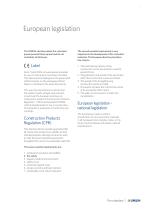
European legislation The UNILIN, division panels fire-retardant panels prevent flame spread and do not contribute to flashover. Label Since 1 April 2004, all wood panels intended for use in construction must have a CE label. This label must be displayed on the panel itself (official stamp), on the packaging (official label), or indicated in the sales documents. This way, the manufacturer confirms that the product meets all legal requirements, in particular the European directives on construction products (Construction Products Regulation - CPR) and standard EN 13986 «Wood-based panels for use...
Open the catalog to page 7
Spread of the fire Flame spread and flashover Flame spread The flame spread is the speed with which flames spread over the surface of a given m aterial. This speed differs from material to material. The spread of the fire is not only determined by the flame spread, but also by the heating of non-combustible materials. This heating can cause the formation of combustible gases, which can in turn ignite other materials ( flashover). Reaction to fire of construction materials What is ‘Reaction to fire’? Reaction to fire is the measurement of how a material contributes to the fire to which it...
Open the catalog to page 8
Walls & ceilings The Single Burning Item or SBI test (EN 13823) is used to determine the reaction to fire of walls and ceilings. This test determines the potential contribution that a material makes to the fire when a burning object is located in the corner The SBI test examines flame spread, heat generation, smoke development (s1, s2, s3) and flaming droplet formation (dO, d1, d2). EN 13823 standards clearly define minimum requirements values have been defined for Euroclass F. UNILIN's fire-retardant Antivlam chipboard is classified as B-s1,d0, where Euroclass 'B' refers to extremely limited...
Open the catalog to page 9
Fire resistance of a construction element Definition Main observation criteria The fire-resistance tests establish the b ehaviour of a specific construction element when exposed to certain heating and pressure conditions, like those present during a fully- eveloped fire. The combustibility is the d property of composite constructions. This is a test of structures rather than of separate materials. The performance criteria below are the most commonly observed criteria in fire-resistance tests: Until recently, manufacturers of products with fire-resistant properties had to carry out tests in...
Open the catalog to page 10
Fire-retardant wood panels Knowhow For UNILIN, division panels, safe, fire-retardant products have been a priority for more than 40 years. So we know everything there is to know about wood panels’ fire behaviour. UNILIN, division panels manufactures fire-retardant chipboard panels (Antivlam and HydroFlam) and fire-retardant MDF panels (FibroFlam) with a Euroclass B certificate (EN 13501-1). The main advantages of fire-retardant wood p anels compared with standard, untreated wood: • • • • • burning time increased by 25% no contribution to flashover or flame spread limited release of ignitable...
Open the catalog to page 11
Possible applications: melamine, lacquer, laminate or veneer • Fire-retardant chipboard for use in dry environments • Euroclass B-s1, d0 • Powerfully fire-retardant chipboard for applications in dry environments • Compliant with the stringent ‘Class 0 British Standard’ and the Wheelmark certificate standards • Fire-retardant and moisture resistant construction board for structural applications • Fire-retardant MDF board for industrial processing and interior applications in dry environments • Fire-retardant Antivlam chipboards • 90-minute fire resistance • Lightweight chipboard for interior door...
Open the catalog to page 12All Unilin Panels catalogs and technical brochures
 Decorative Range 2022-2026
36 Pages
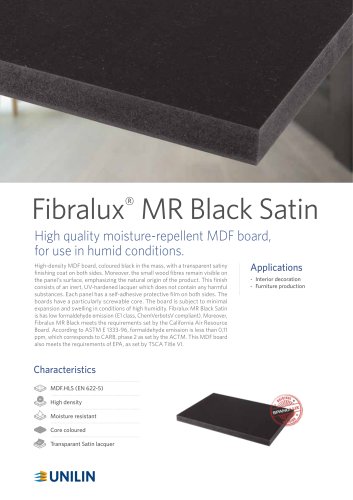 Fibralux® MR Black Satin
3 Pages
 Fibralux® MR Grey Super Matt
3 Pages
 Evola-HPL CC
2 Pages
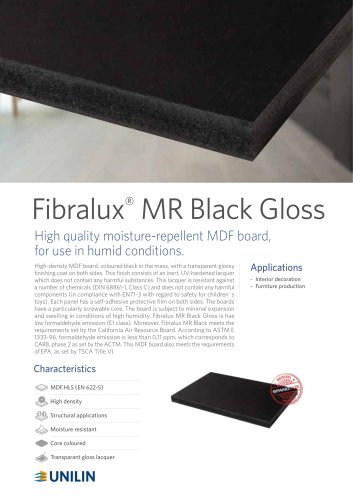 Fibralux® MR Black Gloss
2 Pages
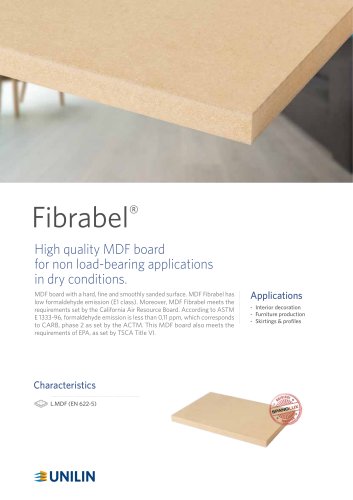 Fibrabel®
2 Pages
 I-Joist
3 Pages
 RWH
RWH2 Pages
 Durelis Vapourblock
2 Pages
 Hydroflam
2 Pages
 Betonspan
2 Pages
 Hydrolis
2 Pages

Archived catalogs
 Essentia
8 Pages
 Antivlam
16 Pages
 uniCHIP p2
3 Pages
 uniFLAX
2 Pages
 unipaint
2 Pages
 unicomponen
2 Pages
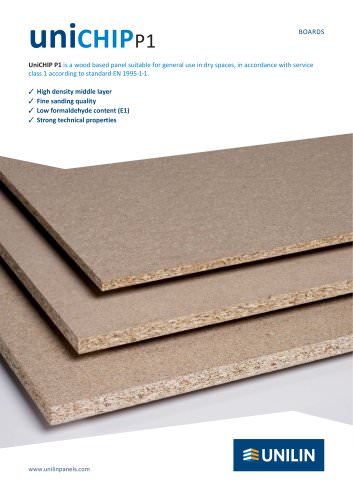 unichip p1
2 Pages
 unimdf comfort
3 Pages
 Full range 2017 - 2021
13 Pages
 Evola
Evola15 Pages
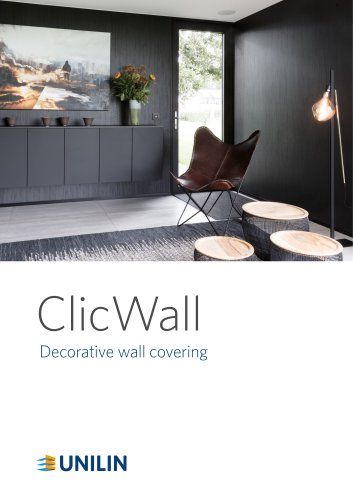

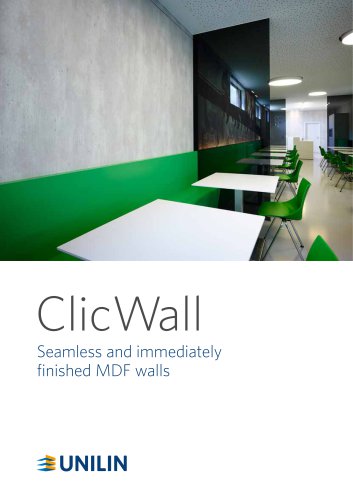
- Decorative panel
- Interior decorative panel
- Wall-mounted decorative panel
- Commercial decorative panel
- Home decorative panel
- Cover decorative panel
- Textured decorative panel
- Furniture decorative panel
- Interior panel
- High-resistance decorative panel
- Commercial panel
- Wood decorative panel
- Home panel
- Smooth decorative panel
- Building decorative panel
- Laminate decorative panel
- Matte decorative panel
- High-gloss decorative panel
- Sustainable panel
- Melamine decorative panel