


- Company
- Products
- Catalogs
- News & Trends
- Exhibitions
TERRE & Creations #4

TERRE & Creations #4
The document is a magazine issue by Terreal focusing on the use of terracotta in public buildings. It highlights the versatility and aesthetic appeal of terracotta in architecture, showcasing its application in various projects.
- Terracotta in Architecture: Terracotta is extensively used in facades, roofs, interiors, and even on the ground, often combined with vegetation. It is praised for its aesthetic appeal and technical properties such as durability, shock and fire resistance, and low maintenance.
- Case Studies: The magazine presents several case studies of public buildings utilizing terracotta, including the Louise Michel School in Aussonne and the Vy-lès-Lure school complex. These projects demonstrate the material's adaptability and the creative collaboration between architects and Terreal experts.
- Innovative Applications: The document highlights innovative uses of terracotta, such as the Diabolo® paving system designed for the Amiens Citadel, which integrates vegetation into the paving.
- Architectural Insights: Architects involved in these projects share their experiences and the benefits of using terracotta, emphasizing its durability, aesthetic versatility, and the support provided by Terreal in project execution.
- Louise Michel School, Aussonne: Features 187 m² of latticework brick screens, emphasizing aesthetics and technical performance. The project showcases the collaboration between architects and Terreal in achieving a harmonious design.
- Vy-lès-Lure School Complex: The roof, covered with Santenay ribbed tiles, blends with the surrounding environment while maintaining a modern look. The project won an award for its innovative use of traditional materials.
- ZAC Bédier: An example of transparency and lightness in architecture, using terracotta to create striking visual contrasts in a youth hostel complex.
The magazine underscores terracotta's role as a timeless and innovative material in contemporary architecture, highlighting its ability to meet modern construction challenges while maintaining traditional aesthetics.
The document discusses various architectural projects that utilize terracotta as a key material, highlighting its aesthetic and functional benefits. The projects include the Bédier ZAC in Paris, La Cerisaie City Center Mall in Fresnes, and the Le Mans University Department of Education.
This project features a mixed development zone with 450 apartments. The design emphasizes transparency and lightness, using chocolate-brown terracotta baguettes for visual appeal. The architecture combines historical materials with modern applications, reflecting the Art Deco style prevalent in the area.
The renovation aimed to create harmony between existing and new structures using natural materials. Terracotta was chosen for its durability and aesthetic qualities, contributing to a 30% increase in commercial activity post-renovation.
Designed by Pierre Lombard, this building integrates terracotta with translucent panels to enhance natural light. The use of terracotta is praised for its simplicity, durability, and ability to add warmth to the architecture.
This project showcases the innovative use of custom-made terracotta bricks to achieve a blend of tradition and modernity. The design features a façade with suspended bricks that play with light, creating a dynamic visual experience.
- Terracotta is valued for its timelessness, durability, and aesthetic versatility.
- The material is used to bridge historical architectural styles with contemporary design.
- Projects demonstrate the successful integration of terracotta in enhancing both the visual and functional aspects of buildings.
The document discusses the innovative redevelopment of the Amiens Citadel into a university campus and public space, emphasizing the integration of modernity with historical architecture. The project, led by Renzo Piano Building Workshop (RPBW), involved the creation of a unique terracotta ground covering called Diabolo-Citadelle d’Amiens®.
The redevelopment aimed to transform a 17th-century citadel into a vibrant space for 4,000 students and local residents. The design focused on balancing historical preservation with modern needs, creating a dialogue between the citadel and the town.
The Diabolo-Citadelle d’Amiens® is a terracotta ground covering designed to support vegetation. It offers a flat, permeable, and non-slip surface, eliminating the need for rainwater run-off slopes. This innovation was a result of collaboration between RPBW, AIA Ingénierie, Amiens Aménagement, and Terreal.
The Diabolo® system involves elements laid in lines like parquet flooring, clipped together to allow grass to grow in the joints. This system was also used to cover the barracks roof terrace, showcasing the project's technical and aesthetic achievements.
Paul Vincent, an architect at RPBW, highlighted the project's aim to mix different eras and uses, emphasizing the practical benefits of the Diabolo® for various users. Pierre Kerien from AIA Ingénierie discussed the technical challenges and collaboration with Terreal. Jean-Maurice Moulène from Amiens Aménagement praised the project's innovative use of terracotta and its role in linking past and present.
The Amiens Citadel project is a world-first innovation, demonstrating the potential of terracotta in modern architecture. It serves as a model for future projects, with plans to use the Diabolo® system in other developments, such as the École Normale Supérieure in Saclay.
Catalog excerpts
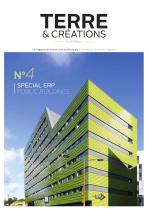
TERRE & CRÉATIONS By TERREAL Le magazine de la terre cuite architecturale / Architecture terracotta magazine SPÉCIAL ERP PUBLIC BUILDINGS
Open the catalog to page 1
On façades, on roofs, in interiors and even on the ground combined with vegetation… today terracotta is everywhere. And terracotta is sometimes found where you don’t expect it! It’s astounding, it’s confounding, it stimulates the imagination and innovation: monumental when it encases a building like Residence Verde in Newcastle, it can also be as delicate as lace when subtly married with glass as for Aussone school. So in this edition featuring public buildings you will find unique interpretations of this multifaceted material which appeals aesthetically but also in its technical properties...
Open the catalog to page 2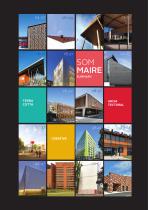
TERRA COTTA ARCHI TECTURAL TERRE & CRÉATION
Open the catalog to page 3
ULTRA DESIGN, LE MOUCHARABIEH VERSION TERRE CUITE ! es façades sur rue ajourées qui filtrent les rayons du soleil et habillent le sol intérieur d’un damier lumineux plus ou moins marqué au fil du jour... Le Groupe scolaire Louise Michel d’Aussonne, est l’expression parfaite du mariage de l’esthétisme et de la technique. 187 m² de moucharabiehs en briques ont été ici érigés : un défi relevé par les cabinets d’architecture Damon et Sagnes en étroite collaboration avec les équipes Terreal. Ces dernières ont en effet partagé leur savoir et leur expérience tout au long du projet, des premiers dessins...
Open the catalog to page 4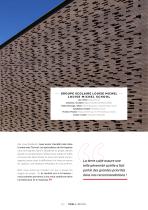
G R O U P E S CO L A I R E LO U I S E M I C H E L LOUISE MICHEL SCHOOL Lieu / Place : Aussonne (31) Architecte / Architect : Agence Danièle DAMON Architecte Maître d’ouvrage / Client : Mairie d’Aussonne / Aussonne town council Couleur / Colour : Gris perle / Pearl grey des moucharabiehs, nous avons travaillé main dans la main avec Terreal. Les spécialistes de l’entreprise nous ont épaulés dans la faisabilité du projet, alertés quand nos propositions n’étaient pas viables et aidés à trouver des alternatives. Ils nous ont même accompagnés jusque dans la définition et la mise en œuvre du support,...
Open the catalog to page 5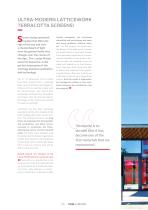
ULTRA-MODERN LATTICEWORK TERRACOTTA SCREENS! treet-facing openwork façades that filter the rays of the sun and cast a checkerboard of light over the ground inside that changes over the course of the day... The Louise Michel school in Aussonne, is the perfect expression of the marriage between aesthetics and technology. 187 m² of latticework brick screens have been erected here: a challenge taken up by the Damon and Sagnes architectural firms working closely with the Terreal teams who shared their knowledge and experience throughout the project, from the first drawings to the design of the metal...
Open the catalog to page 6
TERRE & CRÉATION
Open the catalog to page 7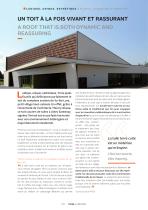
UN TOIT À LA FOIS VIVANT ET RASSURANT A ROOF THAT IS BOTH DYNAMIC AND REASSURING udique, unique, esthétique. Trois qualificatifs qui définissent parfaitement le toit du complexe scolaire de Vy-lès-Lure, petit village haut-saônois. En effet, grâce à l’inventivité de l’architecte Thierry Gheza, ce toit couvert de tuiles à côtes Santenay signées Terreal est en parfaite harmonie avec son environnement hétérogène et majoritairement résidentiel. Primé au concours Architendance * 2014, ce projet a su relever deux défis de taille : un toit à faible pente pour éviter que ce bâtiment de plain-pied ne soit...
Open the catalog to page 8
This project, which won an award at the 2014 Architendance competition, was able to meet two significant challenges: a roof with a low pitch to prevent this single-storey building from being too high, and a resolutely modern look using a traditional product. It soon became apparent that Santenay ribbed tiles were the only available solution. And thanks to its wide colour palette, this attractive product became a real source of inspiration for the architect! Thierry Gheza, the architect for the Vylès-Lure school, said: I find terracotta tiles inspring: Terreal Santenay. Tile can be laid on very...
Open the catalog to page 9
LA TERRE CUITE : POINT FOCAL DE LA ZAC BÉDIER ransparence et légèreté, malgré l’importance du bâtiment. C’est ce que ressent le visiteur qui découvre la Zac Bédier, imaginée par l’atelier Rolland & associés. mier comme en lévitation, le second encastré dans l’un des plots. Choisie pour sa seule esthétique, la terre cuite vient ici contraster et étonner. Car tous admirent mais peu devinent de quelle matière sont recouvertes ces “boîtes” accrochées aux bâtiments… Cette auberge de jeunesse atypique compte 450 logements au total répartis en trois plots : une résidence étudiante, un foyer pour jeunes...
Open the catalog to page 10
MAISON INTERNATIONALE DE SÉJOUR ZAC BÉDIER BEDIER STUDENT RESIDANCE Lieu / Place : Paris (75), France Architecte / Architect : Atelier Fréderic Rolland et associés / Fréderic Rolland and partners Maître d’ouvrage / Client : SIVU des Rivières Produit / Product : Autan® XL Droplet Couleur / Colour : Brun chocolat / Chocolate brown
Open the catalog to page 11
TERRACOTTA IS THE HIGHLIGHT OF THE BÉDIER ZAC isitors to the Bédier ZAC (mixed development zone), designed by Rolland and partners, get a sense of transparency and lightness, despite the large size of the building. This atypical youth hostel has a total of 450 apartments spread over three blocks: a student hall of residence, a hostel for young workers and a socially oriented residential hotel. On the ring road side, large screenprinted glass façades join the buildings together. On the Paris side, the atmosphere is calm and private. What catches your eye here is the vivid contrast between the...
Open the catalog to page 12Archived catalogs
 Technical guide Terreal Façade
92 Pages
 Inspiration Terracotta
87 Pages
 TERRE & Creations #6
25 Pages
 TERRE & Creations #5
44 Pages
 TERRE & Creations #3
52 Pages
 TERRE & Creations #1
20 Pages
 TERRE & Creations #2
23 Pages