

TECTA Magazin 2017

TECTA Magazin 2017
Andree Weißert, a carpenter and architect, founded his design studio in Berlin in 2009, focusing on architecture, space conception, and furniture design. His collaboration with Tecta began in 2013, leading to the creation of several furniture pieces, including the M38 "Red Table" in 2015.
Weißert's design philosophy emphasizes the potential of spaces and the joy of creation. The M38 table was inspired by the red anti-corrosive paint on steel parts, linking architecture and furniture through color. The renovation of Tecta's headquarters involved updating the 1950s office structure to promote cooperation and interaction, using Tecta furniture to offer flexible working environments.
Tecta's headquarters, a patchwork of designs by various architects, required careful renovation to respect the original creators' work while modernizing the space. Weißert's approach involved analyzing work methods and integrating insights into the new design, creating zones for different work activities.
The M38 table, designed during the renovation, features a robust cement top and a red steel frame, symbolizing the raw construction material. The office's color scheme enhances the table's presence, using vibrant colors and materials to create a dynamic environment.
Tecta's Chair Configurator allows customers to personalize the iconic F51 armchair, originally designed by Walter Gropius. The configurator offers 564 combinations of colors and materials, reflecting Bauhaus's spirit of constant evolution.
Daniel Lorch's Split Chair for Tecta exemplifies innovative production methods, such as splitting and bending steel tubes. The chair's development took seven years, requiring the invention of a new manufacturing process. Lorch's design philosophy aligns with Tecta's exploration of production limits, creating objects that respond to change and enhance potential.
The document highlights the integration of innovative design and architecture at Tecta, emphasizing the importance of color, material, and flexibility in modern workspaces. The collaboration between designers and Tecta showcases a commitment to evolving Bauhaus principles and pushing the boundaries of furniture design.
Tecta was founded in 1956 by architect Hans Könecke in Lauenförde, Germany. In 1972, Werner and Axel Bruchhäuser took over the company with the aim of popularizing classic modernism in Germany. Tecta is renowned for its authentic and licensed Bauhaus re-editions, making it a leading producer of original Bauhaus designs.
Tecta's production facilities are located in Lauenförde, Germany, benefiting from proximity to suppliers in the furniture and crafts trade. The company emphasizes traditional craftsmanship and customizes products to meet individual customer specifications.
Tecta specializes in fulfilling unique customer requests and creating personalized products, which aligns with their commitment to the Bauhaus spirit. This approach defies conventional economic principles but has proven successful.
The Cantilever Chair Museum, founded in 1979, is the world's only museum dedicated to the development of the cantilever chair. It serves as a museum, company archive, and showroom. The museum is closely linked to Tecta's work and showcases the evolution of the cantilever chair.
The museum, designed by Peter Smithson, features a unique layout that allows exhibits to interact with the environment and architecture. It emphasizes the concept of "families of chairs," reflecting the interconnectedness of the exhibits.
Tecta aims to continue developing its collection and exploring new materials and designs. The museum seeks to remain a vibrant place for inspiration and creative exchange, particularly appealing to younger visitors.
Daniela Drescher highlights the timeless nature of the collection, noting that sitting remains a popular topic. Visitors often find the designs contemporary, despite their age, due to their relevance to modern life.
Christian Drescher explains the redesign inspired by Peter Smithson's "Art Barn" concept, which allows easy access to exhibits. The museum now features exhibits moved to the center of rooms for interaction, with added typographic text levels. The redesign also involved decluttering, replacing the original carpet with a waxed screed floor to enhance transparency and airiness.
The Cantilever Chair Museum is unique for its lack of white walls, being completely glazed with a steel lattice structure. This design allows for complex views and a sense of motion, with a concrete floor guiding visitors through the collection.
The Tecta Landscape is an industrial and landscape park developed over years with contributions from architects Alison & Peter Smithson. The landscape includes an outdoor platform designed by Simon Smithson, enhancing views and serving as a focal point. Recent renovations by Andree Weißert have revealed new perspectives of the park.
Christian Drescher outlines goals for the next decade, including updating the collection with new materials and designs, fostering interest in modernist ideas among younger visitors, and making the museum more open and vibrant to inspire creative dialogue.
Catalog excerpts
Katalog Bauhaus Oblique Kragstuhl Unique
Open the catalog to page 3
4 Tecta Gestalter /Designer
Open the catalog to page 4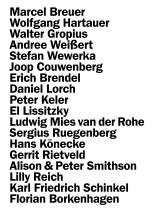
Marcel Breuer Wolfgang Hartauer Walter Gropius Andree Weiftert Stefan Wewerka Joop Couwenberg Erich Brendel Daniel Lorch Peter Keler El Lissitzky Ludwig Mies van der Rohe Sergius Ruegenberg Hans Konecke Gerrit Rietveld Alison & Peter Smithson Lilly Reich Karl Friedrich Schinkel Florian Borkenhagen
Open the catalog to page 5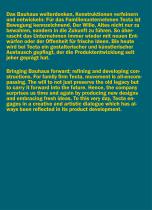
Das Bauhaus weiterdenken, Konstruktionen verfeinern und entwickeln: Für das Familienunternehmen Tecta ist Bewegung kennzeichnend. Der Wille, Altes nicht nur zu bewahren, sondern in die Zukunft zu führen. So überrascht das Unternehmen immer wieder mit neuen Entwürfen oder der Offenheit für frische Ideen. Bis heute wird bei Tecta ein gestalterischer und künstlerischer Austausch gepflegt, der die Produktentwicklung seit jeher geprägt hat. Bringing Bauhaus forward; refining and developing constructions. For family firm Tecta, movement is all-encompassing. The will to not just preserve the old legacy...
Open the catalog to page 6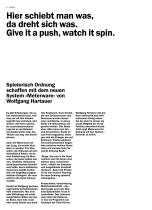
Hier schiebt man was, da dreht sich was. Give it a push, watch it spin. Spielerisch Ordnung schaffen mit dem neuen System »Meterware« von Wolfgang Hartauer Es gibt Erfindungen, die sofort einleuchtend sind, weil man sie mit den Händen begreift: hier schieben, dort drehen, mit ihnen spielen, sie auseinandernehmen. Lego ist so ein Beispiel, der Zauberwürfel oder das »Wisch und weg« des Smartphones. Auch die Meterware hat das Zeug, ein echter Klassiker zu werden. Für Menschen, die Ordnung auf dem Schreibtisch lieben, ist sie eine Entdeckung; für Menschen, die keine halten können, ebenfalls. Reduzierte...
Open the catalog to page 8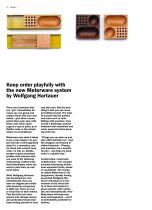
Keep order playfully with the new Meterware system by Wolfgang Hartauer There are inventions that you “get” immediately because you can grasp and explore them with your own hands - give them a push, watch them spin, play with them, take them apart. Lego is a case in point, as is Rubik’s cube or the simple swipe of a smartphone. Meterware has what it takes to be a real classic. For people who like a well-organised desk it is a revelation; and for those who cannot keep order, no less so. Simple, powder-coated aluminium profiles with interiors that you want to fill, featuring meticulously crafted...
Open the catalog to page 10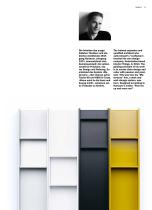
Die Arbeiten des ausge-bildeten Tischlers und stu-dierten Architekten Wolfgang Hartauer, Jahrgang 1971, kennzeichnet eine Gemeinsamkeit: die Leiden-schaft fur Prazision, kla-res Design und Ordnung. So entstand das System »Me-terware«, aber ebenso seine Tische K8 und K8B fur Tecta. »Nimm mich in die Hand und beweg mich!«, scheinen seine Produkte zu fordern. The trained carpenter and qualified architect who calls himself a “craftsman”, founded his own design company, Holzminden-based Interior Things, in 2014. The guiding principle of his work is to create clean design and order with passion and...
Open the catalog to page 11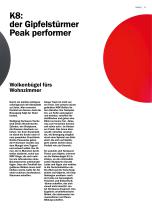
K8: der Gipfelstürmer Peak performer Wolkenbügel fürs Wohnzimmer Durch ein leichtes Antippen schwingt sich die Oberplatte zur Seite. Man erwartet förmlich ein Surren, doch die Bewegung folgt der Hand lautlos. Wolfgang Hartauers Tische sind kleine Wunderwerke. Zylinder, wie Skulpturen, die Räumen Ausdruck verleihen. Vor ihrer Konstruktion stand die Suche nach ei nem passablen Couchtisch. Nichts Passendes gefunden? Hartauer machte aus dem Mangel eine Tugend und entwarf selbst. Der Ulmer, der in München Architektur studierte, schuf aus MDF Ringe, die sich nahtlos wie Jahreskreise eines Baumstammes...
Open the catalog to page 13
Tap it lightly and the tabletop opens out. You virtually expect some kind of buzzing sound but the movement follows your hand noiselessly. Wolfgang Hartauer’s tables are ingenious marvels. Sculptural cylinders that make a statement out of a room. Hartauer designed them while looking for a decent coffee table. Not found anything suitable? He made the best of a difficult situation and simply designed one himself. Ulm-born Har-tauer, who studied architecture in Munich, created rings out of MDF boards and joined them together seamlessly, like the annual growth rings on a tree. For him the fact that...
Open the catalog to page 14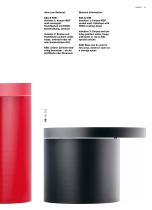
Infos zum Material: K8A & K8B Variante 1: Korpus MDF matt versiegelt, Tischflachen mit FENIX-Beschichtung, schwarz Variante 2: Korpus und Tischflache lackiert: weiB, taupe, anthrazit oder rot oder Sonderfarben RAL K8B: unterer Zylinder beid-seitig benutzbar - als Ab-stellflache oder Stauraum Material information: K8A & K8B Variation 1: Corpus MDF, sealed matt, tabletops with FENIX coating, black Variation 2: Corpus and tabletop painted: white, taupe, anthracite or red or RAL special colours K8B: Base can be used in two ways, closed or open as a storage space
Open the catalog to page 15
M38: ein Tisch aus der Schlosserei A table from the metal workshop Wandel lohnt sich. Während der Tecta-Firmensitz umgebaut wurde, ist auch ein besonderer Tischentstanden – der M38 von Andree Weißert Das Tecta Headquarter ist ein Stückwerk verschiedenster, großartiger Gestalter. Die Büros und Produktionsgebäude stammen aus den 1950er Jahren von Hans Könecke, Architekt und Gründer von Tecta. Peter und Alison Smithson haben drei rote Ausstellungspavillons gebaut, Stefan Wewerka den Besprechungsraum. Ein großes Erbe. Wie war da Ihre Vorgehensweise? Alles war in einem Zustand, der ein Update verlangte....
Open the catalog to page 16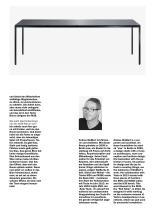
und bietet den Mitarbeitern vielfaltige Moglichkeiten, zu sitzen, zu kommunizieren, zu arbeiten. Die Arbeit kann, aber muss nicht zwingend am Schreibtisch stattfinden, und das ist in den Tecta-Buros ubrigens der M38. Wie sieht das Farbkonzept um den M38 herum aus? Ich arbeite auch hier ger-ne mit Farben, weil sie den Raum bereichern. Und daher habe ich die Farbe so einge-setzt, dass ein lebendiges Spiel mit Proportionen, Tie-fen entsteht. Es gibt Holz, Stahl und farbig lackierte Flachen sowie gelb geton-tes Glas. Das ganze Buro hat keine riesige Grundflache. Eine Schrankwand aus den 50er Jahren...
Open the catalog to page 17Archived catalogs
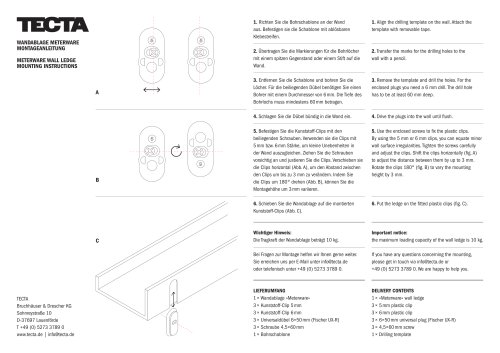 METERWARE WALL LEDGE
1 Page
 TECTA-PRESSEMAPPE
32 Pages
 HOW TO MOVE THE LOT
1 Page
 TECTA Meterware
2 Pages
 TECTA - Flying Furniture
131 Pages
 Original-Bauhaus-Modelle
5 Pages
