
- Catalogs
- TECNASFALTI (ISOLMANT)
- SOUND ABSORBER


SOUND ABSORBER

SOUND ABSORBER
The document highlights the impact of noise on quality of life, noting that excessive noise can lead to health issues. It explains reverberation as the increase in sound levels due to reflections in enclosed spaces, contributing to background noise. Proper acoustic design is crucial to manage reverberation time, which should be tailored to the intended use of the space.
Sound absorption involves using materials that dissipate sound energy to reduce reflections and control noise levels. The document describes the sound absorption coefficient and how materials like porous and fibrous substances effectively absorb sound. It differentiates between sound absorption and sound insulation.
Italian legislation on interior acoustics is limited, with specific standards for schools. The document references the Prime Ministerial Decree and the UNI 11532 standard, which provide guidelines for optimal reverberation times in various environments, including schools, offices, and healthcare facilities.
IsolSpace Style is an acoustic panel designed for high sound absorption, made from recycled polyester fiber. It is non-toxic, non-flammable, and customizable in color and shape. The panel's variable density enhances its acoustic performance, making it suitable for various environments.
The document discusses the application and benefits of IsolSpace Style panels for acoustic correction in various environments. These panels improve sound absorption without altering the fiber diameter or introducing new materials, offering superior performance, especially at lower frequencies. They are environmentally friendly, made from 100% recycled polyester from plastic bottles.
The panels come in standard sizes and shapes, allowing easy integration into any environment. They can be installed on walls and ceilings, using baffle or island suspension, or within aluminum frames.
- Children's Areas: Essential for creating sound environments that facilitate learning and social interaction, especially in kindergartens.
- Classrooms: Critical for maintaining a conducive learning environment, with legal limits on reverberation time (T60 not exceeding 1.2 seconds).
- Canteens and Gyms: Address noise from voices and activities, with specific reverberation time standards (T60 of 2.2 seconds for gyms).
- Offices: Open-plan offices benefit from reduced noise propagation, enhancing productivity and communication.
- Conference Rooms: Professional acoustic correction is crucial to manage reverberation and ensure clear communication.
- Recording Studios: Require precise acoustic treatment to maintain sound quality, with a target reverberation time of around 0.2 seconds.
- Restaurants: Acoustic correction enhances the dining experience by managing diverse background noises.
- Gyms and Other Installations: Effective in managing noise in large, reflective spaces like gyms and churches.
The document includes examples of successful installations, such as the IPIBI bank offices in Milan, where acoustic refurbishment significantly improved reverberation times, enhancing speech intelligibility and communication.
IsolSpace Style panels offer versatile and effective solutions for acoustic correction across various environments, improving both functionality and aesthetics.
The document discusses the acoustic refurbishment of a refectory under cultural heritage supervision, focusing on the installation of sound-absorbing panels to improve reverberation times while preserving the room's architectural integrity.
Approximately 38 m2 of IsolSpace Style panels were installed, resulting in a 44% improvement in reverberation times, particularly at medium-high frequencies, with a peak improvement of 51% at 2000 Hz.
Panels are installed using various methods including recesses in walls, steel cables, Velcro bands, and frames. The document details installation procedures for each method, emphasizing minimal invasiveness and reversibility.
The document lists accessories such as Velcro, aluminum frames, baffle suspension kits, and ceiling brackets, providing specifications for each.
IsolSpace Sky is introduced as an alternative for ceiling installations, offering high thermal and acoustic performance with easy installation.
Detailed instructions are provided for glue, Velcro, frame, baffle, and island suspension systems, including step-by-step guides and diagrams for proper installation.
The document concludes with notes on the effectiveness of the installation systems and the importance of maintaining the historical integrity of the building.
Catalog excerpts

Custom Sound Absorbers
Open the catalog to page 1
CONTENTS Acoustic environment Case histories Sound absorption Other sound absorbers Installation instructions IsolSpace Style school canteens school gyms conference rooms music spaces other applications
Open the catalog to page 3
SOUND ABSORPTION Noise: an old problem turn into real disorders (second level), up to determine a physical injury (third level). Noise has always been a problem since the ancient past. Reference to this problem can be found in Marziale’s “epistolae”. Marziale craves his country house because “for a poor there is no place to think or to rest in Rome” due to the incessant noise of the city. Also Seneca complains about his house above the thermal baths and underlines that “during study, silence is as necessary as sight”. An acoustic environment falls into one or another category, depending on several...
Open the catalog to page 4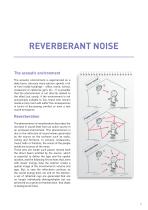
REVERBERANT NOISE The acoustic environment The acoustic environment is experienced on a daily basis, because every person spends a lot of time inside buildings – office, home, school, restaurant or cafeteria, gym, etc... It is possible that the phenomenon is not directly related to the effect but surely, if the environment is not acoustically suitable to live, those who remain inside a noisy room will suffer the consequences in terms of decreasing comfort or even a real sound annoyance. Reverberation The phenomenon of reverberation describes the increase in sound level from an active source in...
Open the catalog to page 5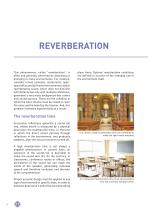
Reverberation This phenomenon, called “reverberation”, is often and generally perceived as disturbing or annoying in many environments. For instance, consider school canteens, restaurants, openspace office and all those environments in which reverberating sound, which does not diminish with distance but only with multiple reflections, generates a very noisy background that covers new sound sources. Those are the condition in which the voice volume must be raised to cover the noise and be heard by the listener. And, this problem increases exponentially as a result. place there. Optimal reverberation...
Open the catalog to page 6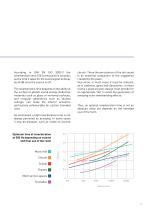
According to UNI EN ISO 3382-2 the reverberation time T60 is measured in seconds, as the time it takes for the sound signal to decay by 60 dB once the source is off. The reverberation time depends on the ability of the surface to absorb sound energy. Reflective materials such as glass or mirrored surfaces, and irregular geometries such as vaulted ceilings, can make the interior acoustics particularly unfavourable for certain intended uses. As mentioned, a high reverberation time is not always perceived as annoying. In some cases it may be pleasant, such as inside an ancient Optimum time of reverberation...
Open the catalog to page 7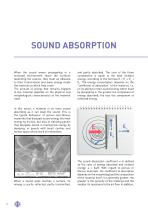
SOUND ABSORPTION When the sound waves propagating in a enclosed environment reach the surfaces delimiting the volume, they meet an obstacle to their transmission and leave energy inside the material on which they crash. The amount of energy that remains trapped in the material depends on the physical and morphological characteristics of the material itself. In this sense, a material is as more sound absorbing as it can keep the sound. This is the typical behaviour of porous and fibrous materials that dissipate sound energy into heat energy by friction, but also of vibrating panels that dissipate...
Open the catalog to page 8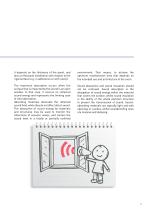
it depends on the thickness of the panel, and also on the panel installation with respect to the rigid surface (e.g. in adherence or with cavity). environment. That means, to achieve the optimum reverberation time that depends on the intended use and architecture of the room. The maximum absorption occurs when the surface that is impacted by the sound is an open window. In that case, it returns no reflected sound energy and represents the limiting case of total absorption. Absorbing materials attenuate the reflected sound field, while they do not affect direct sound. The absorption of sound energy...
Open the catalog to page 9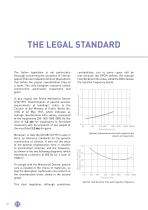
Moreover, in Italy the DM 08/12/1975 is also in force, as reference standards for the general construction of schools. It sets out the value of the optimal reverberation time in relation to environment volumes, and the frequency, as shown in the two following diagrams, which represents a scenario at 500 Hz for a room of 1000 m3. To comply with the Ministerial Decree, special care is needed in the choice of materials, so that the absorption coefficients can conform to the reverberation times shown in the second graph. This dual regulation, although sometimes In this regard, the Prime Ministerial...
Open the catalog to page 10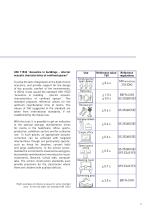
UNI 11532 “Acoustics in buildings - interior acoustic characteristics of confined spaces” To solve the lack of legislation in the field of room acoustics, and provide support for the design of the acoustic comfort of the environments, in 20014 it was issued the standard UNI 11532 “Acoustics in building - interior acoustic characteristics of confined spaces”. This standard proposes reference values for the optimum reverberation time of rooms. The values of T60 suggested in the standard are taken from international standards, if not established by the Italian law. With this tool, it is possible...
Open the catalog to page 11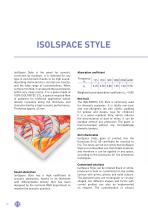
ISOLSPACE STYLE IsolSpace Style is the panel for acoustic correction by Isolmant. It is indented for any type of environment thanks to its high soundabsorbing characteristics, its total non-toxicity, and the wide range of customizations. When surface mounted, it can absorb the sound waves within very noisy rooms. It is a panel made of 100% ISOLFIBTEC STL, a special recycled fibre of polyester for technical application whose density increases along the thickness, and characterized by a high acoustic performance. Thickness approx. 45 mm. Absorption coefficient Frequency Hz Weighted sound absorbtion...
Open the catalog to page 12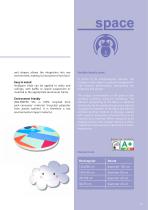
and shapes allows the integration into any environment, making it a nice piece of furniture. Easy to install IsolSpace Style can be applied to walls and ceilings, with baffle or island suspension or inserted in the appropriate aluminium frame. Environment friendly ISOLFIBTEC STL is 100% recycled from post-consumer material (recycled polyester from plastic bottles). It is therefore a low environmental impact material. Variable density panel In terms of its morphological features, the IsolSpace Style panel is specially designed for high acoustic performance, maintaining low thickness and weight....
Open the catalog to page 13All TECNASFALTI (ISOLMANT) catalogs and technical brochures
 ISOLMANT CATALOG 2023
74 Pages
 SOUNDPROOFING PRODUCTS
40 Pages
 WOODEN FLOORING
36 Pages
 CATALOGUE BUILDING 2016
43 Pages
 GreenPlanet brochure
8 Pages
 IsolDrum
6 Pages
 IsolTile
4 Pages
 Product Catalogue
8 Pages
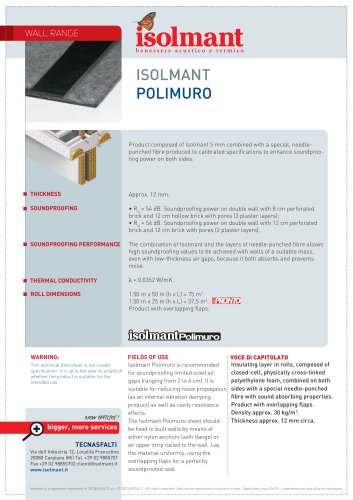 Isolmant Polimuro
1 Page
 Isolmant D311
1 Page
 Isolmant Radiante
1 Page
 Isolmant BiPlus
1 Page
 Isolmant MonoPlus
1 Page
 Isolmant UnderLivell
1 Page
 Isolmant UnderSpecial
1 Page
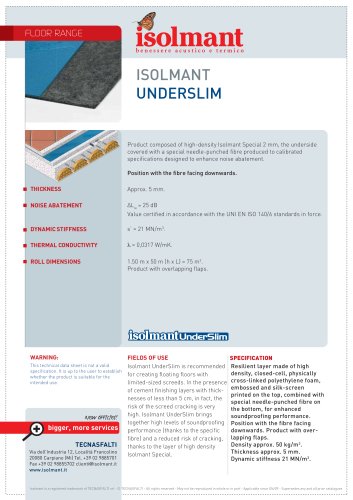 Isolmant UnderSlim
1 Page
 Isolmant Special
1 Page
 Isolmant perfetto Style
16 Pages
 CATALOGUE ISOLMANT
64 Pages


- Panel insulation
- Thermal insulation
- Synthetic insulation
- Wall insulation
- High-performance insulation
- Thermal-acoustic insulation
- Industrial acoustic insulation
- Roll insulation
- Lightweight insulation
- Flooring insulation
- Exterior insulation
- Insulation with vapor barrier
- Ceiling insulation
- Recyclable insulation
- Eco-friendly insulation
- Sustainable insulation
- Waterproof insulation
- Industrial vapor barrier
- High-resistance insulation