
- Catalogs
- Targetti Sankey S.p.a.
- Light of Florence 2020


- Company
- Products
- Catalogs
- News & Trends
- Exhibitions
Light of Florence 2020

Light of Florence 2020
The document explores the relationship between art and light, focusing on Florence's unique lighting and its impact on art presentation. It includes dialogues with notable figures in the art and lighting fields, discussing how light enhances cultural heritage.
Light of Florence
Florence's light is shaped by its natural environment and architecture, with historical materials like "pietra forte" sandstone influencing its color palette. This section highlights how Florence's light has influenced art both historically and in contemporary times.
Dialogues on Art
Conversations with Antonio Natali, Felice Limosani, and Massimo Iarussi discuss the role of light in enhancing art. Natali emphasizes simple lighting for appreciating art's poetry, while Limosani and Iarussi discuss technical and creative lighting design aspects.
Exhibition Spaces and Lighting
The document discusses modern exhibition spaces and the importance of lighting in creating the right atmosphere, balancing uniformity and contrast, and using optical systems to enhance art displays.
Case Histories
Case studies, including the Galleria delle Statue e delle Pitture in Florence and the MEF Museo Ettore Fico in Turin, illustrate how lighting enhances historical and artistic heritage, focusing on architectural integration and evocative use of light.
Conclusion
The document concludes with a discussion on ethical considerations in art conservation and enhancement, stressing non-intrusive setups and preserving cultural value through thoughtful lighting strategies.
Lighting designers enhance art appreciation by shaping its perception through light, working alongside curators, exhibition designers, and architects. Their role is interpretative, adding meaning to artwork.
Challenges and Teamwork
Translating lighting awareness into action faces challenges like market pressures and budget constraints. Successful projects require respecting professional roles and skills, with teamwork being crucial.
Influence of Florence
Working in Florence instills humility and responsibility in lighting designers, who aim to enhance heritage beauty without overshadowing it.
Approach to Lighting Projects
Lighting projects should be unobtrusive, focusing on the artwork rather than the lighting design, and integrating seamlessly with the environment.
Impact of LED Technology
LED technology has revolutionized lighting design, offering lower emissions and modulating color spectra, leading to new standards for lighting artistic heritage.
Significant Projects
The document mentions various prestigious projects, emphasizing the ongoing nature of lighting design work and the continuous pursuit of excellence.
Effective museum lighting enhances visual experience and preserves artworks. LED lighting reduces light damage and aligns with artworks' chromatic properties.
Lighting Standards and Quality
LED lighting must comply with standards like UNI 10829:1999 to prevent damage. Quality is assessed using the Colour Rendering Index (CRI) and TM-30 index.
Lighting Design Approaches
Contrast is preferred for ancient art, while contemporary art uses uniform lighting. Optical systems like indirect optics and wall washer optics achieve desired effects.
Advanced Lighting Technologies
Targetti's collaboration with Lens Vector offers dynamic lighting systems ideal for art galleries, adjusting beam angles via IoT systems.
Case Study: Uffizi Gallery
The Uffizi Gallery's lighting project balances preservation and visibility, using custom solutions and LED technology to enhance the visual experience.
The document discusses lighting systems in art and historical spaces, focusing on LED boards for direct and indirect lighting, and using asymmetrical optics and anti-glare grills.
Case Histories
Uffizi Gallery, Florence: The lighting system integrates with architecture to illuminate frescoed ceilings and sculptures, enhancing natural integration.
MEF Museo Ettore Fico, Turin: LED projectors create a soft lighting effect, maintaining uniformity in large spaces.
Evocative Light in Religious Spaces
Lighting in religious spaces enhances architectural features while maintaining spiritual atmosphere, using control systems like DALI and Casambi.
Lighting Control Systems
DALI and Casambi systems manage lighting in complex installations, allowing dynamic scenes and remote control.
Restoration and Lighting Projects
Cathedral of Santa Maria Assunta, Volterra: The lighting design enhances architectural details subtly, using custom alabaster fixtures.
The document discusses modern lighting solutions in cathedrals, focusing on the Cathedral of Santa Maria Assunta in Volterra and the Cathedral of Santo Eccehomo in Valledupar.
Cathedral of Santa Maria Assunta
- Architectural Integration: Retains its Latin-cross basilica shape with elements from different eras.
- Lighting Design: Alabaster lanterns provide diffused light, enhancing architectural details.
- Technological Features: LED strips and custom projectors illuminate different areas.
- Lighting Control: DALI BUS system allows tailored lighting scenes.
Cathedral of Santo Eccehomo
- Architectural Design: Modern architecture with strong religious identity.
- Symbolism: Design symbolizes ascension, with vertical walls representing sacraments.
- Lighting Concept: Integrates natural and artificial light, minimizing artificial lighting needs.
- Lighting Systems: LED strips and projectors highlight architectural features.
- Philosophy: Lighting enhances historical and cultural value.
- Design Approach: Emphasizes historical memory recovery and space reinterpretation.
- Indoor vs. Outdoor: Different approaches for indoor and outdoor lighting.
Joachim Teichmüller introduced 'Lichtarchitektur', emphasizing electrical light as a design tool. Post-World War I, electricity allowed nighttime design of buildings and urban spaces.
Approaches to Illuminating Architecture
'Illuminated architecture' uses wide beam lighting, while 'luminous architecture' alters light-dark ratios. This dual approach is seen in projects like Rome Termini station.
Modern Lighting Techniques
Grazing light enhances textures, and LED technology offers energy-efficient solutions for cultural heritage.
LED Technology and Cultural Heritage
LEDs reduce costs and maintenance, integrating lighting systems with architecture for minimal visual impact.
Targetti's Approach to Lighting
Targetti emphasizes minimalism and integration, offering tailored lighting solutions that comply with regulations.
Case Study: Salone dei Cinquecento
The lighting project balances conservation with visual comfort, respecting the historical significance of the hall.
Project Objectives and Implementation
The project maintains historical aspects while supporting various functions, adhering to guidelines limiting light exposure.
Conclusion
The Salone dei Cinquecento project demonstrates integrating modern lighting technology with historical architecture.
1. Three RAY versions with 59W, WFL Optic, 3000K, Ra 97, Rf 96, Rg 102.
2. Two RAY versions with 59W, FL Optic, 3000K, Ra 97, Rf 96, Rg 102.
3. RAY version with 59W, FL Optic, customized spectrum with dominant red.
4. RAY version with 59W, FL Optic, customized spectrum with dominant blue.
Surface mounted LED projector with options for SP, FL, MWFL, and WFL optics, all at 25W and 3000K, Ra 97, Rf 96, Rg 102.
1. Custom profile for accent lighting of sculptures at 24W/ml, 3000K.
2. Custom LED board with strip LED in a special profile at 15W/ml, 3000K.
The lighting project for the Tower of Pisa enhances its historical significance, using custom fixtures to optimize performance without masonry work.
1. Custom calendered projectors with 30° profiles and strip LEDs.
2. STILO custom projectors with a hinge system for precise lighting.
Targetti emphasizes collaboration and customization, offering solutions from standard products to highly customized designs.
Product Customization Levels
1. Simple modifications include finish and power supply changes.
2. Intermediate modifications involve specific color rendering and remote power supply.
3. Complex modifications include custom sizes, materials, and optic designs.
Targetti has been involved in numerous projects worldwide, enhancing cultural heritage through tailored lighting solutions.
The document provides specifications and descriptions of Targetti's lighting products for art and museum settings, covering models, installation methods, optical features, power supply options, and finishes.
Specifications
Products are categorized by use, such as indoor or outdoor lighting, with key specifications including IP ratings, lumen output, color temperatures, and color rendering indices.
Product Features
- ZENO Series: Available in various sizes with IP40 rating, offering optics from narrow spot to wide flood.
- LABEL Series: Compact projectors for track installation, available in 48V and 230V versions.
- VOLTA Series: Adjustable LED projectors for wall or cornice installation.
- TONES Series: LED strips with customizable light tones.
- KEPLERO Series: Recessed LED up-lights for outdoor use.
- JEDI COMPACT Series: Linear LED fixtures for indoor and outdoor applications.
- DART Series: Outdoor projectors with various optics.
Products offer flexible installation options, with control systems including DALI, Casambi, and dimming options.
Finishes
Available finishes include white, black, grey, Bianco Fiorentino, and custom options.
Conclusion
Targetti's lighting solutions meet the complex requirements of art and museum lighting, offering high-quality optics, flexible installation, and advanced control systems.
Catalog excerpts

Chapter 01 Light of Florence Florence and its light 4 Dialogue with Antonio Natali 12 Curator and art historian Dialogue with Felice Limosani 16 Multidisciplinary artist Dialogue with Massimo Iarussi 20 Lighting designer 03 Art in the spotlight 24 Lighting museums The relationship between Art and Light 27 Exhibition spaces today 30 CASE HISTORIES Galleria delle Statue e delle Pitture, Florence 50 MEF Museo Ettore Fico, Turin 62 Lighting places Of W°rship Light as the first creative act 73 The church as a place of prayer 76 Flexible light: control systems 78 CASE HISTORIES The Cathedral of Santa...
Open the catalog to page 5
Living and working in Florence deeply influences our approach to the world of Art and the way to illuminate it; it is part of our DNA, our nature.
Open the catalog to page 7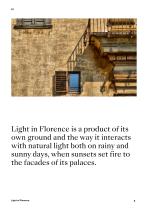
Light in Florence is a product of its own ground and the way it interacts with natural light both on rainy and sunny days, when sunsets set fire to the facades of its palaces.
Open the catalog to page 8
The golden brown “pietra forte” sandstone similar to tobacco, strongly characterises the colour scheme of the city. This sandstone extracted from Boboli hill in the centre of the city was used in the 1300 and 1400 to build bridges and the most important palaces in Florence (Palazzo Vecchio, Palazzo del Bargello, Palazzo Pitti, Palazzo Medici Riccardi and Palazzo Strozzi). The romantic and gothic period gave way to white, green and red marble inlays typical of some of the facades of Florentine churches, while during the Renaissance period white plaster became a fundamental element to enhance space...
Open the catalog to page 9
SPIRITUAL GUARDS - JAN FABRE TEMPORARY EXPOSITION 2016 - FLORENCE, ITALY COURTESY OF © ANGELOS BVBA
Open the catalog to page 10
Dialogues with Antonio Natali Felice Limosani Massimo larussi
Open the catalog to page 12
The enhancement of the artistic and cultural heritage by means of light is a complex subject that requires a multidisciplinary approach and the involvement of very different competences working with a common goal: to create the ideal experience for the enjoyment of art. We have collected the testimonies of professionals with international reputation who live in Florence and work daily in this field. Together with their “illuminated sight”, experience and sensitivity they have shared with us their intimate relationship with the light-art pairing.
Open the catalog to page 13
Antonio Natali Curator and art historian Art historian, Director of the Uffizi Gallery in Florence from 2006 to 2015, he was the first Director of the Centre for Renaissance, Mannerism and Contemporary Art Studies at the same Museum. From 2000 to 2010 he taught Museology at the University of Perugia. Author of books on painting and sculpture from the XV and XVI century and monographs on Michelozzo and Andrea del Sarto. He has curated many important art exhibitions such as “Il Cinquecento a Firenze” in Palazzo Strozzi between 2017 and 2018, where he brought together works of art by artists such...
Open the catalog to page 14
painted the two works. In my opinion a figurative work of art is poetry expressed in a figurative way instead of in words and poetry is appreciated not only for the language but also (I would say to above all) for its content; it is the content that pulls at the heartstrings. Q. How has the way of exhibiting works of art | changed over the years? AN. I think the relationship between people and works of art has changed. I often use the example of the room with the Mona Lisa in the Louvre. I show a picture of a day when the museum is closed, I show a normal day when it is open with the room teeming...
Open the catalog to page 15
AN. Museums are places of education and this defini tion could make us think (in this incoherent time) of a dusty place. Obviously in the digital era we cannot do without teaching in line with the times but works of art must be exhibited in the best way and in a place that allows for suitable appreciation and “enjoyment”. Giuseppe Pelli Bencivenni, Director of the Uffizi in the 18th century used to say something like this: “Young people should come to the Uffizi to learn and understand beauty because then they will know how to recognise it in every moment of life”. Recognising beauty is not innate...
Open the catalog to page 16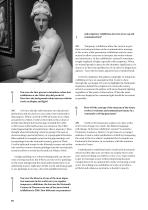
Q. You were the first person to introduce colour into exhibitions at the Uffizi, why did you do it? How does the background colour interact with the works on display and light? AN. As I have already said museums are educational institutions and my choice to use colour was functional to this purpose. When I arrived in 1981 all rooms were white, around forty of them. I believe that white is the colour of intellectual abstraction but having extended the Uffizi to 100 rooms white had become too intrusive; the Uffizi risked appearing like a hospital more than a museum. I then thought about introducing...
Open the catalog to page 17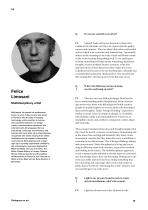
Felice Limosani Multidisciplinary artist Self-taught. He started his professional career as a DJ. Today he lives and works in Florence with the idea of merging technology and humanities to remove the boundaries between art, design, culture, communication experience and entertainment. All languages that are intrinsically connected, that influence and interact with each other. He is internationally recognised with works ranging from artistic installations to the creation of immersive environments (both physical and virtual) right up to curating experiential exhibitions. His commissions have been...
Open the catalog to page 18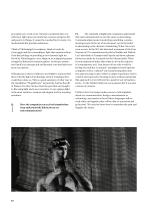
perception of a work of art. Natural or artificial, direct or reflected, light does not invade but caresses and gives life and poetry to things. It cannot be touched but it exists, it is insubstantial but provides substance. Think of Michelangelo’s sculpture, think of works by Caravaggio and the extraordinary light that animates them. I had the privilege of providing a new dynamic light for David by Michelangelo, every shape in its sculptural posture changed in dimension and perception. Its beauty manifested itself in an unexpected and dynamic way that had never been seen before. If Renaissance...
Open the catalog to page 19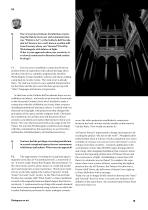
Q. One of your most famous installations expres sing the link between art and communication was “Fabric is Art”, at the Galleria dell’Accade-mia in Florence for a well-known woollen mill from Tuscany where you “dressed” David by Michelangelo with fabrics of light. What is your approach when your creativity is so closely connected to historical and artistic heritage? FL. It is not easy to establish a connection between modern forms of expression with cultural heritage above all when it involves a symbolic sculpture like David by Michelangelo. It takes humility, sobriety and always talking a step...
Open the catalog to page 20All Targetti Sankey S.p.a. catalogs and technical brochures
 T23 NEWS
144 Pages
 T25 the collection
708 Pages
 IVY
IVY12 Pages
 The Projects
118 Pages
Archived catalogs
 Light Lines 2020
348 Pages
 Targetti 2021
898 Pages
 Brand Book
62 Pages
- Wall-mounted light
- Contemporary wall-mounted light
- Metal wall light
- LED wall light
- Light fixture
- Industrial LED light
- Metal light fixture
- Fixed wall light
- Commercial light fixture
- 1 bulb wall-mounted light
- Commercial wall light
- Contemporary light fixture
- Black wall light
- Industrial LED spotlight
- Recessed light fixture
- Dimmable light fixture
- Linear light fixture
- Industrial downlight
- Metal spotlight
- White light fixture