

- Products
- Catalogs
- News & Trends
- Exhibitions
Ventilation products 60 Hz

Ventilation products 60 Hz
Systemair focuses on trust, cooperation, quality, deliveries, and documentation as a supplier. The catalogue targets new markets with products designed for a 60 Hz power supply, providing essential technical details.
Systemair leads in product development with advanced technologies in fans, motors, and heat recovery systems, ensuring high efficiency and low power consumption. The company has expanded its presence in Asia with production in Malaysia and sales in India and Australia.
The catalogue includes various ventilation products such as duct fans, roof fans, axial fans, wall fans, air curtains, and air handling units, available for different voltage requirements (110V and 230-460V).
Systemair's production units focus on efficiency, flexibility, and a safe working environment. The company adheres to AMCA and ISO standards and is ISO 9001 and ISO 14001 certified, emphasizing continuous improvement and environmental responsibility.
Systemair has manufacturing facilities in countries like Norway, Canada, the USA, Sweden, and others, each specializing in different products.
The catalogue provides detailed technical information on fan construction, including materials and insulation, designed for corrosion resistance and efficient cooling.
Systemair is committed to providing high-quality ventilation products with reliable deliveries, aiming to simplify customer projects and maintain a strong market presence.
Fans are made from galvanized sheet steel with backward-curved impellers. The motor and impeller assembly is dynamically balanced according to DIN ISO 1940 standards.
The motor's ball bearings are maintenance-free, with a life expectancy of at least 40,000 hours at 40°C ambient temperature.
Fans include an integral thermal protection relay, disconnecting power at critical temperatures.
Rated voltage and frequency must adhere to DIN IEC 38 standards, with specific power and current ratings.
Airflow is measured under free-blowing conditions, with static pressure shown in fan diagrams.
Sound pressure and power levels are measured and adjusted with an A filter for ear sensitivity.
Various methods for speed control are discussed, including transformers and phase controls.
Fans can be installed in any position, with recommendations for roof fans to prevent vibration transfer.
Detailed calculations for sound pressure levels and reverberation times are provided, with guidelines for absorption factors.
Explains how to calculate sound pressure level from sound power level using distance and directional factors.
Describes the dominance of sound source in the near field and reflected sound in the reverberation field.
Sound sources are added logarithmically, with examples provided.
Weighting filters are used to compensate for ear sensitivity variability.
Achieved through absorption or reflection, with calculations provided.
Describes the construction and cooling of an external rotor motor.
Includes nominal voltage, frequency, power, current, airflow, pressure, and sound levels.
Discusses methods and impacts on noise and motor life.
Details specifications and installation guidelines for various fan models, including circular duct fans, square duct fans, roof fans, and axial fans.
Designed for duct installation with backward-curved blades and external rotor motors, suitable for outdoor and wet room applications.
Features mixed flow impellers and integral thermal contacts for motor protection.
Suitable for exhaust-air ventilation systems, with built-in thermal overload protection.
Designed for large ventilation challenges, with aerodynamically designed blades.
Includes voltage, power, current, airflow, RPM, temperature, weight, and insulation class.
Specifications and features of various roof fans, including TFSR, TFSK, DVS, DVN, and DVV models.
Details on fan models, including materials, construction, performance, and safety features.
Fans are compatible with standard roof curbs and can be connected directly to ducts.
Provides voltage, power, current, airflow, and sound pressure levels for each model.
Specifications and features of axial fans and air handling units, including compliance with regulations.
Lists various models with specifications for different applications.
Available in various diameters, designed for high efficiency and low noise levels.
Configurable with multiple sections, designed for flexibility and performance.
Compliance with EC Directives and harmonized technical regulations.
Casing and motor plate made from galvanized steel, suitable for outdoor installations.
Systemair offers a comprehensive range of axial fans and AHUs designed for high efficiency and compliance with international standards.
Dimensions and specifications for flexible connections and counterflanges.
Installation and fitting procedures for flexible connections and counterflanges.
Conversion formulas for airflow, power, pressure, and energy.
Explains IP ratings for motor protection.
Specific dimensions and protection levels for components.
Emphasizes the importance of selecting the correct size and type of connection or flange.
Catalog excerpts
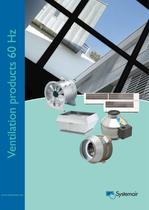
Ventilation products 60 Hz www.systemair.com
Open the catalog to page 1
We work to gain your trust We consider your trust in us as a supplier an important goal. It is always included in our work on all levels and areas whether it's a question of cooperation, quality, deliveries or documentation. This catalogue is of course a part of this work. The idea of catalogue, which contains products for a 60 Hz power supply, is to help us explore some new markets. And it contains the most essential technical details. More detailed information is available in our online catalogue at www.systemair. com. Our product development leads the field – latest technologies in fans, motors...
Open the catalog to page 2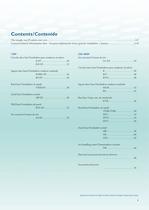
Systemair reserves the right to make technical changes without prior notice 3 110V Circular duct fan/Ventiladores para conductos circulares K-EF . . . . . . . . . . . . . . . . . . . . 20 KD-EF . . . . . . . . . . . . . . . . . . 22 Square duct fans/Ventiladores conducto cuadrado KDRE-EF. . . . . . . . . . . . . . . . 24 RS-EF . . . . . . . . . . . . . . . . . . . 26 Roof fans/Ventiladores de tejado TFER-EF . . . . . . . . . . . . . . . . 28 Axial fans/Ventiladores axiales AW-EF . . . . . . . . . . . . . . . . . . 30 Wall fans/Ventiladores de pared RVF-EF. . . . . . . . . . . . . . . . . . 32...
Open the catalog to page 3
Dal, Eidsvoll – Norway/Noruega In Eidsvoll, Norway we manufacture air handling units for the Norwegian market. The Norwegian warehouse is also located here. En Eidsvoll, Noruega, fabricamos climatizadores para el mercado noruego. El centro de distribución para noruega también se encuentra aquí. Bouctouch – Canada/Canadá In Bouctouche, Canada we primarily produce duct fans and heat exchangers for home ventilation on the North American market. En Bouctouche, Canadá, producimos principalmente ventiladores de conducto e intercambiadores de calor para el mercado norteamericano. The straight way was...
Open the catalog to page 4
Skinnskatteberg – Sweden/ Suecia Main plant The main plant in Skinnskatteberg houses one of the company's two central warehouses and the largest production installation as well as the group's head office. Fans and accessories are produced here as stock items. Centro principal de producción El centro principal de producción de Systemair en Skinnskatteberg cuenta con uno de los dos almacenes centralizados de la empresa y del centrode producción más grande, así como de las oficinas centrales del grupo. Aquí se producen ventiladores y accesorios para stock. Klockargården Systemair's compact air handling...
Open the catalog to page 5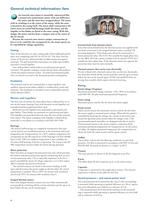
6 An external rotor motor is essentially constructed like a normal non-synchronous motor, with one difference: the stator and the rotor have swapped places. The stator with its windings is at the centre of the motor, while the rotor is located in the casing itself. The motor shaft (connected to the rotor) turns on sealed ball bearings inside the stator, and the impeller or fan blades are fitted to the rotor casing. With this design, the motor and fan form a compact unit at the centre of the air stream. Because the external rotor motor's unique construction allows it to be cooled by the transported...
Open the catalog to page 6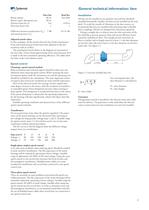
7 Duct fan Roof fan Room volume 80 m3 Free field Room's equiv. absorption area 20 m2 – Distance from fan (r) 3 m 4/10 m Direction factor (Q) 1 1 Difference between sound power (LW) -7 dB 23/-31 dB and sound pressure (Lp) Adjusted sound values In this catalogue, all the sound values for fans (both sound power levels and sound pressure levels) have been adjusted to the ear's sensitivity with an A filter. The sound power levels shown in the diagram are measured at the fan's inlet. Octave band apportioning of the sound pressure level is made at the fan's maximum operating efficiency. The tables show...
Open the catalog to page 7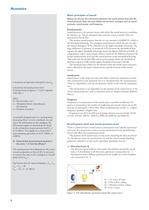
8 Acoustics Calculation of equivalent absorption area Aeqv Calculation of sound pressure level Estimate based on figures 1, 2 and 3 together with table 1. where S = Size of surface (m2) a = Absorption factor, depending on the material n = Number of surfaces A normally damped room in a nursing home, measuring 30 m3, is to be ventilated. According to the information in the catalogue, the directional supply-air terminal device fitted in the ceiling has a sound pressure level (LpA) of 33 dB(A). This applies to a room with a space damping equivalent to 10 m2 Sabine, or 4 dB(A). A) What will the sound...
Open the catalog to page 8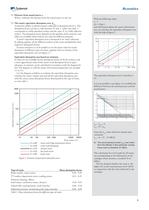
9 Acoustics With the following values r = 1 Q = 2 (fig.1) and information about the room's dimensions, you can calculate the equivalent absorption area with the help of figure 2. The equivalent absorption area is therefore 4 m2. It is now possible to use figure 3 to establish the difference between the sound pressure and the sound power. LpA - LWA = 0 LpA = 0 + LWA Enter the LWA value which has already been calculated. LpA = 0 + 37 = 37 dB(A) A) The sound pressure level (LpA) one metre from the diffuser in this particular nursing home room is therefore 37 dB(A). This calculation has to be made...
Open the catalog to page 9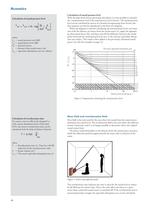
10 Acoustics Calculation of sound pressure level where LpA = sound pressure level (dB) LwA = sound power level (dB) Q = direction factor r = distance from sound source (m) Aeqv = equivalent absorption area (m2 Sabine) Calculation of reverberation time If a room is not too effectively damped (i.e. with a mean absorption factor of less than 0.25), the room's reverberation time can be calculated with the help of Sabine's formula: where T = Reverberation time (s). Time for a 60 dB reduction of the sound pressure value V = Room volume (m3) Aeqv = The room's equivalent absorption area, m2 Calculation...
Open the catalog to page 10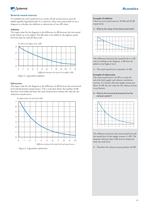
11 Example of addition There are two sound sources, 40 dB and 38 dB respectively. 1) What is the value of the total sound level? The difference between the sound levels is 2 dB and, according to the diagram, 2 dB must be added to the highest level. 1) The total sound level is therefore 42 dB. Example of subtraction The total sound level is 34 dB in a room fitted with both supply and exhaust ventilation systems. It is known that the supply system produces 32 dB, but the value for the exhaust system is not known. 2) What is the sound level produced by the exhaust system? The difference between...
Open the catalog to page 11All Systemair catalogs and technical brochures
 SYSAQUA_BLUE_H
24 Pages
 DKIR1
DKIR13 Pages
 MUB 016 200EC
5 Pages
 KV DUO 150 EC
9 Pages
 K 100 M sileo
10 Pages
 SYSPLIT CASSETTE 09 EVO HP Q
4 Pages
 MRT Catalogue
28 Pages
 Fan Catalogue 2016
584 Pages
 Smoke Extract Fans
12 Pages
 SAVE Brochure
8 Pages
 Fire Safety products
8 Pages
 Hydronic Air Conditioning
268 Pages
 DVu-HP
8 Pages
 AHU Catalogue
174 Pages
 Chillers - Air Conditioning
90 Pages
 Grilles & Diffuser
24 Pages
 Fan Catalogue
464 Pages
 Air Conditioning - VRF
68 Pages
 Fan Catalogue 2012
403 Pages
 Systemair product news
20 Pages
 Air Distribution Products
104 Pages
 Residential Ventilation
64 Pages
 Air Handling Units Catalogue 2012
138 Pages
 Air Handling Units
80 Pages
 Circular Duct Fan prioAir
6 Pages

Archived catalogs
 Systemair Diffusers
6 Pages
 Systemair Air Curtains
6 Pages
 Danvent DV
82 Pages
 Maxi Air Handling Unit
16 Pages
 Air handling units
76 Pages
 Maxi Comfort 800
20 Pages
 EC/DC Residential units
16 Pages
 Fans with EC-motors
12 Pages
 Air curtain
4 Pages
 Systemair Air curtains
12 Pages
 TSF exhaust diffuser
4 Pages
 VR 400/700 DCV/DC Good
12 Pages
 Systemair residential units
4 Pages
 Topvex
60 Pages
 KDRE/KDRD
8 Pages
 TFSK/TFSR roof
6 Pages
 Axial Fans
40 Pages
 Systemair circular duct fans
6 Pages

- Extractor hood
- Range hood with built-in lighting
- Wall-mounted cooker hood
- Industrial heat pump
- Ventilation grill
- Industrial solar shading
- Residential heat pump
- Industrial air conditioner
- Air source heat pump
- Metal fan
- Metal ventilation grill
- Facade solar shading
- Indoor fan
- Rectangular ventilation grill
- Commercial fan
- Ducted range hood
- Mechanical ventilation unit
- Metal solar shading
- Commercial air conditioning cabinet
- Split air conditioning unit