
- Catalogs
- STÖCKL PARKETT
- BHARD INSTALLATION


BHARD INSTALLATION

BHARD INSTALLATION
These guidelines are essential for the installation and maintenance of B:hard multilayer engineered planks by Stöckl GmbH. Adhering to these instructions ensures warranty validity and optimal results.
- Ensure the room is ready for living and inspect the product for damage.
- Acclimatize sealed packages in a room with 20°C and 50% relative humidity for at least two days.
- Check subfloor for evenness, compression resistance, and dryness. Suitable subfloors include screeds, mastic asphalt, and wood-based materials.
- Use a CM-reading to check residual moisture, following ÖNORM standards.
- Ensure the subfloor is clean, dust-free, and permanently dry.
- For heated screeds, maintain a maximum surface temperature of 28°C and provide a heating protocol.
- Flatness must meet ÖNORM DIN 18202 standards, with a maximum deviation of 4 mm over 1 m.
- Floating Installation: Use Stöckl Universol Standard Alu 2.0 or Standard 2.0 underlay mats. Maintain subfloor temperature between 15°C to 28°C and relative humidity of 45% to 65%.
- Full Surface Bonding: No PE-foil or insulating carpet pad required. Follow adhesive manufacturer's guidelines.
- Maintain edge distances of 10-15 mm for wood expansion and contraction.
- For underfloor heating, full-surface bonding is recommended. Ensure uniform temperature control across heating circuits.
- For floor cooling systems, ensure supply temperature does not drop below 18°C and install monitoring devices for temperature and humidity.
- Use an electronic data logger like Fidbox® to monitor room climate.
- Ensure proper ventilation for wooden substrates to prevent mold growth.
Maintain specific climatic conditions during and after installation to prevent joint and crack formation, deformation, or detachment of cover lamellas. For heated screeds, ensure uniform temperature control and surface temperature should not exceed 28°C.
For varnished surfaces, remove dirt with a mop or vacuum and clean with lukewarm water and parquet cleaner. Avoid sharp or corrosive cleaners and excessive water. For oiled surfaces, dry clean with a vacuum or damp mop with wooden floor soap. Avoid microfiber cloths and excessive water to prevent swelling.
Varnished surfaces require periodic care with parquet care products. Oiled surfaces should be initially oiled after installation and maintained based on usage. Repairs can be made by replacing damaged elements.
Use PALLMANN products for cleaning and refinishing, following specific instructions. Ensure proper drying times and tool cleaning.
Maintain a relative humidity of 45-65% and a room temperature of 18-22°C for optimal wood floor conditions. Exceeding these can lead to wood deformation and health issues.
Use movement joint profiles in large or complex areas to accommodate expansion. Avoid fixing floating constructions with heavy objects unless expansion is allowed in other directions.
Use suitable castors on swivel chairs and felt glides on furniture to prevent scratches. Install dirt-stop mats in entrances and consider using a humidifier during heating periods. Be aware of natural wood changes due to sunlight exposure.
Catalog excerpts

Installation instructions www.stoeckl.com It’s wood. It’s hard. It’s nature
Open the catalog to page 1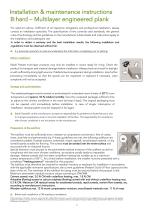
Installation & maintenance instructions B:hard – Multilayer engineered plank For optimum advice, fulfillment of all inspection obligations and professional installation, please contact an installation specialist. The specifications of the currently valid standards, the general rules of technology and the guidelines on the manufacturer's data sheets and instructions apply to the installation and subsequent use. In order to obtain a warranty and the best installation results, the following installation and regulations must be observed without fail. It is extremely important to read and understand...
Open the catalog to page 2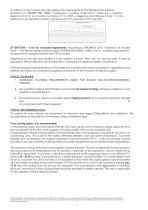
In addition to the moisture test, also observe the requirements for the flatness of the subfloor. According to ÖNORM DIN 18202 "Tolerances in building construction", these are a maximum deviation of 4 mm at an inside micrometer of 1 m. With a measuring point distance of e.g. 1 m, the subfloor is to be allowed a maximum allowance of 4 mm according to the standard. Measuring point distance Inside micrometer ATTENTION! – 3 mm for increased requirements. According to ÖNORM B 2218 "Installation of wooden floors" – the flatness tolerances according to ÖNORM DIN 18202 – table 3, line 4 "increased requirements"...
Open the catalog to page 3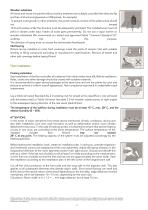
Wooden substrates All wood and wood-mix panels without surface treatment are suitable, provided that they are flat and free of structures (plywood or OSB panels, for example). To prevent mold growth or other problems, the wood moisture content of the substructure should not exceed 12 % and cavities under the structure must be adequately ventilated. The installed level must not yield or vibrate under load. Fasten all loose parts permanently. Do not use a vapor barrier on wooden substrates! We recommend our tested and approved Stöckl "Universol Standard 2.0" underlay mat for this purpose. The direction...
Open the catalog to page 4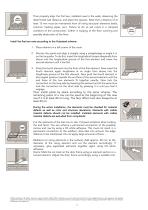
Then properly align the first two, installed rows to the walls, observing the determined wall distance, and place the spacers. Note that a distance of at least 15 mm must be maintained from all rising structural elements (walls, columns, heating pipes, etc.). Failure to do so will result in a clamped condition of the construction, further in bulging of the floor covering and possibly destruction of the floor. Install the first two rows according to the illustrated scheme: 1. Place element in a left corner of the room. 2. Shorten the panel and align it straight using a straightedge or angle it...
Open the catalog to page 5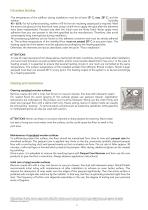
Full surface bonding The temperature of the subfloor during installation must be at least 15° C, max. 28° C, and the relative humidity 45 – 65 %. For full surface bonding, neither a PE-foil nor an insulating carpet pad is required. Mark the area to be glued on the first three rows using a chalk line to apply the glue after the elements have been reassembled. Proceed only after the initial rows are firmly fixed. Never apply more adhesive than you can process in the time specified by the manufacturer. Therefore, also avoid unnecessarily long interruptions during installation. All processing guidelines...
Open the catalog to page 6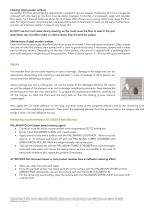
Cleaning oiled wooden surfaces If possible, the floor should be dry cleaned with a powerful vacuum cleaner. If adhering dirt can no longer be removed with dry cleaning, the floor must be damp mopped. To do this, mix lukewarm water with wooden floor soap. For 5 liters of water use about 50 ml of soap. With this lye and a wrung cotton mop, wipe the floor well. For larger areas or very heavy dirt, use a second bucket of clear water to wash out the wipe. Furthermore, you can use intensive cleaner in case of very heavy dirt Do NOT use too much water during cleaning, as this could cause the floor to...
Open the catalog to page 7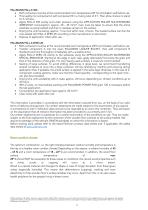
PALLMANN PALL-X 350 • Both containers must be at the recommended room temperature (20 °C) and shaken well before use. • Thoroughly mix component A with component B in a mixing ratio of 3:1. Then allow mixture to stand for 5 minutes. • Apply PALL-X 350 evenly and under pressure using the APPLICATION ROLLER SOLVENTBASED 4MM/25CM. Consumption: approx. 20 – 35 ml/m². Care must be taken to ensure that the entire substrate is evenly wetted and that no residues remain on the surface. • Drying time until recoating: approx. 1 hour but within max. 4 hours. The treated surface can then be over-sealed with...
Open the catalog to page 8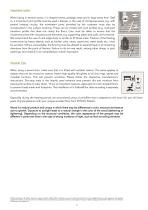
Important notes When laying in several rooms, in L-shaped rooms, passage areas and in large areas from 10x8 m, a movement joint profile must be used. Likewise, in the case of contiguous areas, e.g. with several heating circuits, the movement joints provided by the customer must also be incorporated in the surface covering. These can be closed with joint profiles (e.g. multi-part transition profile that does not clamp the floor). Care must be taken to ensure that the movement joints with rising structural elements, e.g. supporting pillars and walls, are functional. We recommend the use of cork...
Open the catalog to page 9
With the publication of this edition, all previous versions lose their validity! With this information, we want to advise you to the best of our knowledge based on our tests, experience and standards applied. The conditions on site are not known to STÖCKL and must be checked by a specialist and the structure adapted if necessary. Valid for all pages. Stöckl GmbH I Heide 25 | 3331 Kematen an der Ybbs I www.stoeckl.com
Open the catalog to page 10All STÖCKL PARKETT catalogs and technical brochures
 EPICO 190 trend
1 Page
 2-PARQUET INSTALLATION
9 Pages
 BHARD MODERN
14 Pages
 ECODUR
9 Pages
 B:HARD
6 Pages
- Industrial wood floor
- Glued parquet flooring
- Engineered parquet flooring
- Oak parquet floor
- Strip parquet floor
- Oiled parquet flooring
- Home parquet flooring
- Living room parquet flooring
- Commercial parquet flooring
- PEFC certified parquet floor
- Matte wood floor
- Varnished parquet floor
- Chevron parquet flooring
- Sustainable parquet flooring
- Wide plank parquet flooring
- Boat deck parquet floor
- Kitchen parquet floor
- American walnut parquet floor
- Ash parquet floor
- HDF parquet floor