
- Catalogs
- Steuler-Fliesen
- steuler | design catalogue 2024

- Products
- Catalogs
- News & Trends
- Exhibitions
steuler | design catalogue 2024
steuler | design catalogue 2024
- Tile Formats and Series: The catalog lists various tile formats ranging from small sizes like 7.2 × 7.2 cm to large formats like 120 × 260 cm. Each tile series is associated with specific formats and includes names like Gold Tiles, Midland, Brush, and more.
- Specifications: Detailed specifications for each tile series are provided, including dimensions, weight, and packaging details. The catalog also highlights special features such as rectification and slip resistance.
- Sustainability Commitment: Steuler emphasizes its dedication to sustainability by using modern exhaust-air technology, wastewater-free production processes, and collaboration with eco-certified suppliers. The company is a member of the IBU (Institute of Construction and Environment e.V.).
- Design Philosophy: Steuler's design approach focuses on creating fresh and modern tiles with attention to detail and innovation in color, format, and design. The company aims to produce exclusive tiles that are both contemporary and of high quality.
- Slip Resistance: The catalog includes information on the slip resistance of plain tiles, categorized by the level of color interplay from single-colored to strong color interplay.
- Packaging Information: Detailed packaging data is provided, including the number of pieces per carton and pallet, and the weight per square meter.
The document provides detailed specifications for various wall tiles, including dimensions, weight, and packaging details. The tiles are available in different sizes such as 30x60 cm, 35x100 cm, and 40x120 cm, with thicknesses of 6 mm and 8 mm. Each tile type is associated with specific product codes and finishes, such as glossy, matte, and decorated surfaces.
Product Types and Finishes:
The tiles are categorized into different series like PURE WHITE, WONDERWALL, and WESTERLAND, each offering unique finishes and designs. For instance, the PURE WHITE series includes options like white glossy and white matte, with some tiles featuring undulated surfaces for decorative purposes.
Packaging and Weight Details:
The document outlines the packaging details, including the number of pieces per carton and pallet, as well as the weight per square meter and per pallet. For example, the 30x60 cm tiles have a weight of 1.44 kg/m² and are packaged with 8 pieces per carton.
Special Formats and Recommendations:
Some tiles are noted as special formats, with specific packaging instructions highlighted. The document advises consulting separate price lists for detailed pricing information.
Decorative Options:
Several tiles are available with decorative motifs, such as the WONDERWALL series, which includes decor sets consisting of multiple pieces. These decorative options are designed to enhance the aesthetic appeal of the tiles.
Key Considerations:
The document emphasizes the importance of noting packaging information for special sizes and recommends referring to separate price lists for accurate pricing details.
The document provides detailed specifications for various porcelain gres tiles under the HOLMEN, HOMEBASE, and HYGGE collections. These tiles are solid-coloured, rectified, and available in multiple formats and colors such as greige, taupe, cement, chalk, sand, granite, anthracite, pebble, and clay.
Tile Formats and Sizes:
- HOLMEN#6MM: Available in sizes 120x260/06 cm, 120x120/06 cm, 100x100/06 cm, 60x120/06 cm, and 60x60/06 cm.
- HOMEBASE: Sizes include 60x120 cm, 60x60 cm, and 4.8/9.8/14.8x60 cm.
- HYGGE#6MM: Available in 120x260/06 cm, 120x120/06 cm, 60x120/06 cm, and 60x60/06 cm.
Packaging and Weight Information:
Each tile format is accompanied by detailed packaging information, including the number of pieces per square meter, weight per square meter, and the number of pieces per carton and pallet. Special attention is given to the packaging of special sizes.
Pricing Structure:
The document lists the price per piece or square meter for each tile format, along with the weight and packaging details. Prices are provided in multiple currencies.
Special Notes:
- Some formats are marked as special sizes, requiring attention to packaging information.
- Commissioned production tiles have specific delivery times.
Key Considerations:
- The document emphasizes the importance of noting packaging information for special sizes.
- Delivery times should be considered for commissioned production tiles.
The document provides detailed specifications for various tile formats, including dimensions, weight, and packaging details. The tiles are made of porcelain gres, solid-coloured, and rectified, ensuring uniform size and minimal visible joints.
Procedures:
Instructions for handling and transporting large format tiles are provided, emphasizing the use of appropriate lifting aids and fork extensions. Packaging fees are specified for transport crates and racks.
Standards and Norms:
The tiles comply with EN 14411 standards for quality and are suitable for both indoor and outdoor use. Frost resistance is ensured through minimal water absorption, tested according to EN 10545-12 and EN 10545-3.
Recommendations:
Recommendations for tile installation include considerations for slip resistance, categorized under DIN 51097 and DIN 51130 standards. The document outlines different slip resistance groups (R9 to R13) and their suitable applications.
Key Data from Tables:
The tables provide information on tile sizes, price per square meter, weight, and packaging details. Special attention is given to the packaging information for large formats, including specific fees and maximum pieces per crate or rack.
Quality and Testing:
The document details the quality assurance processes, including calibration, rectification, and testing for abrasion resistance (PEI ratings) and deep abrasion resistance according to EN ISO 10545-6. The tiles are tested for bending strength and chemical resistance, ensuring durability and suitability for various environments.
- Aqueous Test Solutions: Household chemicals include ammonium chloride solution (100g/l) and swimming pool salts like sodium hypochloride solution (20g/l).
- Classes: Unglazed and glazed tiles are classified as A/B/C, with A being the highest resistance.
- Acids and Alkalis: Low concentration includes hydrochloric acid (3%), citric acid (100g/l), and potassium hydroxide (30g/l). High concentration includes hydrochloric acid (18%), lactic acid (5%), and potassium hydroxide (100g/l).
- Classes: Unglazed and glazed tiles are classified as LA/LB/LC or HA/HB/HC, with A being the highest resistance.
- Stain Agents: Includes trace-forming, green and red oil-based stains, chemical stains, iodine in alcohol, film-forming stains, and olive oil.
- Cleaning: Uses hot water (+55°C), mild and strong cleaning agents, and solvents like hydrochloric acid (3%), potassium hydroxide (200g/l), and acetone.
- Classes: Rated from 5 to 1, with 5 being the highest stain resistance.
Glazed surfaces are exposed to acetic acid solution to determine the release of lead and cadmium.
- Initial/Basic Cleaning: Conducted after installation to remove residues from installation work. Proper cleaning prevents future issues.
- Ongoing Maintenance: Use sealants to prevent stains on unglazed tiles. Avoid film-forming cleaning agents.
For large-format porcelain tiles, use C2 S1 or C2 S2 adhesive depending on the substrate and product.
Conducted by the German Social Accident Insurance using DIN 51131. Not for selecting floor coverings but for assessing cleaning success or usage changes.
No regulated requirements for slip resistance in private areas, but slip-resistant tiles are recommended based on personal safety needs.
Regulations require floors to be even, slip-resistant, and easy to clean. Detailed requirements are in the "Technical Rule for Workplaces" ASR A 1.5/1,2 "Floors".
Features an irregular edge over a rectified edge, combining rustic and rectified edge benefits.
Specifications for dimensions, surface quality, and physical and chemical properties must match the table provided.
- Water Absorption: Group BIII > 10%, Group BIA ≤ 0.5%.
- Breaking Load: Minimum requirements based on thickness.
- Bending Strength: Minimum requirements based on thickness.
- Wear Resistance: Volume loss for unglazed tiles and wear class for glazed tiles.
- Stain Resistance: Minimum class 3 for glazed tiles.
- Chemical Resistance: Procedures for low and high concentration acids and alkalis.
- Household Chemicals and Pool Additives: Minimum class B.
- Offers: Non-binding unless stated as "firm" or "binding".
- Prices: Based on the current price list, subject to adjustments.
- Sorting: Tiles sorted according to DIN EN 14411 standards.
- Delivery Times: Binding upon written confirmation.
- Payment Terms: Invoices payable within 30 days, with discounts for early payment.
- Retention of Title: Ownership retained until full payment is received.
Calibration and Rectification: Floor tiles undergo precise calibration to ensure uniform length and width. Post-rectification, tiles are re-measured, and those not meeting dimensional tolerances are discarded. This process allows for minimal visible joints and consistent calibration across delivered tiles.
Surface Quality: Grade 1 porcelain tiles meet EN 14411 standards, suitable for indoor and outdoor use, and resistant to abrasion. Grade 2 tiles do not meet these standards.
Water Absorption/Frost Resistance: Tiles intended for outdoor use must be frost-resistant with low water absorption, tested according to EN 10545-12 and EN 10545-3.
Slip Resistance: Surface properties significantly affect slip resistance, evaluated by DIN 51097 and DIN 51130 standards. Tiles are classified from R9 to R13 based on inclination angles, with specific applications for each class.
Abrasion Resistance: Glazed tiles are classified from PEI 1 to 5 based on wear resistance, tested under EN 10545-7. Unglazed tiles undergo deep abrasion resistance testing per EN ISO 10545-6.
Breaking Strength: Tiles have a thickness of 6 to 11 mm, suitable for residential and administrative use, withstanding higher loads.
Chemical Resistance: Tiles resist chemicals, acids, bases, and stains, tested under EN ISO 10545-13 and EN ISO 10545-14.
Cleaning: Differentiates between initial deep cleaning post-installation and regular cleaning. Recommendations include using specific cleaning agents and avoiding impregnating or nourishing agents.
Installation: For large-format porcelain tiles, use C2 S1 or C2 S2 adhesive depending on the substrate.
Slip Friction: Evaluated by DIN 51131, not a basis for floor selection but useful for assessing cleaning measures.
Private Use Areas: No regulations for private use, but anti-slip tiles are recommended.
Safety on Slippery Floors: Legal requirements mandate floors to be flat, non-slip, and easy to clean, detailed in ASR A 1.5/1.2 standards.
Antique Border: Features an irregular edge on a rectified edge, combining rustic and rectified styles.
Physical Characteristics: Includes water absorption, breaking load, bending strength, abrasion resistance, thermal expansion, thermal shock resistance, and frost resistance, with specific standards and methods outlined.
Catalog excerpts
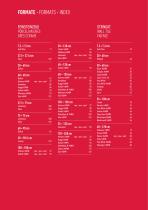
STEINGUT WALL TILE FAIENCE FEINSTEINZEUG PORCELAIN GRES GRES CERAME 7,2 * 7,2 cm 20 * 120 cm Chalet #6MM Feldberg #6MM Sherwood Talo #6MM Gold Tiles 60 * 60 cm Belfort Holmen #6MM Homebase Hygge #6MM Kalmit #6MM Milestone #6MM Talo #6MM 63 neu ■ new ■ neuf 72 80 84 95 111 123 37,5 * 75 cm Limestone Slate 75 * 75 cm Limestone Slate 60 * 120 cm Holmen #6MM neu ■ new ■ neuf 73 Homebase 80 40 * 120 cm Arabesco #6MM Frame #6MM Maison #6MM neu ■ new ■ neuf Paint #6MM Pure White #6MM Stavanger #6MM
Open the catalog to page 2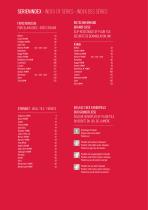
FEINSTEINZEUG PORCELAIN GRES ■ GRES CERAME RUTSCHHEMMUNG GRUNDFLIESE SLIP-RESISTANCE OF PLAIN TILE SECURITE DE DEAMBULATION UNI Holmen #6MM neu ■ new ■ neuf 72 Homebase 80 STEINGUT ■ WALL TILE ■ FAIENCE VIELFALT DES FARBSPIELS DER GRUNDFLIESE COLOUR INTERPLAY OF PLAIN TILE DIVERSITE DU JEU DE LUMIERE Einfarbiges Produkt Single-coloured product Produit uni Produkt mit leichtem Farbspiel Product with slight colour interplay Produit au leger jeu de lumiere Produkt mit ausgepragtem Farbspiel Product with distinct colour interplay Produit au jeu de lumiere marque Produkt mit starkem Farbspiel Product...
Open the catalog to page 3
INHALT CONTENT SOMMAIRE PROLOG · PROLOGUE 002 KATALOG · CATALOG · CATALOGUE 007 INFORMATIONEN · INFORMATION · INFORMATIONS 131 2024 Verpackungsdaten: Rechte Umschlagsausklappseite Packaging units: Right-hand cover fold-out page · Données d’emballage: Page de couverture rabattue à
Open the catalog to page 5
FRISCH UND MODERN FRESH AND MODERN FRAICHE ET MODERNE
Open the catalog to page 6
Bei Steuler denken wir in Räumen – und die denken wir frisch und modern. Unsere maximale Leidenschaft für veredelte Keramik und extravagantes Design lässt uns außergewöhnliche Fliesen erschaffen, mit Liebe fürs Detail und dem Blick für die Wirkung im großen Kontext. Dabei kennen wir keine Grenzen bei Kreationen und Innovationen, sondern gehen gerne neue Wege hinsichtlich Farben, Formaten und Gestaltung. So entstehen unsere exklusiven Fliesen, im Design stets auf der Höhe der Zeit und qualitativ auf höchstem Niveau. Dieser Anspruch treibt uns immer wieder aufs Neue an – und wir haben noch viele...
Open the catalog to page 7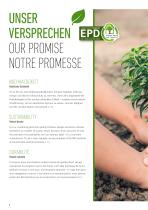
UNSER VERSPRECHEN OUR PROMISE NOTRE PROMESSE NACHHALTIGKEIT Natürliche Schönheit Es ist für uns eine Selbstverständlichkeit, höchste Qualität, zeitloses Design und aktiven Klimaschutz zu vereinen. Denn der Leitgedanke der Nachhaltigkeit ist für uns kein abstraktes Etikett – sondern eine konkrete Verpflichtung. Um ein deutliches Zeichen zu setzen, sind wir Mitglied bei IBU (Institut Bauen und Umwelt e. V.). SUSTAINABILITY Natural beauty For us, combining premium quality timeless design and active climate protection is a matter of course. That’s because, from our point of view, the principle of...
Open the catalog to page 8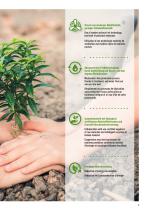
Einsatz von moderner Ablufttechnik, geringer Schadstoffausstoß Use of modern exhaust-air technology, low level of pollutant emissions Utilisation d’une technologie moderne de ventilation avec faibles rejets de matières nocives Abwasserfreier Produktionsablauf durch Aufbereitung und Wasser aus dem eigenen Werksbrunnen Wastewater-free production process thanks to treatment, and water from our own on-site well Déroulement du processus de fabrication sans production d’eaux usées grâce au traitement intégral et à l’eau tirée de notre propre puits Zusammenarbeit mit ökologisch zertifizierten Rohstofflieferanten...
Open the catalog to page 9
Verpackungsdaten: Rechte Umschlagsausklappseite Packaging units: Right-hand cover fold-out page · Données d’emballage: Page de couverture rabattue à droi
Open the catalog to page 10
STEINGUT WALL TILE FAÏENCE
Open the catalog to page 11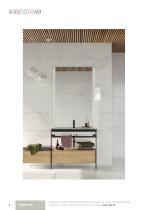
* Sonderformat - Beachten Sie die Verpackungsinformationen · Special size - notice the packaging information Format spécial - veuillez noter les informations relatives à l’emballage: Seite · Page
Open the catalog to page 12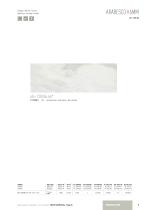
Steingut · Wall tile · Faïence Rektifiziert · Rectified · Rectifié 40 × 120 / 06 cm* Y12320001 014 weiß glänzend · white glossy · blanc brillant FORMAT FORMAT FORMAT 40 × 120 / 06 cm (1198 × 398 × 6 mm) PREIS PRO PRICE PER PRIX PAR M2 STÜCK / M² PIECES / M² PIÈCES / M² KG / M² KG / M² KG / M² M² / KARTON M² / CARTON M² / CARTON STK / KARTON PCS / CARTON PCS / CARTON KG / KARTON KG / CARTON KG / CARTON Dazu passend · Suitable to · Sol coordonné: CHALET #6MM Seite · Page 66 M² / PALETTE STK / PALETTE KG / PALETTE M²
Open the catalog to page 13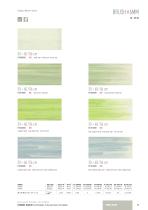
Steingut ■ Wall tile ■ Faience Y31000001 028 weiR matt ■ white mat ■ blanc mat Y31010001 005 jade matt ■ jade mat Y31005001 005 Run jade matt ■ jade mat maigrun matt ■ may green mat ■ vert mai mat Run maigrun matt ■ may green mat ■ vert mai mat Y31030001 005 nordisch blau matt ■ nordic blue mat ■ bleu nordique mat Run nordisch blau matt ■ nordic blue mat ■ bleu nordique mat Dazu passend • Suitable to • Sol coordonne: MARBURG, NAGOLD Extra Preisblatt • Extra price sheet • Extra feuille
Open the catalog to page 15
35 * 100 cm Y15040001 021 beige matt ■ beige mat 30 * 30 cmY30118001 183 dark-sand • dark-sable Mosaik • Mosaic • Mosaique geschnitten aus: cut from tile: decoupe du carreau: CAMPUS & PATCHWOOD 35 * 1 00 cm Y15041001 021 sand matt ■ sand mat ■ sable mat 35 * 1 00 cm Y15043001 174 Flax kupfer matt ■ copper mat ■ cuivre mat Dekor•Decor•Decor FORMAT FORMAT FORMAT Dazu passend • Suitable to • Sol coordonne: HOMEBASE Seite • Page 80, KALMIT #6MM Seite • Page 94
Open the catalog to page 16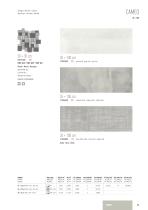
Steingut · Wall tile · Faïence Rektifiziert · Rectified · Rectifié Y30123001 183 light-grau · light-grey · light-gris Y15045001 021 grau matt · grey mat · gris mat Mosaik · Mosaic · Mosaïque geschnitten aus: cut from tile: découpe du carreau: CAMPUS & PATCHWOOD 35 × 100 cm Y15046001 021 zement matt · cement mat · ciment mat 35 × 100 cm Y15048001 174 Flax silber matt · silver mat· argent mat Dekor · Decor · Décor FORMAT FORMAT FORMAT PREIS PRO PRICE PER PRIX PAR STÜCK / M² PIECES / M² PIÈCES / M² KG / M² KG / M² KG / M² M² / KARTON M² / CARTON M² / CARTON STK / KARTON PCS / CARTON PCS / CARTON...
Open the catalog to page 17All Steuler-Fliesen catalogs and technical brochures
 STEULER DESIGN NEWS 2025
68 Pages
 STEULER DESIGN CATALOGUE 2025
149 Pages
Archived catalogs
 talo
talo9 Pages
 season
5 Pages
 milestone
4 Pages
 hygge
hygge12 Pages
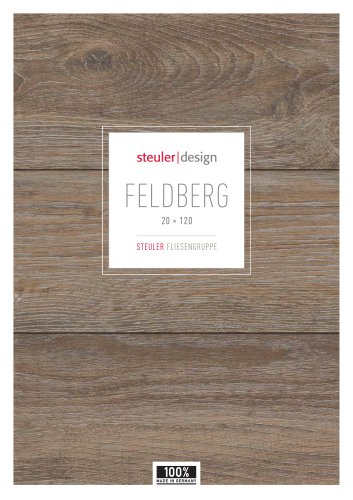 feldberg
8 Pages
 chalet
4 Pages
 Belfort
6 Pages
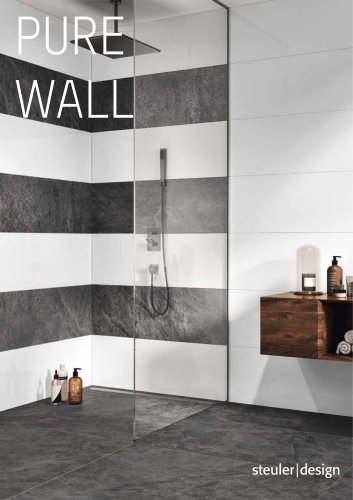 PURE WALL
9 Pages
 CATALOGUE 2020
197 Pages
 INNOVATIONS 2020
32 Pages
 LOOKBOOK 2019
229 Pages
 IBU - SUBSTAINABLE CONSTRUCTION
24 Pages
 Stone collection
44 Pages
 Schwarzwald
16 Pages
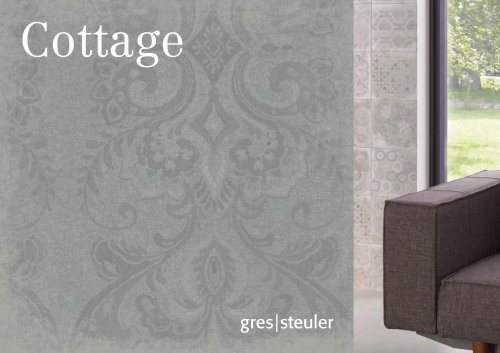 Cottage
16 Pages
 caprano
8 Pages
 beton
beton16 Pages
 Origami
4 Pages
 Teardrop
4 Pages
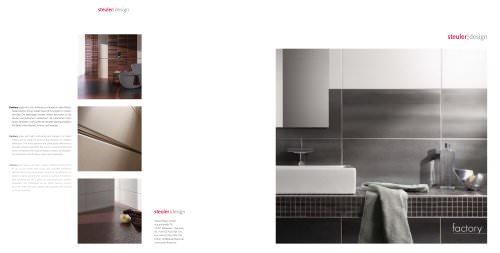 Factory
2 Pages
 Tokame
4 Pages
 Stream
2 Pages
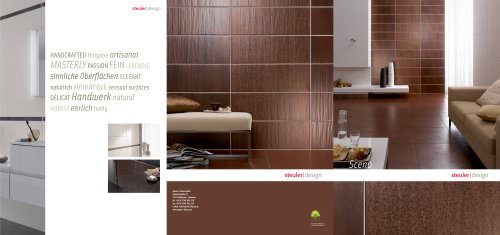 Sceno
Sceno2 Pages
 Organic Sense
4 Pages
 Livin'
8 Pages
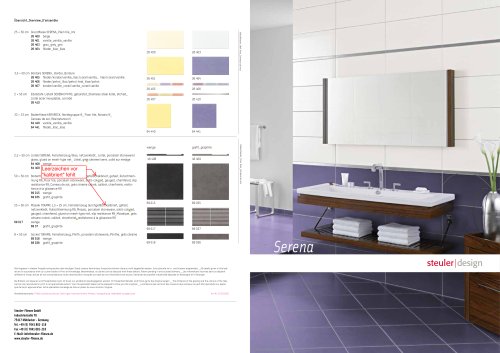 Serena
2 Pages
 Oceans Five
4 Pages
 Moods
Moods8 Pages
 Lounge
12 Pages
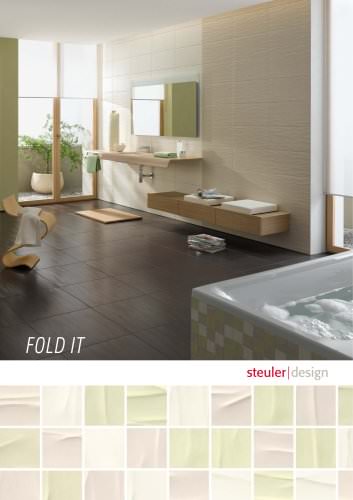 Fold It
8 Pages
 Wild Thing Massai
4 Pages
 Cabado
6 Pages
 Miez!
Miez!2 Pages
 Louis & Ella
2 Pages
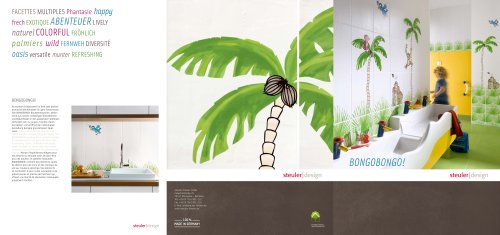 BongoBongo!
2 Pages
 Twister
2 Pages
 Tide
Tide4 Pages
 Moooh!
2 Pages
 Icons
Icons20 Pages
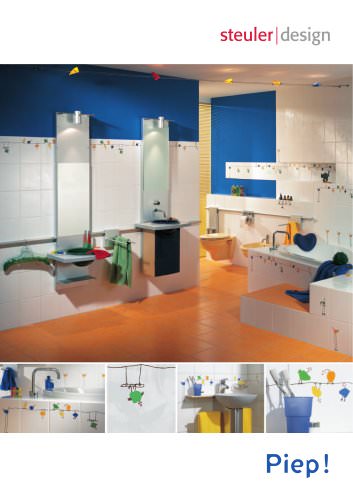 Piep!
Piep!2 Pages
 Little Artists
4 Pages
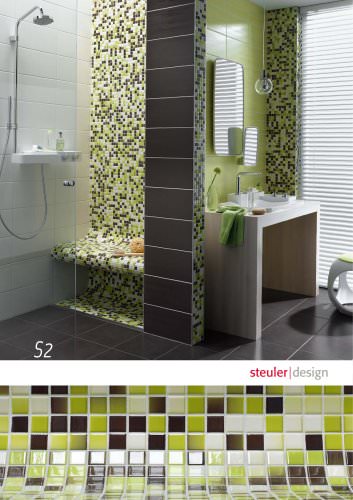 S2
S26 Pages
 Quaaak!
4 Pages