

DEXXO PRO 800 - 1000 RTS

DEXXO PRO 800 - 1000 RTS
This document serves as the installation manual for the Dexxo Pro 800 - 1000 RTS, a motorized garage door system. It adheres to safety standards EN 60335-2.95, EN 13241-1, and EN 12453, ensuring safe operation when properly installed. The product is intended for use in the EU and Switzerland.
Key safety instructions include verifying the door's mechanical condition before installation, placing control systems at least 1.5 meters above the floor, and ensuring the motor reverses upon encountering obstacles. The manual release cord should be accessible, and warning labels must be visible.
The system comprises components such as a motor head, motor cover, built-in light cover, and various brackets and screws. It is compatible with different door types, including projecting, sectional, sideways opening, swinging, and semi/non-projecting doors.
Ensure the garage door operates smoothly and is balanced. Reinforce the garage structure if necessary and avoid water exposure to the system. Install external release mechanisms and safety kits if required.
Installation involves mounting the lintel and door brackets, assembling the rail, and fitting the system onto the ceiling. Consider the installation height and door dimensions. Ensure the chain or belt is correctly tensioned and connect the mains power supply safely.
Programming includes setting end limits and self-learning for door operation. Remote controls can be memorized for total opening mode, with up to 32 control channels available.
Test the remote controls and obstacle detection function. The built-in lighting operates with the motor drive unit and has an adjustable time delay.
Various peripherals such as lights, keypads, and photoelectric cells can be connected. Ensure the power supply is cut before working on peripherals.
The setup includes a general diagram and parameter meanings. Remote controls and settings can be cleared if necessary.
Includes codes for operating, programming, and error/failure, along with accessing stored data.
Details on dimensions and other technical aspects are provided.
The document outlines the technical specifications for the Dexxo Pro 800 RTS and Dexxo Pro 1000 RTS garage door systems. Key specifications include a mains supply of 230 V - 50 Hz, a maximum power consumption of 600 W during operation, and a peak traction force of 800 N for the 800 model and 1000 N for the 1000 model. The systems support up to 20 cycles per day with a standard rail and 50 cycles with a high-performance rail. The maximum speed is 18 cm/s, and the operating temperature range is -20°C to +60°C.
The document provides detailed programming instructions for various parameters such as operating modes, safety mechanisms, obstacle detection sensitivity, and speed settings. It includes steps for setting up the system, memorizing remote controls, and adjusting door positions. The programming interface consists of 7 buttons and a 2-character LCD display.
Safety features include photoelectric cells, sensor bars, and pedestrian door safety kits. The system can be programmed for automatic closure with safety tests conducted at each cycle. Maintenance indicators alert users when service is required after a set number of cycles. The document also provides troubleshooting codes for diagnosing issues.
The system supports various connections, including safety inputs, pedestrian door inputs, and remote lighting outputs. It is compatible with RTS aerials and backup battery packs, providing autonomy for up to 24 hours.
Users are advised to configure safety parameters correctly, conduct regular maintenance checks, and ensure proper alignment of photoelectric cells. The document emphasizes the importance of selecting appropriate settings for safety mechanisms and obstacle detection to ensure safe operation.
Adjustable partial opening position with preset command, progressive start-up feature, and programmable opening and closing speeds ranging from 3.5 cm/s to 18 cm/s with 10 possible values. Closure approach speed can be programmed with options for no slowdown, short slowdown zone (30 cm), or long slowdown zone (50 cm).
Data recording and access include cycle counter, cycle counter with obstacle detection, number of radio channels stored, and history of the last ten defects recorded.
Minimum dimensions: 171 min, 63.6, 140, 12, 5. Available travel: 2,555 / 3,155. Overall length: 3,295 / 3,895 and 3,153 / 3,753. Fixation: 2,982 / 3,582. Rail: 2,900 / 3,500.
The document lists Somfy subsidiaries in various countries including Argentina, Australia, Austria, Belgium, Brazil, Canada, China, Cyprus, Czech Republic, Denmark, Finland, France, Germany, Greece, Hong Kong, Hungary, India, Indonesia, Iran, Israel, Italy, Japan, Jordan, Saudi Arabia, Kuwait, Lebanon, Malaysia, Mexico, Morocco, Netherlands, Norway, Poland, Portugal, Romania, Russia, Singapore, Slovak Republic, South Korea, Spain, Sweden, Switzerland, Syria, Taiwan, Thailand, Turkey, United Arab Emirates, United Kingdom, and United States.
Patents and design patents are pending in some countries, including the US. Somfy SAS is registered with a capital of 20,000,000 Euros, RCS Annecy 303.970.230 as of May 2013.
Catalog excerpts
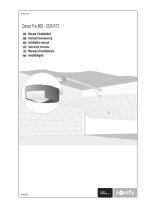
Manuel d’installation Gebrauchsanweisung Installation manual Instrukcja montażu Manuale d’installazione Installatiegids
Open the catalog to page 1
CONTENTS GENERAL PRESENTATION 2 SAFETY INSTRUCTIONS 2 PRODUCT DESCRIPTION 2 Product components Area of application POINTS TO CHECK PRIOR TO INSTALLATION 3 Preliminary checks Safety instructions PROGRAMMING 5 Programming button description End limit setting and self-learning Memorising the remote controls for operation in «Total opening» mode OPERATING TEST 5 Using the remote controls Obstacle detection function Built in lighting operation CONNECTING PERIPHERALS 6 Description of the various peripherals Electrical connectio
Open the catalog to page 2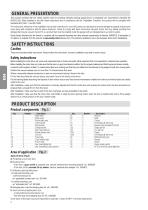
GENERAL PRESENTATION This product complies with the “safety, specific rules for powering vertically opening garage doors in residential use” requirements (standard EN 60335-2.95). When installed in line with these instructions and in compliance with the “Installation Checklist”, the product will be compliant with standards EN 13241-1 and EN 12453. The instructions referred to in the installation manual and instructions for use of this product are designed to prevent damage to property and personal injury along with compliance with the above standards. Failure to comply with these instructions...
Open the catalog to page 3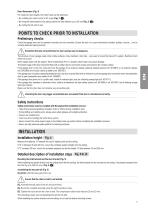
Door dimensions (Fig. 3) For maximum door heights, the motor travel can be optimised: • By installing the motor head at a 90° angle (Fig. 7- • By fixing the lintel bracket to the ceiling, behind the lintel itself by up to 200 mm (Fig. 5- • By cutting the link arm to size. POINTS TO CHECK PRIOR TO INSTALLATION Preliminary checks Check the garage door can be operated manually and runs smoothly. Ensure the door is in good mechanical condition (pulleys, mounts…) and is correctly balanced (spring tension). The structure of your garage (walls, lintel, inside surfaces, cross members, door rails…) are...
Open the catalog to page 4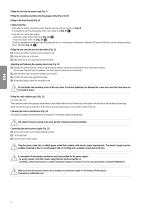
Fitting the rail onto the motor head (Fig. 7) Fitting the complete assembly onto the garage ceiling (Fig. 8 to 10) Fitting to the lintel bracket (Fig. 8) Ceiling mounting F • lush with the ceiling: mount the system directly onto the ceiling using the rail (Fig. 9). It is possible to add mounting points at the motor head level (Fig. 9- ). • ung from the ceiling: two options: H - mount the system at the motor head (Fig. 10- a ). - mount the system at the rail (Fig. 10- b ). To add an adjustable intermediate mounting along the rail, or a mounting at a dimension h between 250 mm and 550 mm, use the...
Open the catalog to page 5
Programming button description . Press for 2 s: memorise remote controls . Press for 7 s: delete remote controls . Press for 0.5 s: call up and exit the setup menu . Press for 2 s: start learning . Press for 7 s: clear learning and settings . Stop learning . Selecting a setting . Modifying a setting value . Using the forced mode . Start the learning cycle . Confirm setting selection . Confirm setting value End limit setting and self-learning Fig. 16 For swinging doors, change the P9 setting before starting self-learning. [1]. ress the “SET” button until the light comes on (2 s). P The display...
Open the catalog to page 6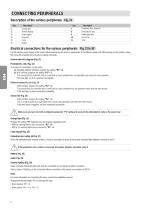
CONNECTING PERIPHERALS Description of the various peripherals Fig. 21 Key 1 2 3 4 5 6 Description Orange light Remote lighting Code keypad Keyswitch Aerial Battery Description Pedestrian door safety kit Photoelectric cells Reflex type cells Sensor bar Siren Electrical connections for the various peripherals Fig. 21 to 30 Cut the electric power supply to the motor before performing any work on peripherals. If the display remains off after working on the system, check the wiring (for possible short circuits or polarity reversals). General electrical diagram (Fig. 21) Photoelectric cells (Fig. 22)...
Open the catalog to page 7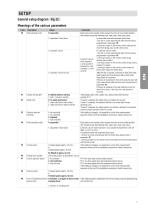
SETUP General setup diagram Fig. 31 Code P0 Description Total operating mode Values 0: sequential 1: sequential + timed close 3: automatic closure by cells Orange warning light Safety input Obstacle detection sensitivity Partial operating mode 0: without advance warning 1: with 2 s advance warning 0: no safety mechanism 1: safety mechanism with self test 2: safety mechanism without self test 0: low sensitivity 1: low sensitivity 2: standard 3: high sensitivity 0: sequential 1: sequential + timed close Closing speed Comments Each press on the remote control causes the motor to move (initial position:...
Open the catalog to page 8
Description Maintenance required indicator Detection of forced entry Safety action prior to 0: no effect opening (safety ADMAP) 1: movement rejected Safety action during closure 1: stop 2: stop + partial re-opening 3: fully reopen Obstacle detection action 2: stop + partial re-opening during closure 3: fully reopen Values 0: no indication 1: 100 cycles to 99: 9900 cycles (number of cycles = value x 100 cycles) 0: no detection of forced entry 1: obvious forced entry detected 2: less obvious forced entry detected Total operating mode automatic timed close Lighting time delay Partial operating mode...
Open the catalog to page 9
Clearing remote controls Fig. 38 Press the “PROG” button until the light blinks (7 s). This clears all of the remote controls memorised. Press the “SET” button until the light goes out (7 s). This clears all previously stored settings and returns them to their default values. Used to lock the programming settings (end limit setting, self-learning, setup). Simultaneously press the “SET”, “+” and “-” buttons: - start by pressing “SET”. - pressing “+” and “-” must take place within two seconds. To access programming mode once again, repeat the same procedure. Position the aerial and fit the covers....
Open the catalog to page 10
Error and failure codes displayed Description Safety input always active Comments Displayed when the safety input remains active for more than three minutes. Safety mechanism self test fault The safety device self test failed Other faults and failure conditions These codes correspond to various electronic circuit board failures. Detection of forced entry Detection of forced entry Displayed when an action occurs from outside the garage (read by reinjection of power) Displayed when an action occurs from outside the garage (read by optical encoder) Displayed when maintenance is required on the installation....
Open the catalog to page 11All SOMFY catalogs and technical brochures
 Situo io II
2 Pages
 Keygo 4 RTS
2 Pages
 TaHoma® switch
12 Pages
Archived catalogs
 HOME ALARM PRODUCT SHEET
15 Pages
 Situo io II
2 Pages
 evohome-User-Guide
20 Pages
 ROLLIXO RTS
4 Pages
 Irismo Wirefree User Manual
116 Pages
 GDK 700
68 Pages
 Lighting Indoor RTS
28 Pages
 INDOOR PLUG PRODUCT SHEET
2 Pages
 Somfy Protect Camera + TaHoma
12 Pages
 Smart Home Brochure
12 Pages
 lightingoutdoor_rts
2 Pages
 Motorized blinds by somfy
8 Pages
 Dexxo Pro
8 Pages
 Sonesse 50
2 Pages
 Sunea Screen io
2 Pages
 LS 40
LS 402 Pages
 Sonesse 40 RTS 447 MHz
2 Pages
 Sonesse 40 RTS
2 Pages
 Sonesse 30
2 Pages
 Screen Up
2 Pages
 Screen Job 40
2 Pages
 LT 50
LT 502 Pages
 J4 WT
J4 WT2 Pages
 LV25 / LW25
2 Pages
 J4 HTM
2 Pages
 LT 28
LT 282 Pages
 J4 2TN
2 Pages
 J4 io
J4 io2 Pages
 J4 1TN
2 Pages
 J4 RTS
2 Pages
 Irismo
2 Pages
 Glydea
2 Pages
 Altus 50 RTS
2 Pages
 SOMFY CATALOG
25 Pages
 Awnings That Think Brochure
2 Pages
 Sunis Flyer
2 Pages
 Sonesse Range Brochure
8 Pages
 animeo IP Brochure
16 Pages
 WireFree Range Brochure
7 Pages
 ZRTSI Flyer
2 Pages
 TaHomA Brochure
28 Pages
 rts_brochure_2012
28 Pages
 enjoy_lifes_simple_pleasures
8 Pages
 2011_rts_pocket_guide_low
93 Pages
 WireFreeSolar Pack
2 Pages
 Awnings That Think
2 Pages
 DEXXO PRO
8 Pages
 Patios - The Somfy way
8 Pages
 Motorised blinds by Somfy
6 Pages




- Industrial light switch
- Contemporary switch
- Recessed switch
- Industrial socket
- Square switch
- Contemporary socket
- Industrial plug socket
- Door intercom
- Push-button switch
- Surface-mounted detector
- Wall-mounted socket
- Recessed socket
- Security camera
- White switch
- White detector
- White socket
- Ventilation controller
- Wall-mounted ventilation controller
- Gate automation
- Surface-mounted security camera