
- Catalogs
- Siemens Home Appliances
- 9000731775

9000731775

9000731775
This section stresses the importance of reading the operating and installation instructions thoroughly to ensure the safe use and maintenance of the fridge-freezer. It highlights technical safety aspects, such as the presence of flammable refrigerant R600a, and provides guidance on actions to take if damage occurs. Important precautions include avoiding the use of electrical appliances inside the fridge and not using steam cleaners for defrosting.
Information Concerning Disposal
Instructions are provided for the environmentally friendly disposal of packaging and old appliances, emphasizing the professional disposal of refrigerants and gases. Steps are outlined to prevent children from playing with discarded appliances.
Scope of Delivery
Users should check for transit damage after unpacking and contact the dealer or customer service if necessary. The delivery includes the appliance, installation materials, interior fittings, operating instructions, and other documentation.
Ambient Temperature and Ventilation
The appliance is designed for specific climate classes, with permissible ambient temperatures listed. Proper ventilation is crucial to prevent increased power consumption, and users are advised not to obstruct ventilation openings.
Connecting the Appliance
Instructions for electrical connection include the need for a correctly installed socket with a protective conductor. The appliance should not be connected to electronic energy saver plugs.
Getting to Know Your Appliance
This section describes the controls and features of the appliance, including the temperature controller, light switch, and various compartments.
Switching On the Appliance
The appliance is switched on using the On/Off button, with factory-recommended temperatures for the refrigerator and freezer compartments provided.
Setting the Temperature
Guidance is given on adjusting temperature settings for both the refrigerator and freezer compartments, with recommendations for different conditions.
Usable Capacity
Information on usable capacity is found on the rating plate inside the appliance. Tips are provided for fully utilizing the freezer volume and removing fittings.
Refrigerator and Freezer Compartments
The refrigerator compartment is ideal for storing various foods, with advice to wrap or cover food to retain freshness. The freezer compartment is used for storing deep-frozen food, making ice cubes, and freezing food.
Max. Freezing Capacity
Details about the maximum freezing capacity within 24 hours are available on the rating plate.
Freezing and Storing Food
Guidelines for purchasing and storing frozen food are provided, along with tips for freezing fresh food. Certain foods are identified as suitable or unsuitable for freezing.
Super Freezing
This feature is used to quickly freeze fresh food and should be activated a few hours before placing the food in the freezer.
Thawing Frozen Food
Recommendations for thawing frozen food are given to maintain quality and safety.
Interior Fittings
Instructions for adjusting or removing interior fittings to accommodate different storage needs are provided.
Cleaning the Appliance
Guidelines for cleaning the appliance, including the removal of the mains plug before cleaning, are outlined.
Light (LED)
Information on the LED light and its maintenance is provided.
Tips for Saving Energy
Energy-saving tips include ensuring proper ventilation, avoiding frequent door openings, and maintaining recommended temperature settings.
Operating Noises
This section explains the normal operating noises of the appliance and what to expect.
Eliminating Minor Faults Yourself
Common issues and troubleshooting tips are provided to help users resolve minor problems without professional assistance.
Customer Service
Contact information for customer service is provided for further assistance.
Catalog excerpts

en enTable of ContentsenInstucr oit nforUse Safety and warning information Before you switch ON the appliance Please read the operating and installation instructions carefully! They contain important information on how to install, use and maintain the appliance. The manufacturer is not liable if you fail to comply with the instructions and warnings. Retain all documents for subsequent use or for the next owner. Technical safety This appliance contains a small quantity of environmentally-friendly but flammable R600a refrigerant. Ensure that the tubing of the refrigerant circuit is not damaged...
Open the catalog to page 3
en ■ ■ ■ ■ ■ ■ ■ ■ 4 Before defrosting and cleaning the appliance, pull out the mains plug or switch off the fuse. Do not pull out the mains plug by tugging the cable. Bottles which contain a high percentage of alcohol must be sealed and stored in an upright position. Keep plastic parts and the door seal free of oil and grease. Otherwise, parts and door seal will become porous. Never cover or block the ventilation openings for the appliance. People (childern incl.) who have limited physical, sensory or mental abilities or inadequate knowledge must not use this appliance unless they are supervised...
Open the catalog to page 4
en Information concerning disposal * Disposal of packaging The packaging protects your appliance from damage during transit. All utilised materials are environmentally safe and recyclable. Please help us by disposing of the packaging in an environmentally friendly manner. Please ask your dealer or inquire at your local authority about current means of disposal. * Disposal of your old appliance Old appliances are not worthless rubbish! Valuable raw materials can be reclaimed by recycling old appliances. ã=Warning Redundant appliances 1. Pull out the mains plug. 2. Cut off the power cord and discard...
Open the catalog to page 5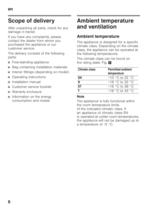
en Scope of delivery After unpacking all parts, check for any damage in transit. If you have any complaints, please contact the dealer from whom you purchased the appliance or our customer service. The delivery consists of the following parts: ■ ■ ■ ■ ■ ■ ■ ■ 6 Free-standing appliance Bag containing installation materials Interior fittings (depending on model) Operating instructions Installation manual Customer service booklet Warranty enclosure Information on the energy consumption and noises Ambient temperature and ventilation Ambient temperature The appliance is designed for a specific climate...
Open the catalog to page 6
en Ventilation Electrical connection The air on the rear panel and on the side panels of the appliance heats up. Conduction of the heated air must not be obstructed. Otherwise, the refrigerating unit must work harder. This increases power consumption. Therefore: Never cover or block the ventilation openings! The socket must be near the appliance and also freely accessible following installation of the appliance. The appliance complies with the protection class I. Connect the appliance to 220–240 V/50 Hz alternating current via a correctly installed socket with protective conductor. The socket...
Open the catalog to page 7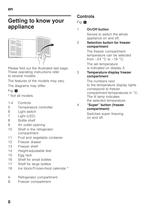
en Getting to know your appliance Controls Fig. 1 1 2 Please fold out the illustrated last page. These operating instructions refer to several models. 3 The features of the models may vary. The diagrams may differ. Fig. 1 * Not all models. 1-4 5 6 7 8 9 10 11 12 13 14 15 16 17 18 Controls Temperature controller Light switch Light (LED) Bottle shelf Air outlet opening Shelf in the refrigerator compartment Fruit and vegetable container Freezer drawer Freezer shelf Height-adjustable feet Egg rack Shelf for small bottles Shelf for large bottles Ice block/Frozen-food calendar * A B Refrigerator compartment...
Open the catalog to page 8
en Switching on the appliance Setting the temperature Switch on the appliance with the On/Off button. Fig. 1/1 Refrigerator compartment The appliance begins to cool. Light is switched on when the door is open. The factory has recommended the following temperatures: ■ Refrigerator compartment: +4 °C ■ Freezer compartment: –18 °C Operating tips Turn temperature controller, Fig. 1/5, to the required setting. We recommend a medium setting. Higher settings lower the temperature in the refrigerator compartment. Select a higher setting only temporarily if: ■ ■ the ambient temperature is high, door is...
Open the catalog to page 9
en Usable capacity Note when loading products ■ Information on the usable capacity can be found inside your appliance on the rating plate. Fig. 9 Fully utilising the freezer volume To place the maximum amount of food in the freezer, all frozen food containers, except the bottom one, can be taken out of the appliance. The food can be stacked directly on the freezer shelves. Removing the fittings To remove a frozen food container, pull out all the way, lift at the front and remove. Fig. 6 Refrigerator compartment The refrigerator compartment is the ideal storage location for ready meals, cakes...
Open the catalog to page 10
en Max. freezing capacity Freezing fresh food Information about the max. freezing capacity within 24 hours can be found on the rating plate. Fig. 9 Freeze fresh and undamaged food only. To retain the best possible nutritional value, flavour and colour, vegetables should be blanched before freezing. Aubergines, peppers, zucchini and asparagus do not require blanching. Freezing and storing food Purchasing frozen food ■ ■ ■ ■ Packaging must not be damaged. Use by the “use by” date. Literature on freezing and blanching can be found in bookshops. Note Keep food which is to be frozen away from food...
Open the catalog to page 11
en Packing frozen food To prevent food from losing its flavour or drying out, place in airtight containers. 1. Place food in packaging. 2. Remove air. 3. Seal the wrapping. 4. Label packaging with contents and date of freezing. Suitable packaging: Plastic film, tubular film made of polyethylene, aluminium foil, freezer containers. These products are available from specialist outlets. Unsuitable packaging: Wrapping paper, greaseproof paper, cellophane, bin liners and used shopping bags. Super freezing Food should be frozen solid as quickly as possible in order to retain vitamins, nutritional value,...
Open the catalog to page 12All Siemens Home Appliances catalogs and technical brochures
 Freestanding Appliances
42 Pages
 EZ977KZY1E
3 Pages
 CM678G4S6B
3 Pages
 HB672GBS1B
3 Pages
 HB676GBS6B
3 Pages
 EC9A5SB90
3 Pages
 WM14XEH4GB
3 Pages
 ET875FCP1D
2 Pages
 ET651HE17E
3 Pages
 Built-in Appliances Brochure
111 Pages
 catalog 2016
79 Pages
 Ovens 2009
22 Pages
 Free-standing Appliances
46 Pages
 Built in brochure
74 Pages
 Freestanding Brochure
46 Pages

Archived catalogs
 EX807LX67E
7 Pages
 2014 Built-in Appliances
77 Pages
 2022 Built-in Appliances
109 Pages
 9000371475
24 Pages
 9000443031
14 Pages
 9000455265
148 Pages
 9000523431
32 Pages
 9000538106
31 Pages
 9000644314
36 Pages
 9000644401
40 Pages
 9000645988
24 Pages
 9000646020
24 Pages
 9000650983
8 Pages
 90005263871
140 Pages
 90007104181
40 Pages
 90005805756
30 Pages
 90006317281
28 Pages
 90006502641
30 Pages
 90006944392
30 Pages
 9000755818
64 Pages
 90004930205
36 Pages
 90004930197
32 Pages
 Freestanding Cooling 09
20 Pages
 Freestanding Dishwashers 09
14 Pages
 Freestanding Washing 09
10 Pages
 Hobs 2009
9 Pages
 Cooker Hoods 2009
18 Pages
 Built-in Cooling 2009
20 Pages
 Built-in Laundry 2009
7 Pages
 Built-in Dishwashers 2009
16 Pages
 Tumble Dryers 2009
7 Pages
 Smart Living 2009
16 Pages

- Siemens oven
- Siemens electric oven
- Siemens range hood
- Range hood with built-in lighting
- Siemens cooktop
- Industrial coffee machine
- Siemens single oven
- Siemens cooktop with front controls
- Siemens wall-mounted range hood
- Siemens built-in cooktop
- Convection oven
- Automatic coffee machine
- Industrial dishwasher
- Siemens built-in oven
- Siemens single-chamber oven
- Siemens ducted range hood
- Industrial wine cellar
- Black coffee maker
- Cappuccino coffee machine
- Siemens induction cooktop