
- Catalogs
- Siemens Home Appliances
- 90007104181

90007104181

90007104181
- Baking and Pastry: Suitable for bread, rolls, and choux pastry with even heat distribution from top and bottom.
- Pizza Setting: Ranges from 30-275 °C for quick preparation of frozen products without preheating.
- Grill Settings: Available in small and large areas with low, medium, and high settings for grilling meats and fish.
- Slow Cook: Operates at 70-90 °C for gentle cooking of meats.
- Defrost: Ranges from 30-60 °C, using a fan to circulate warm air.
- Plate Warming: Operates at 30-70 °C for warming ovenware.
- Keep Warm: Maintains cooked dishes at 60-100 °C.
- Intensive Heat: Ranges from 30-300 °C for dishes requiring a crispy base.
- Bottom Heating: Used for preserving and additional browning.
- Hot Air Grilling: Alternates between grill element and fan for roasting meats and fish.
- Starting and Pausing: Use the † button to start or pause the oven. Adjust temperature or grill settings with the rotary selector.
- Setting Cooking Time: Access time-setting options via the 0 button. Set cooking time, later end time, or use the timer independently of the oven.
- Rapid Heating: Suitable for specific heating types and temperatures above 100 °C. Activated with the c button.
- Memory Function: Save and recall settings for frequently prepared dishes.
- Sabbath Mode: Maintains temperature between 85 °C and 140 °C for extended periods without manual intervention.
- Childproof Lock: Prevents accidental operation by children. Activated by holding the @ button.
- Oven Door Lock: Can be set to lock when the oven reaches a certain temperature.
- To install the panels, align the retaining carriers over the screw holes and secure them in place. Ensure the seal is hooked at the bottom of the panel.
- For removal, unscrew the retaining clips, lift the panel, and remove the seal. Insert the uppermost panel at an angle, ensuring the seal is not pushed back.
- Reattach the cover and oven door only after panels are correctly installed.
Troubleshooting
- Common malfunctions include power cuts and incorrect settings. Refer to the malfunction table for solutions before contacting after-sales service.
- Error messages with 'E' can often be resolved by pressing the 0 button to cancel the message. Persistent errors require professional service.
Replacing Oven Light Bulbs
- Use heat-resistant, 25 watt, 230 V halogen bulbs. Switch off the circuit breaker before replacing bulbs.
- Remove the glass cover, replace the bulb, and refit the cover securely.
Energy Efficiency and Environmental Considerations
- The appliance features an energy-efficient 'Hot air eco' heating type, suitable for cooking without preheating.
- To save energy, avoid preheating unless necessary, use dark baking tins, and minimize opening the oven door during cooking.
Cooking Guidelines
- Tables provide guidance on temperatures and cooking times for various dishes using 'Hot air eco'.
- For optimal results, place items in the oven before it heats up and use the recommended accessories and shelf positions.
Automatic Programmes
- Automatic programmes simplify cooking of roasts and stews, requiring minimal intervention.
- Use suitable ovenware with a lid and follow the weight and liquid guidelines provided in the tables.
After-Sales Service
- Contact after-sales service for repairs, providing the product and production numbers found on the oven door's rating plate.
- Service visits may incur a fee, even during the warranty period.
- Poultry and Beef: The document outlines weight ranges for different cuts of poultry and beef, specifying whether to add liquid and how to set the weight for cooking. For example, beef pot roast ranges from 0.5-3.0 kg and requires liquid.
- Veal and Pork: Similar instructions are provided for veal and pork, with distinctions between fresh and frozen cuts. For instance, fresh veal joints range from 0.5-3.0 kg and require liquid.
- Lamb and Game: Instructions for lamb and game meats include weight settings and liquid recommendations. For example, fresh lamb legs range from 0.5-2.5 kg and may require a little liquid.
- Fish preparation involves adding vinegar, lemon juice, or wine. Specific instructions are given for braising and baking different types of fish, such as trout and cod, with weight settings based on total weight.
- Cakes and Pastries: The document provides guidelines for baking on one or multiple levels, recommending specific heating types and shelf positions. For example, Victoria sandwich cakes should be baked at 170-180°C using top/bottom heating.
- Baking Tips: Tips include using dark-colored metal tins for even browning and adjusting temperatures for different baking results.
- The document explains how to select and set cooking programs using a rotary selector and adjust settings for individual preferences. It includes steps for setting weight and cooking time, as well as tips for adapting programs based on previous results.
- Recommendations are provided for handling large joints, adjusting liquid amounts for desired juice consistency, and ensuring proper lid fit to prevent burning smells.
- Guidance is given for preparing frozen meat and using specific cookware and accessories for optimal results.
1. Baking Instructions:
- Preheat the oven as specified for different types of food.
- Use 3D hot air for baking on multiple levels.
- For sponge cakes, check doneness with a cocktail stick.
- Adjust fluid content and temperature to prevent cake collapse or uneven baking.
- Use universal pans and wire racks for optimal results.
2. Baking Tips:
- Ensure proper spacing between items to allow for expansion.
- Use deeper pans to prevent overflow of fruit juices.
- Condensation is normal and may form on cooler surfaces.
3. Roasting Guidelines:
- Use universal pans with wire inserts for roasting.
- Adjust cooking times based on the weight of the meat.
- Allow meat to rest after roasting for better juice distribution.
- For pork with rind, make cross cuts and start with rind side down.
4. Grilling Instructions:
- Preheat the grill and keep the oven door closed.
- Ensure even thickness of food for uniform cooking.
- Use a wire rack with a universal pan to collect juices.
- Avoid placing pans at high levels to prevent distortion.
5. Slow Cooking Tips:
- Ideal for tender cuts of meat, maintaining succulence.
- Use shallow ovenware and preheat the oven.
- Sear meat before slow cooking for best results.
- Maintain a core temperature of 60°C for at least 30 minutes.
6. Preprepared Products:
- Follow packaging instructions and ensure proper spacing.
- Use greaseproof paper suitable for high temperatures.
- Quality of the raw product affects the final result.
7. Pizza Cooking:
- Use the pizza setting or 3D hot air for different bases.
- Adjust temperature and time based on thickness and type of pizza.
- Cooking Instructions: Detailed cooking instructions for various food items such as pizza, potato products, baked goods, fried foods, and lasagne. Each item includes recommended oven settings, temperature ranges, and cooking times.
- Special Dishes: Instructions for preparing special dishes like yoghurt and proving dough at low temperatures using 3D hot air. Steps include preheating, ingredient preparation, and incubation times.
- Defrosting and Drying: Guidelines for defrosting frozen goods and drying fruits and vegetables using 3D hot air. Includes temperature settings and time estimates.
- Preserving: Instructions for preserving fruits and vegetables in jars. Details include jar preparation, temperature settings, and timing for different types of produce.
- Acrylamide Reduction: Tips for minimizing acrylamide formation in food, focusing on cooking times, temperatures, and food preparation techniques.
- Baking and Grilling: Recommendations for baking and grilling, including types of heating, temperature settings, and cooking times for various baked goods and grilled items.
- Always preheat the oven as specified for optimal results.
- Use appropriate ovenware and positioning for different types of food.
- Follow specific temperature and time guidelines to ensure food safety and quality.
- For preserving, ensure jars and seals are clean and intact to prevent contamination.
- Minimize acrylamide by avoiding overcooking and using lower temperatures where possible.
Catalog excerpts
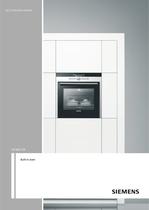
[en] Instruction manual HB78GB.70B Built-in oven
Open the catalog to page 1
: Important safety information Read these instructions carefully. Only then will you be able to operate your appliance safely and correctly. Retain the instruction manual and installation instructions for future use or for subsequent owners. This appliance is only intended to be fully fitted in a kitchen. Observe the special installation instructions. Check the appliance for damage after unpacking it. Do not connect the appliance if it has been damaged in transport. Only a licensed professional may connect appliances without plugs. Damage caused by incorrect connection is not covered under warranty....
Open the catalog to page 4
The cable insulation on electrical appliances may melt when touching hot parts of the appliance. Never bring electrical appliance cables into contact with hot parts of the appliance. ■ Penetrating moisture may cause an electric shock. Do not use any highpressure cleaners or steam cleaners. ■ When replacing the cooking compartment bulb, the bulb socket contacts are live. Before replacing the bulb, unplug the appliance from the mains or switch off the circuit breaker in the fuse box. ■ A defective appliance may cause electric shock. Never switch on a defective appliance. Unplug the appliance from...
Open the catalog to page 5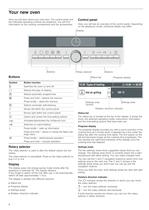
Your new oven Here you will learn about your new oven. The control panel and the individual operating controls are explained. You will find information on the cooking compartment and the accessories. Control panel Here, you will see an overview of the control panel. Depending on the appliance model, individual details may differ. 'LVSOD\ RQ RII 3 VWDUW VWRS 0 %XWWRQV 5RWDU\ VHOHFWRU Buttons %XWWRQV 6WDWXV EDU Symbol Button function ‡ Switches the oven on and off " Selects the type of heating X Selects automatic programmes l 3URJUHVV GLVSOD\ Press and hold = selects the memory Press briefly =...
Open the catalog to page 6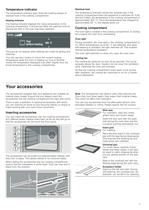
Temperature indicator Residual heat The temperature indicator bars show the heating phases or residual heat in the cooking compartment. The temperature indicator shows the residual heat in the cooking compartment when the appliance is switched off. If the last bar is filled, the temperature in the cooking compartment is approximately 300 °C. Once the temperature has dropped to approximately 60 °C, the display goes out. Heating indicator The heating indicator displays the rising temperature in the cooking compartment. If all bars are filled, the optimum time for placing the dish in the oven has...
Open the catalog to page 7
Optional accessories You can purchase optional accessories from the after-sales service or specialist retailers. You will find a comprehensive range of products for your oven in our brochures and on the Internet. The availability of optional accessories and the option for ordering these online varies from country to country. Please see the sales brochures for more details. Not all optional accessories are suitable for every appliance. When purchasing, please always quote the exact designation (E-no.) of your appliance. Optional accessories HZ number Use Suitable for self-cleaning Wire rack HZ334000...
Open the catalog to page 8
After-sales service products You can obtain suitable care and cleaning agents and other accessories for your domestic appliances from the after-sales service, specialist retailers or (in some countries) online via the eShop. Please specify the relevant product number. Cleaning cloths for stainless-steel surfaces Product no. 311134 Reduces the build-up of dirt. Impregnated with a special oil for perfect maintenance of your appliance's stainless-steel surfaces. Oven and grill cleaning gel For cleaning the cooking compartment. The gel is odourless. Product no. 463582 Microfibre cloth with honeycomb...
Open the catalog to page 9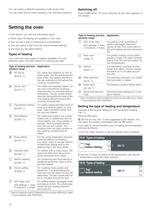
You can select a different operating mode at any time. Switching off You can read how to make settings in the individual sections. Press the‡ button. The oven switches off, the clock appears in the display. Setting the oven In this section, you will find information about ■ which types of heating are available in your oven Type of heating and tem- Application perature range ■ how you set a type of heating and a temperature * Grill, small area ■ how you select a dish from the recommended settings ■ and how you set rapid heating . Slow cook Types of heating Your oven has many types of heating available....
Open the catalog to page 10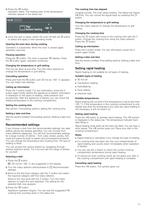
3. Press the † button. Operation starts. The heating bars of the temperature indicator appear in the status bar. 3UHKHDWLQJ 7RS ERWWRP KHDWLQJ & The cooking time has elapsed A signal sounds. The oven stops heating. The status bar shows x 0:00. You can cancel the signal early by pressing the 0 button. Changing the temperature or grill setting Turn the rotary selector to change the temperature or grill setting. Changing the cooking time 4. Once the dish is ready, switch the oven off with the ‡ button or select and apply a new operating mode. Opening the oven door during cooking Operation is suspended....
Open the catalog to page 11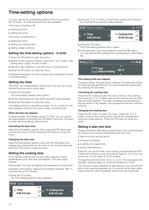
Time-setting options You can call up the time-setting options menu by pressing the 0 button. The following functions are available: 2. Using the ¿ or ¾ button, move to the cooking time and set the cooking time using the rotary selector. If the oven is switched off: ■ ■ 7\SHV RI KHDWLQJ Setting the timer Setting the clock 7LPHU PLQVHF If the oven is switched on: ■ Setting the timer ■ Setting the cooking time ■ Setting a later end time &RRNLQJ WLPH PLQVHF 3. Press the 0 button. The Time-setting options menu closes. 4. If the operation has not yet started, press the † button. Setting the time-setting...
Open the catalog to page 12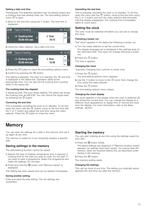
Setting a later end time Cancelling the end time Prerequisite: The selected operation has not already begun and a cooking time has already been set. The time-setting options menu 0 is open. This is possible, providing the oven is on standby. To do this, open the menu with the 0 button, move to the end time using the ¿ or ¾ button and turn the rotary selector anti-clockwise until the display disappears. The cooking time immediately starts to count down. 1. Move to the end time using the ¿ button. The end time is displayed. 7\SHV RI KHDWLQJ &RRNLQJ WLPH PLQVHF (QG &RRNLQJ WLPH PLQVHF The oven must...
Open the catalog to page 13All Siemens Home Appliances catalogs and technical brochures
 Freestanding Appliances
42 Pages
 EZ977KZY1E
3 Pages
 CM678G4S6B
3 Pages
 HB672GBS1B
3 Pages
 HB676GBS6B
3 Pages
 EC9A5SB90
3 Pages
 WM14XEH4GB
3 Pages
 ET875FCP1D
2 Pages
 ET651HE17E
3 Pages
 Built-in Appliances Brochure
111 Pages
 catalog 2016
79 Pages
 Ovens 2009
22 Pages
 Free-standing Appliances
46 Pages
 Built in brochure
74 Pages
 Freestanding Brochure
46 Pages

Archived catalogs
 EX807LX67E
7 Pages
 2014 Built-in Appliances
77 Pages
 2022 Built-in Appliances
109 Pages
 9000371475
24 Pages
 9000443031
14 Pages
 9000455265
148 Pages
 9000523431
32 Pages
 9000538106
31 Pages
 9000644314
36 Pages
 9000644401
40 Pages
 9000645988
24 Pages
 9000646020
24 Pages
 9000650983
8 Pages
 90005263871
140 Pages
 9000731775
23 Pages
 90005805756
30 Pages
 90006317281
28 Pages
 90006502641
30 Pages
 90006944392
30 Pages
 9000755818
64 Pages
 90004930205
36 Pages
 90004930197
32 Pages
 Freestanding Cooling 09
20 Pages
 Freestanding Dishwashers 09
14 Pages
 Freestanding Washing 09
10 Pages
 Hobs 2009
9 Pages
 Cooker Hoods 2009
18 Pages
 Built-in Cooling 2009
20 Pages
 Built-in Laundry 2009
7 Pages
 Built-in Dishwashers 2009
16 Pages
 Tumble Dryers 2009
7 Pages
 Smart Living 2009
16 Pages

- Siemens electric oven
- Siemens range hood
- Range hood with built-in lighting
- Siemens cooktop
- Industrial coffee machine
- Siemens single oven
- Siemens wall-mounted range hood
- Siemens cooktop with front controls
- Siemens built-in cooktop
- Convection oven
- Automatic coffee machine
- Industrial dishwasher
- Siemens built-in oven
- Siemens single-chamber oven
- Siemens ducted range hood
- Industrial wine cellar
- Black coffee maker
- Cappuccino coffee machine
- Siemens cooktop with touch controls