
- Catalogs
- SIEMENS GAMESA
- integralBlades®


integralBlades®

integralBlades®
Introduction to IntegralBlade Technology
IntegralBlade is a patented technology developed by Siemens Wind Power for manufacturing wind turbine blades. It is used for Siemens wind turbine platforms with power ratings from 1.3 to 6.0 MW and rotor diameters from 62 to 154 meters. The blades are constructed from fiberglass-reinforced epoxy resin, featuring advanced aerodynamic designs.
Manufacturing Process
The IntegralBlade technology enables the production of single-piece blades through a closed process. The process involves laying out fiberglass reinforcement in a special mold, injecting epoxy resin under vacuum conditions, and hardening the blade at high temperatures. The inner mold is then collapsed and removed, resulting in a seamless blade.
Advantages of IntegralBlade Technology
This technology offers several benefits over traditional methods, including the use of a single mold set, reduced space and manpower requirements, and the elimination of potential weak points such as adhesively bonded joints. The closed manufacturing process also ensures a clean and attractive work environment.
Contact Information
For further details, Siemens AG can be contacted at their Customer Support Center via phone or email. The document also notes that the information provided is subject to change and should be specified in contracts.
Catalog excerpts

All blades for Siemens wind turbine platforms with power ratings from 1.3 to 6.0 MW and rotor diameters from 62 to 154 meters are manufactured using the patented IntegralBlade technology. The blades are made from fiberglass- reinforced epoxy resin, and their external design represents state-of-the-art wind turbine aerodynamics. The IntegralBlade technology invented by Siemens Wind Power allows the manufacture of single-piece wind turbine blades in a closed process. The fiberglass reinforcement is laid out to dry using a special molding arrangement with a closed outer mold and an expanding inner mold. After completion of the fiberglass lamination process, the epoxy resin is injected under vacuum conditions. Then the blade, which is still enclosed in the mold, is hardened at high temperature. Finally, the blade is removed from the outer mold after the epoxy resin has The inner mold is collapsed with a vacuum and pulled from the blade. The result is a complete, seamless blade finished in a single process. A truly integrated success.
Open the catalog to page 1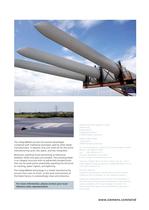
Published by and copyright © 2012: Siemens AG Energy Sector Freyeslebenstrasse 1 91058 Erlangen, Germany The IntegralBlade process has several advantages compared with traditional processes used by other blade manufacturers. It requires only one mold set for the entire manufacturing cycle, less space, and less manpower. Moreover, potential issues pertaining to tolerances between shells and spars are avoided. The resulting blade is an integral structure with no adhesively bonded joints that can be weak points potentially exposing the structure to cracking, water ingress, and lightning. The IntegralBlade...
Open the catalog to page 2All SIEMENS GAMESA catalogs and technical brochures
 SG 14-222 DD
3 Pages
 SG 3.4-132
4 Pages
Archived catalogs
 SG 8.0-167 DD
2 Pages
 SG 11.0-200 DD
3 Pages
 SWT-DD-130
2 Pages
 SWT-DD-120
2 Pages
 Siemens Gamesa 5.X
4 Pages
 SG 2.9-129
4 Pages
 SG 5.0-132
4 Pages
 SG 2.6-114
4 Pages
 SG 2.2-122
4 Pages
 SG 2.1-114
4 Pages
 SWT-3.3-130
4 Pages
 SWT-2.3-120
4 Pages
 SWT-6.0-154
16 Pages
 SWT-7.0-154
4 Pages
 D6 Platform
8 Pages
 SWT-6.0
16 Pages
 SICAM General
232 Pages
 SWT-2.3-93
8 Pages
 SWT-2.3-101
8 Pages
 SWT-3.0
8 Pages
 SWT-2.3-113
8 Pages
 Bolted Steel Shell Toweer
2 Pages
 High Wind Ride Through
2 Pages
 Lightning Protection System
2 Pages
 Turbine Load Control
2 Pages
 SWT-3.6-120
10 Pages
 SWT-2.3-108
8 Pages
 SWT-2.3-82
8 Pages
 SWT-3.6-107
8 Pages


