
- Catalogs
- SIEMENS GAMESA
- Aeroelastically Tailored Blades


Aeroelastically Tailored Blades

Aeroelastically Tailored Blades
The document discusses Siemens' innovative aeroelastically tailored blade designed to increase energy production in wind turbines without increasing structural loads.
Specifications and Design
The new blade design incorporates a bend-twist-coupling mechanism that allows for controlled torsional twisting in response to aerodynamic loading. This design improves performance at low wind speeds and maintains optimal load characteristics across all wind speeds.
Advantages
- Enables larger rotor sizes without significant structural changes to the turbine.
- Reduces the cost of energy production.
- Robust design with no additional maintenance costs compared to traditional blades.
- No increased loading or wear on the pitch system.
- No need for additional control systems or hardware.
Comparison with Traditional Blades
Traditional blades have a fixed twist and rely entirely on the pitch system for regulation. In contrast, the aeroelastically tailored blades adjust to wind gusts and turbulence independently, enhancing efficiency and reducing stress on the turbine.
Technological Innovation
The Siemens IntegralBlade® technology supports this advancement by providing a robust and flexible design without glue joints or weak spots, making it ideal for the intelligent use of the blade's flexing capabilities.
Conclusion
The aeroelastically tailored blade represents a significant advancement in wind turbine technology, offering increased energy production and reduced operational costs without compromising structural integrity.
Catalog excerpts

Siemens aeroelastically tailored blade Innovative blade increases energy production The new aeroelastically tailored blade from Siemens increases energy production without increasing loads on the wind turbine. The energy output of a wind turbine is dependent on the rotor size. With larger rotor sizes, higher production can be obtained. However, a bigger rotor traditionally increases the loads on the wind turbine, which calls for larger and heavier structural components. Siemens new aeroelastically tailored blade changes that. The newly developed blade design couples controlled torsional twisting of the blade with aerodynamic loading. The secret behind the aeroelastically tailored blade is to be found in the intelligent design work, which added a bend-twist-coupling within the blade, resulting in the blade reducing the loads on the turbine. The new blade will instantly adjust the blade’s angle of attack created by wind gusts. This minimizes the stress on the turbine, whereas the pitch and turbine control system handles the slower variations in the wind speed for optimal operation. These properties represent major advances in blade performance and design. This ultimately provides improved performance at low wind speeds due to the larger rotor, and optimal load characteristics at all wind speeds. Answers for energy.
Open the catalog to page 1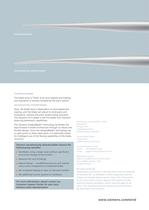
Traditional blade Aeroelastically tailored blade Traditional blades The blade twist is “fixed” at all wind speeds and loading, and regulation is entirely handled by the pitch system. Aeroelastically tailored blades Here, the blade twist is dependent on wind speed and loading, and the blade can adjust to wind gusts and turbulence, without the pitch system being activated. The Siemens 53 m blade is the first blade from Siemens featuring aeroelastic capabilities. The Siemens IntegralBlade® technology facilitates this leap forward in blade architecture through its robust and flexible design. Since...
Open the catalog to page 2All SIEMENS GAMESA catalogs and technical brochures
 SG 14-222 DD
3 Pages
 SG 3.4-132
4 Pages
Archived catalogs
 SG 8.0-167 DD
2 Pages
 SG 11.0-200 DD
3 Pages
 SWT-DD-130
2 Pages
 SWT-DD-120
2 Pages
 Siemens Gamesa 5.X
4 Pages
 SG 2.9-129
4 Pages
 SG 5.0-132
4 Pages
 SG 2.6-114
4 Pages
 SG 2.2-122
4 Pages
 SG 2.1-114
4 Pages
 SWT-3.3-130
4 Pages
 SWT-2.3-120
4 Pages
 SWT-6.0-154
16 Pages
 SWT-7.0-154
4 Pages
 D6 Platform
8 Pages
 SWT-6.0
16 Pages
 SICAM General
232 Pages
 SWT-2.3-93
8 Pages
 SWT-2.3-101
8 Pages
 SWT-3.0
8 Pages
 SWT-2.3-113
8 Pages
 Bolted Steel Shell Toweer
2 Pages
 High Wind Ride Through
2 Pages
 integralBlades®
2 Pages
 Lightning Protection System
2 Pages
 Turbine Load Control
2 Pages
 SWT-3.6-120
10 Pages
 SWT-2.3-108
8 Pages
 SWT-2.3-82
8 Pages
 SWT-3.6-107
8 Pages


