


PILOT 3000

PILOT 3000
The manual for the SGM Pilot 3000 provides detailed instructions on its technical specifications, usage guidelines, and technical support diagrams. It highlights the importance of thoroughly reading the manual to achieve optimal results and notes that product improvements may cause discrepancies between the manual and the equipment.
Safety guidelines are crucial for the safe operation of the Pilot 3000. Users are advised to strictly follow these instructions to prevent accidents or damage. The unit should only be used by adults, not in extreme temperatures or humidity, and repairs should be conducted by authorized personnel to maintain warranty validity.
The Pilot 3000 supports two DMX-512 Universes and can be controlled via MIDI, SMPTE, or DMX for synchronized show programming. It features a comprehensive fixture library and supports external trigger sources. The hardware layout includes various inputs and outputs for comprehensive control.
This section provides a step-by-step guide to setting up the Pilot 3000, programming cues, creating cue-lists, and cue-list playback, helping users quickly familiarize themselves with basic operations.
The architecture includes external connections, software interface, and various controllers. It explains the main interface, LCD display, editor keyboard, and playback keyboard.
Instructions for configuring the Pilot 3000 cover address patching, fixture configuration, and slider configuration. Tools for backup/restore and touch calibration are also discussed.
This section covers fixture selection operations, editing attributes, storing cues or cue-lists, and modifying cues, providing comprehensive guidance on programming the Pilot 3000 effectively.
Details on playback architectures, including normal mode, chase mode, and live mode, are provided. The section also covers cue timing and playback register pages.
The structure and creation of palettes are explained, including pan tilt, color, and other palettes. Instructions for modifying, moving, and deleting palettes are included.
The architecture of the shape engine is introduced, providing insights into its functionality and application within the system.
The document provides detailed instructions on configuring and operating the Pilot 3000 lighting console, including attribute reactions during fade times and procedures for modifying attribute paths, standby settings, and Hi-Lite configurations.
The Path feature allows users to define attribute reactions during crossfade times, with options like Linear, Snap Start, and Snap End.
The Stand-By function is activated by the Clear All or Release commands, while the Hi-Lite command is used for quick identification of fixtures.
The Locate command sets fixture attributes to predefined values, facilitating projector identification and programming.
The Options menu allows users to set default delay and fade-in times, standby time, and playback mode (LTP or HTP).
This section describes how to configure pan and tilt movement reversals for projectors.
The console features six controllers that can be configured as Register Master or Manual Cue.
The Tools area includes functions for saving and restoring shows, setting the internal clock, and calibrating the touch panel.
To permanently erase a show, select it with the related key, press the Erase key, confirm by pressing Yes on the warning window, and wait for the progress bar to complete.
This function cancels the current show from temporary memory to start a new one.
Access the Date/Time panel via the Clock key in the Tools menu.
To recalibrate the touch panel, press the Touch Calibration key and follow the on-screen instructions.
Before programming, ensure the console is correctly configured. Programming involves selecting fixtures, editing attributes, and saving them in a Cue.
Select fixtures using the touch panel, either individually or through pre-created groups.
Attributes editing is essential for programming, with adjustments made using the console's wheels.
After using the Locate command, the Jog-Ball can control the beam position of projectors with Pan-Tilt capabilities.
The document provides detailed instructions on controlling motorized projectors using the Pilot 3000 system.
To choose a color or gobo, users must press the respective key and rotate the encoder to the desired setting.
Attributes are grouped into six families, and users can modify these attributes by selecting the appropriate family and using the encoder.
The document explains how to configure fixture attributes using the Fixture description file.
Users can store programmed scenes as Cues in the Pilot 3000, which can be activated during playback.
The Pilot 3000 allows for the configuration of Manual-Cues, which can be stored and accessed quickly.
To modify a Cue, users must load it into the editor, make changes, and update the Cue.
The HILITE key is used to detect projectors and modify palettes.
The document describes the playback process, highlighting different modes such as Normal, Chase, and Live.
The Chase panel allows for visualization and setting adjustments, with key controls for manual and automatic triggering.
Pressing the Live! Key switches to Live! mode, allowing direct access to Cue-List Cues via Playback keys.
PLAYBACK keys activate Cue-Lists, and the “Release” command disables a Register's PLAY status.
Pilot 3000 assigns four default times to Cues, which can be modified in the SETUP menu.
Chase timing uses Speed (Bpm) and Fade (%) parameters.
Operators can organize Cue-Lists across 20 Register pages.
Palettes speed up programming and Cue modification, categorized into six types.
The document outlines the configuration of fixture attributes and the creation of palettes.
The Pilot 3000 comes with pre-programmed palettes, which can be modified or new ones added.
Partialized palettes allow for the creation of palettes that affect only specific attributes.
The document provides instructions on modifying, moving, and deleting palettes.
The palette window can be customized in terms of colors and labels.
Palettes are used in cue programming to apply pre-defined settings to fixtures.
The Shape Engine in Pilot 3000 allows for creating complex dynamic effects.
The Shape Engine Editor is used to apply effects to attributes.
The manual explains how to apply effects to lighting attributes using the Pilot 3000 console.
The process involves selecting fixtures, defining attributes, choosing oscillator types, and setting effect margins and parameters.
Steps include selecting fixtures, defining attributes, and using the Shape Engine to apply effects.
Similar to color effects, users select the Dimmer Attribute and apply a LINEAR oscillator.
Special shapes are available for Pan and Tilt attributes, allowing for complex movement effects.
The SELECTOR window aids in selecting fixtures and groups for effect creation and editing.
Effects can be removed using the "FREE" key in the Shape Engine window.
The manual describes how to play back Cues with effects, allowing users to adjust parameters during playback.
SGM Technology for Lighting Spa disclaims responsibility for damages caused by incorrect use of the Pilot 3000 console.
Catalog excerpts

LIGHTING CONSOLES
Open the catalog to page 1
Vi ringraziamo per aver acquistato un prodotto SGM. Per ottenere i migliori risultati dal suo utilizzo, vi preghiamo di leggere attentamente questo manuale di istruzioni. Al suo interno troverete le informazioni tecniche e le specifiche d’uso del prodotto. Nelle pagine in appendice troverete inoltre schemi e diagrammi destinati all’assistenza tecnica. Nell’ottica di qualità SGM, è possibile che l’Azienda apporti migliorie ai suoi prodotti, per cui consigliamo di allegare il manuale al prodotto stesso e di trascrivere il numero di serie nell’ultima pagina della copertina: utilizzando il presente...
Open the catalog to page 2
Symbols used This manual uses graphic symbols to emphasize any hazards during the operation work described. THIS SYMBOL INDICATES A GENERAL RISK THIS SYMBOL INDICATES ELECTRIC SHOCK RISK Changes to this manual SGM has an on-going product development policy, so the information printed in this manual may not be completely up to date. If any doubts arise regarding the topics covered in this manual or should any further help be required, our online services (internet-server www.sgm.it) are available 24 hours a day. In the FAQ section of the technical assistance zone, answers can be found to numerous...
Open the catalog to page 5
Safety Information Read the instructions in this manual carefully, as they give important instructions regarding installation, operation and maintenance safety. This manual must be kept with the fixture for future consultation. In the event of the fixture being sold or passed to another user, always make certain that the booklet is with the unit, to enable the new owner to be informed on its operation and relative care. THIS UNIT NOT FOR HOME USE; ONLY FOR PROFESSIONAL USE AFTER HAVING REMOVED THE PACKAGING, MAKE CERTAIN THE UNIT IS NOT DAMAGED IN ANY WAY. WHEN IN DOUBT, DO NOT USE THE UNIT AND...
Open the catalog to page 6
General Warranty Conditions The unit is guaranteed for 24 months from the date of purchase against manufacturing faults of the unit or the material it is made from Faults or breakdowns caused by inexperienced or incorrect use of the unit are not covered by the guarantee The guarantee will be considered null and void if the unit has been opened or tampered with by unauthorized personal The guarantee does not foresee the replacement of the unit External components such as handles, switches and removable parts are excluded from the guarantee Transport costs and consequent risks are the responsibility...
Open the catalog to page 7
1.1 System Characteristics Thank you for having chosen the SGM Pilot 3000 Pilot 3000 is a lighting Console dedicated to the control of both conventional and automated lighting fixture of any kind. By means of its two DMX-512 Universes, it is possible to control the timing and running modes of any kind of fixture available on the market thanks to a comprehensive fixture library that can be updated on an on-going basis. This manual describes all the Pilot 3000 features available with Software version1.0. Future software updates along with the relative documentation, can be downloaded from the web...
Open the catalog to page 8
1.4 Hardware layout The standard hardware features for Pilot 3000 consists of: 2 DMX Universes allowing 1024 DMX output channels Midi IN OUT THRU DMX IN SMPTE IN 20 Playback Registers 6 Registers for Playback Control 4 encoders used for handling attributes and Speed Jog-Ball for Pan and Tilt control USB Serial port Audio In Remote pedal IN 1.5 Terminology The following terms are used to indicate Pilot 3000 console functions: Cue: establishes the times and modes of an attribute status of connected fixtures. The concept of a cue is similar to other frequently used terms such as Scene or Memory...
Open the catalog to page 9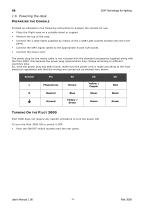
1.6 Powering the desk PREPARING Proceed as indicated in the following instructions to prepare the console for use. Place the Flight-case on a suitable stand or support. Remove the top of the case. Connect the 2 desk-lights supplied by means of the 2 USB-Light sockets located onto the front panel. Connect the DMX signal cables to the appropriate 5-pole XLR socket. Connect the power cord. The power plug for the mains cable is not included with the standard accessories supplied along with the Pilot 3000, this because the power plug requirements may change according to different countries laws. So,...
Open the catalog to page 10
QUICK START This chapter is intended for those users wanting a rapid effective approach to the console, in order to learn basic programming procedure in a short time Pilot 3000 allows programming maximum 999 Cues for each single Register (Cue-List). These Playback Registers are 20 for each single Page, and the total available Pages are 20. This chapter explains what to do by means of the following points: Quick Pilot 3000 setup Basic programming of a Cue. Preparing a Cue-list on Playback Registers Playback of a Cue-list 2.1 Setup Connect the DMX signal cables. Connect the console to the mains...
Open the catalog to page 11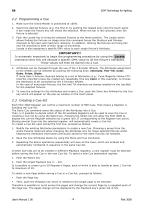
2.2 Programming a Cue 1. Make sure the Grand Master is positioned at 100%. 2. Select the desired fixtures (e.g. the first 3) by pushing the related keys onto the touch panel. A bar inside the fixture key will shows the selection. When the bar is red coloured, then the fixture is selected. 3. Push the Locate key to bring the selected fixtures to the Home position. The Locate action allows finding the fixtures on stage since this command forces the Shutters and Dimmer channels to full open and maximum intensity. In addition, Homing the fixtures will bring Pan and Tilt channels to 50% of their range...
Open the catalog to page 12
2.4 Cue-list Playback IMPORTANT!! Before running a Cue or Cue-list, make sure the Live Editor doesn't still involve any fixtures. Push Ctrl all twice to close the Editor. Pushing the Register's key, will automatically run the related Cue. A repeated push of the Register's key will sequentially playback Cues of the related Cue-list. Each Cue can be run with preset times. The times that control a Cue are: 1. Delay time 2. Fade In time 3. Wait time 4. Fade Out time Allocating or changing the times is very easy: Push the Q List key to display all the Cues related to the Cue-list of the selected Register....
Open the catalog to page 13All SGM Light catalogs and technical brochures
 G·4 Wash-Beam
6 Pages
 i·5 RGBW POI
7 Pages
 i·5 UV POI
6 Pages
 Q·7 W POI
6 Pages
 Q-SERIES
26 Pages
 P-SERIES
24 Pages
 I-SERIES
24 Pages
 SGM SAFETY INFORMATION
8 Pages
 G‐WASH MOVING HEAD
68 Pages
Archived catalogs
 IDEA MOVING LED 300
22 Pages
 P-5
P-544 Pages
 Studio 12 scan control
62 Pages
 X-5 / XC-5 LED Strobe
28 Pages
- Light fixture
- Industrial LED light
- Commercial light fixture
- Dimmable light fixture
- Linear light fixture
- Surface-mounted light fixture
- Outdoor light fixture
- Plastic light fixture
- LED floodlight
- Outdoor projector
- Commercial floodlight
- IP65 light fixture
- Public space light fixture
- Flexible LED light strip
- IP66 floodlight
- IP65 floodlight
- Indoor projector
- Industrial management software
- Moving head spot
- Industrial strip light