


Profile 28 - current issue
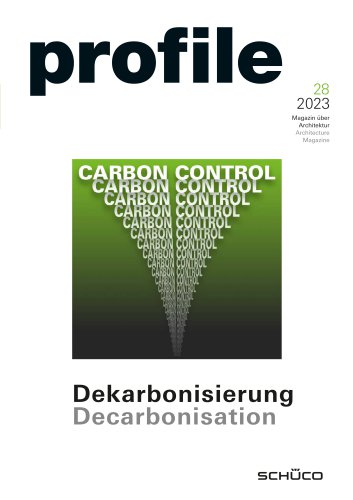
Profile 28 - current issue
Andreas Engelhardt, Managing Partner of Schüco International KG, emphasizes the importance of climate neutrality in construction. He introduces Schüco Carbon Control, a modular system for managing the carbon footprint of building envelopes throughout their lifecycle.
- Decarbonisation: Strategies for reducing carbon emissions in construction.
- Interview with Professor Ortwin Renn: Discusses systemic risks in transformation processes and climate change challenges.
- Schüco Carbon Control: Schüco's approach to minimizing CO2 emissions in building envelopes.
- Living and Global Living: Concepts of openness and modular living spaces in architecture.
- Office and Business: Innovations in sustainable and modern co-working spaces.
- Education and Culture: Examines identity in architecture with projects like the H.C. Andersen Museum.
- Professor Ortwin Renn: Highlights understanding systemic risks and societal participation in addressing climate change.
- Thomas Rau: Discusses forward-thinking approaches in architecture and sustainability.
The magazine emphasizes innovative solutions and societal involvement for sustainability in architecture, highlighting Schüco's commitment to reducing the construction industry's carbon footprint.
Andreas Engelhardt introduces Schüco Carbon Control, a system designed to simplify decarbonization of building facades, offering products and services throughout a building's lifecycle.
Buildings produce operational and embodied carbon emissions. Reducing operational emissions involves energy-efficient products, while reducing embodied emissions requires careful material selection and design.
Schüco Carbon Control supports minimizing CO2 emissions through building shape, material choice, and smart technology. Certifications like LEED, BREEAM, and DGNB enhance building value.
Schüco Carbon Control helps manage carbon footprint using SchüCal software, offering Low Carbon and Ultra Low Carbon aluminium options.
Schüco provides products for efficient building operation, including intelligent management systems and building-integrated photovoltaics.
The concept promotes material circulation in closed cycles, ensuring materials can be reused without quality loss, supporting sustainability in construction.
Ensures construction products can be fully recycled and reused, aligning with circular economy principles. Schüco is a leader in implementing this with over 60 certified aluminum systems.
Overview of global projects featuring Schüco systems, detailing location, architects, and specific systems used.
An innovative residential building in Berlin using pre-cast concrete elements, offering affordable housing with flexible spaces.
An architectural marvel in Amsterdam with a mix of residential, commercial, and cultural spaces, featuring a natural stone facade and glass elements using Schüco systems.
Describes a unique architectural design with 200 apartments in high-rise towers, featuring a natural stone façade and plant integration.
Schüco USC and UCC systems are used for glass façades, providing a structured contrast to the building's organic design.
Lists various projects across locations, detailing client, architects, and Schüco systems used.
Renovation of a 1970s office building in London into a modern co-working space with a new curtain wall façade using Schüco systems.
A seven-storey timber office building in Uppsala, Sweden, designed for resource efficiency and sustainability.
Discusses a timber building by Vasakronan aiming for climate neutrality by 2030, LEED platinum certified.
Features a glass façade with red slate shingle cladding, green roofs, and a timber façade.
Incorporates photovoltaic modules, ground-source heat pumps, and battery storage for sustainability.
Located in Odense, Denmark, featuring five circular timber pavilions designed by Kengo Kuma And Associates.
New campus in Milan with glass façades and expanded metal elements for sun protection.
Describes a complex of buildings with amorphous floor plans, featuring horizontal aluminum facades and expanded metal grilles for sun shading.
Rau discusses the need for systemic change, proactive planning, and the role of the state and companies in addressing climate issues.
Rau emphasizes treating materials as valuable resources within a closed system and suggests manufacturers take responsibility for recycling.
Rau envisions a future where materials have a sacred identity, leading to new value chains and sustainable economic models.
Discusses the future of the construction industry and the shift towards a circular economy, highlighting the economic benefits of sustainable practices.
- Circular Economy: Transition from a linear economy to a circular one, reducing waste and promoting sustainability.
- Material Registry: Madaster platform ensures materials can be tracked and reused efficiently.
- Innovative Construction Solutions: Highlights Schüco products promoting efficiency, sustainability, and security.
- Grid2Shell System: Bolted connection system facilitating quick construction.
- AF UDC 80 Green Façade: Absorbs particulates, reduces noise, and improves microclimate.
- Schüco AWS WoodDesign: Combines timber with aluminum for aesthetic and robust construction.
- Sälzer S1es-60 Façade: High-security façade offering protection against break-ins, bullets, and explosions.
- AS FD 90.HI Folding Sliding System: Provides large, transparent passageways with foldable glass units.
Calls for adopting circular economy principles and highlights the role of innovative construction technologies in achieving sustainable development.
Catalog excerpts
28 2023 Magazin über Architektur Architecture Magazine Dekarbonisierung Decarbonisation
Open the catalog to page 1
FOTO PHOTO Bart van Hoek
Open the catalog to page 2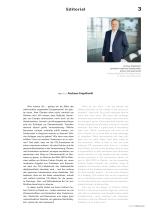
Andreas Engelhardt, persönlich haftender Gesellschafter Schüco International KG Andreas Engelhardt, Managing Partner of Schüco International KG Text Words Andreas Engelhardt Was meinen Sie – gelingt die bis Mitte des Jahrhunderts angestrebte Energiewende? Ich glaube daran. Aber Glauben allein reicht natürlich bei Weitem nicht. Wir wissen, dass Gebäude Unmengen von Energie verbrauchen, mehr noch als der Verkehrssektor. Umwelt- und klimagerechtes Bauen sind der Schlüssel zur Klimaneutralität. Trotzdem herrscht aktuell große Verunsicherung: Welche Parameter müssen zukünftig erfüllt werden, um Fördermittel...
Open the catalog to page 3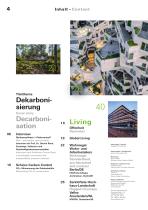
Inhalt – Content Cover story Schüco Carbon Control CO2−Minimierung der Gebäudehülle Minimising CO2 in construction Living Offenheit Openness Interview isikoempfinden = Risikoverlauf? R Risk – perception versus reality Interview mit Prof. Dr. Ortwin Renn, Soziologe, Volkswirt und Nachhaltigkeitswissenschaftler Interview with Professor Ortwin Renn, a sociologist, economist and sustainability research scientist Global Living 22 Wohnregal Wohn- und Arbeitsateliers Wohnregal Standardised, pre-fabricated and modular Berlin/DE FARFrohn & Rojas Architekten, Berlin/DE section.d www.sectiond.at Viktoria...
Open the catalog to page 4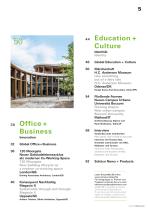
Global Education + Culture 50 Märchenhaft H.C. Andersen Museum Like something out of a fairy tale H.C. Andersen Museum Odense/DK Kengo Kuma And Associates, Tokio/JPN 54 Fließende Formen Nuovo Campus Urbano Università Bocconi Flowing shapes New urban campus Bocconi University Mailand/IT S A N A A /Kazuyo Sejima und Ryūe Nishizawa, Tokio/JP Global Office + Business 36 120 Moorgate Neuer Gebäudelebenszyklus als moderner Co-Working-Space 120 Moorgate New building lifecycle as a modern co-working space London/GB Darling Associates Architects, London/GB 40 Konsequent Nachhaltig Magasin X Sustainable...
Open the catalog to page 5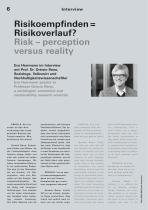
Risikoempfinden = Risikoverlauf? Risk – perception versus reality Eva Herrmann im Interview mit Prof. Dr. Ortwin Renn, Soziologe, Volkswirt und Nachhaltigkeitswissenschaftler Eva Herrmann speaks to Professor Ortwin Renn, a sociologist, economist and sustainability research scientist wirkungen der systemischen Risiken der Tr a n s f o r m a t i o n . W i e definieren Sie diese? O r t w i n R e n n : Systemi- sche Risiken sind Risiken, die die Funktionsfähigkeit eines Systems infrage stellen und auch sehr schnell auf andere Systeme überspringen. Wir haben verschiedene Merkmale von systemischen...
Open the catalog to page 6
Der Klimawandel ist eine abstrakte Erscheinung, dessen Folgen wir in die Zukunft projizieren. Das motiviert nicht unbedingt zum Handeln. Um dies zu überwinden, brauchen wir Nachhaltigkeitswissenschaftler wie Prof. Dr. Ortwin Renn, der sich mit dem Spannungsfeld zwischen den systemischen Risiken und Transformationsprozessen beschäftigt, zugunsten einer sozialverträglichen und nachhaltigen Wirtschafts- und Gesellschaftsentwicklung, der Beteiligung der Gesellschaft an politischen Entscheidungsprozessen und der Rolle von technologischen Innovationen. Climate change is an abstract phenomenon, the...
Open the catalog to page 7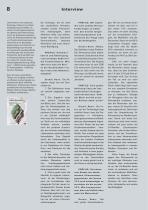
Ortwin Renn ist ein deutscher Soziologe, Volkswirt und Nach-haltigkeitswissenschaftler. Zu seinen Forschungsschwerpunk-ten gehoren das Risikomanage-ment, die Risikokommunikation sowie die Partizipationsforschung und Transformationsprozesse. Ortwin Renn hat Nachhaltig-keitskonzepte und Verfahren zur Burgerbeteiligung entwickelt und untersucht gesellschaftliche Auswirkungen des technischen Fortschritts. Bis Ende 2022 war er Wissenschaftlicher Direktor am Institut fur Transformative Nachhaltigkeitsforschung (IASS) (seit 1.1.2023 Forschungsinstitut fur Nachhaltigkeit - Helmholtz Zentrum Potsdam)....
Open the catalog to page 8
motivation as well as more intensive participation. PROFILE: Communication and participation are important levers for transformation. How do we get society as a whole to play an active role? Isn't that a mammoth task? Ortwin Renn: Acceptance depends on four parameters. 1. The measure must be considered reasonable. 2. The result must have a positive cost-benefit outcome. And this is where things start to get difficult, because how do you assess a positive benefit that will only arise in the future? This is where communication comes into play. Not only to warn people about future damage, but to...
Open the catalog to page 9
Carbon Control Schüco Carbon Control CO2−Minimierung der Gebäudehülle Minimising CO2 in construction »Herausforderung Klimawandel« lautet eines der Leitthemen der Bau 2023. Die Baubranche arbeitet an den Lösungen zur Bewältigung dieser Herausforderung bereits seit vielen Jahren und bietet Bauschaffenden Produkte und Leistungen für nachhaltiges Bauen im Neubau und Bestand. Dennoch hat sich die Realisierung klimaneutraler Bauvorhaben noch nicht flächendeckend umsetzen lassen. Im Kontext des europäischen Green Deal werden die regulatorischen Anforderungen nun weiter verschärft und stellen Investoren,...
Open the catalog to page 10
Carbon Control Der Bausektor gehört zu den energieintensivsten Wirtschaftssektoren weltweit. Er ist damit für einen großen Teil der global entstehenden CO2-Emissionen verantwortlich. Das verabschiedete Ziel ist daher so ambitioniert wie notwendig: Mit dem Europäischen Green Deal wollen die 27 EU-Mitgliedstaaten bis 2050 klimaneutral werden. In einem ersten Schritt sollen die Treibhausgasemissionen bis 2030 um mindestens 55 Prozent gegenüber dem Stand von 1990 sinken. Das deutsche Klimaschutzgesetz verschärft die Vorgabe noch einmal und fordert eine Reduktion um 67 Prozent. Was dabei Architektur-...
Open the catalog to page 11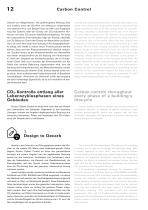
Carbon Control Vielzahl von Möglichkeiten. Die größtmögliche Wirkung lässt sich erzielen, wenn der CO2-Wert von Anfang an mitbetrachtet und optimiert wird, zum Beispiel über die Wahl und Ausgestaltung des Systems oder den Einsatz von CO2-reduziertem Aluminium mit einer CO2-armen Oberflächenveredelung. Am Ende des Lebenszyklus eines Gebäudes trägt der Rückbau ebenfalls zur CO2-Bilanz bei. Durch den Einsatz von Materialien und Systemen, die nach dem Ende ihrer Nutzung in die Ausgangsrohstoffe zerlegt und wieder zu einem neuen Produkt genutzt werden können, lässt sich der Ressourcenverbrauch deutlich...
Open the catalog to page 12All Schüco catalogs and technical brochures
 Issue 21/2018
41 Pages
 Special Issue BAU 2019
35 Pages
 Issue 22/2019
41 Pages
 Special Issue BAU 2019
34 Pages
Archived catalogs
 PVC-U systems
125 Pages
 Mullion / transom Façades
14 Pages
 Schüco steel systems Jansen
32 Pages

