
- Catalogs
- Schluter Systems
- Tile Countertops

Tile Countertops

1 / 8 PagesView full catalog
Tile Countertops
Product catalog summary
Introduction
Tile countertops were once a popular choice in North American homes due to their aesthetic appeal and functionality. Traditionally installed using the mortar bed method, these countertops were durable and moisture-resistant. However, advancements in adhesive and tile manufacturing led to changes in installation methods, which presented new challenges.
Historical Installation Methods
Initially, tile countertops were installed using the mortar bed method, which ensured a solid and moisture-resistant surface. This method allowed for the creation of flat, plumb, level, and square countertops. Special ceramic trim pieces were used to enhance the design, offering features like tiled under sinks and ceramic coves.
Challenges with Modern Methods
With the introduction of thin-set mortar and organic adhesives in the late 1950s and early 1960s, the traditional mud-set method became less common. This shift led to the use of plywood substrates, which are prone to moisture damage, reducing the service life of tile countertops.
Technological Advancements
The development of the monocottura process improved the strength and durability of ceramic tiles, allowing for larger formats. However, this process did not support the production of special trim pieces needed for countertops.
Modern Solutions
Schluter®-Systems offers a new system for tile countertops that addresses previous challenges. The Schluter®-DITRA membrane allows for independent movement between the tile and plywood, preventing damage from expansion and contraction. It also provides waterproofing and vapor management.
Schluter® Products
- Schluter®-DITRA: Protects tiles from substrate movement and moisture.
- Schluter®-KERDI-BAND: Seals seams and transitions.
- Schluter®-KERDI-FIX: Seals areas between DITRA and sinks.
- Schluter®-DILEX Profiles: Provide maintenance-free transitions and eliminate caulk joints.
- Schluter®-RONDEC Profiles: Offer elegant sink rails and edge protection.
Conclusion
Schluter®-Systems' modern components and methodologies offer a user-friendly system that surpasses traditional methods in both technical and aesthetic aspects. These advancements, combined with modern tile manufacturing, promise timeless elegance and durability for tile countertops.
Tile countertops were once a popular choice in North American homes due to their aesthetic appeal and functionality. Traditionally installed using the mortar bed method, these countertops were durable and moisture-resistant. However, advancements in adhesive and tile manufacturing led to changes in installation methods, which presented new challenges.
Historical Installation Methods
Initially, tile countertops were installed using the mortar bed method, which ensured a solid and moisture-resistant surface. This method allowed for the creation of flat, plumb, level, and square countertops. Special ceramic trim pieces were used to enhance the design, offering features like tiled under sinks and ceramic coves.
Challenges with Modern Methods
With the introduction of thin-set mortar and organic adhesives in the late 1950s and early 1960s, the traditional mud-set method became less common. This shift led to the use of plywood substrates, which are prone to moisture damage, reducing the service life of tile countertops.
Technological Advancements
The development of the monocottura process improved the strength and durability of ceramic tiles, allowing for larger formats. However, this process did not support the production of special trim pieces needed for countertops.
Modern Solutions
Schluter®-Systems offers a new system for tile countertops that addresses previous challenges. The Schluter®-DITRA membrane allows for independent movement between the tile and plywood, preventing damage from expansion and contraction. It also provides waterproofing and vapor management.
Schluter® Products
- Schluter®-DITRA: Protects tiles from substrate movement and moisture.
- Schluter®-KERDI-BAND: Seals seams and transitions.
- Schluter®-KERDI-FIX: Seals areas between DITRA and sinks.
- Schluter®-DILEX Profiles: Provide maintenance-free transitions and eliminate caulk joints.
- Schluter®-RONDEC Profiles: Offer elegant sink rails and edge protection.
Conclusion
Schluter®-Systems' modern components and methodologies offer a user-friendly system that surpasses traditional methods in both technical and aesthetic aspects. These advancements, combined with modern tile manufacturing, promise timeless elegance and durability for tile countertops.
See more
All Schluter Systems catalogs and technical brochures
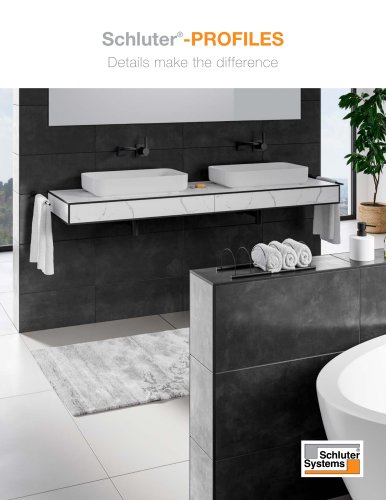 Schluter® -PROFILES
21 Pages
 FLOOR PROFILES
9 Pages
 Commercial Product Overview
32 Pages
 Brochure KERDI-LINE
8 Pages
 CountertopBrochure
2 Pages
 corporateprofile
8 Pages
 Schluter® Profiles
9 Pages
 The Next Generation Bathroom
7 Pages
 Product Overview
20 Pages
 Schluter® -Shower System
40 Pages
 Schluter® -DITRA
36 Pages


Related Searches
- Waterproofing membrane
- Schluter Systems edge trim
- Roll waterproofing membrane
- Metal profile
- Plastic waterproofing membrane
- Schluter Systems tile edge trim
- Schluter Systems aluminum edge trim
- Outside corner edge trim
- Industrial stair nosing
- Straight edge trim
- Edge profile
- Transition profile
- Linear shower drain
- Non-slip stair nosing
- Stainless steel edge trim
- Metal stair nosing
- Aluminum stair nose
- Industrial flashing
- Strip type waterproofing membrane
*Prices are pre-tax. They exclude delivery charges and customs duties and do not include additional charges for installation or activation options. Prices are indicative only and may vary by country, with changes to the cost of raw materials and exchange rates.
About ArchiExpo
ArchiExpo is a marketplace that offers B2B players a complete experience, from product sourcing to purchase. ArchiExpo is an entity of VirtualExpo Group.
Are you a buyer?
Are you a supplier?