
- Catalogs
- Schluter-Systems
- Schlüter® -BARA-ESOT

Schlüter® -BARA-ESOT

Schlüter® -BARA-ESOT
Schlüter®-BARA-ESOT is an angular support profile designed for bonding skirting tiles to non-load-bearing substrates such as zinc-flashing or bituminous waterproofing layers, typically used at wall/floor transitions on balconies and terraces. A foam insulation strip is placed between the profile's vertical leg and the wall. The anchoring leg is embedded in tile adhesive and covered by the floor tile, with a special perforation allowing for a 1 mm gap from the insulating strip. A joint of approximately 5 mm is left between the skirting and floor tile, filled with grout, and sealed with a flexible compound.
Material
The profile is made of 0.8 mm thick stainless steel with perforated legs and spacer deflections. It is used where there is no load-bearing substrate for the base tile, such as over waterproofing membranes. The Schlüter®-TROBA-PLUS drainage system is recommended to prevent water collection.
Installation
1. Apply a foam insulation strip to the wall.
2. Embed the anchoring leg into the floor surface contact layer.
3. Embed floor tiles into adhesive over the anchoring leg.
4. Apply adhesive to the base tiles and attach to the profile's vertical leg.
5. Fill the joint between floor and base tile with grout.
6. Seal the wall connection above the skirting with a flexible compound.
Maintenance
No special maintenance is required for Schlüter®-BARA-ESOT profiles.
Catalog excerpts
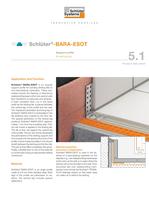
NNOVATIVE PROFILES Support profile support profile for bonding skirting tiles to non-load-bearing substrates. These sub- strates Include zinc-flashing or bituminous waterproofing layers which are used at wall/ floor transitions on balconies and terraces. A foam insulation strip, cut in the same width as the skirting tile, is placed between the vertical leg of the profile and the wall. tile adhesive and covered by the floor tile. The special perforation of the vertical leg positions Schluter®-BARA-ESOT approxi- mately 1 mm from the Insulating strip. First, dry-set mortar Is applied to the skirting tile. The tile is then set against the vertical leg of the profile. The dry-set mortar penetrated the perforations of the skirting support and thus locked Into the special structure of the profile. Ajoint of approximately 5 mm should be left between the skirting and the floor tile. The joint Is then filled completely with grout. Finally, a flexible joint on top of the base tile Is constructed using an appropriate sealing Schluter®-BARA-ESOT is an angle profile made of 0.8 mm thick stainless steel. Both legs of the profile are perforated. In ad- dition, the vertical leg Includes spacer Material properties sence of a load-bearing substrate for the base tile, e.g., over waterproofing membranes which carry up the wall, or In cases where the skirting will not be bonded to the wall. Floor structures laid over waterproofing mem- branes must Include the Schluter®-TROBA- PLUS drainage system so that water does not collect at or behind the skirting.
Open the catalog to page 1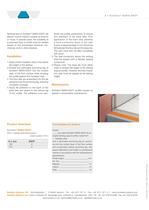
Skirtings laid on Schlüter®-BARA-ESOT will absorb normal impacts caused by brooms or mops. In special cases, the suitability of a proposed type of profile must be verified based on the anticipated chemical, me- chanical, and/or other stresses. 1. Apply a foam insulation strip to the wall at 2. Embed the perforated anchoring leg of Schluter®-BARA-ESOT into the contact layer of the floor surface while pressing the profile against the Insulation strip. 3.The floor tiles are embedded into the tile adhesive over the anchoring leg, ensuring complete coverage. 4.Apply tile adhesive to the back of the...
Open the catalog to page 2All Schluter-Systems catalogs and technical brochures
 SCHLÜTER®-KERDI-DRAIN-SP-E
2 Pages
 Schlüter®-DITRA-SOUND
6 Pages
 8.6 Schlüter® -KERDI-SHOWER
4 Pages
 10.1 Schlüter® -BARIN
6 Pages
 Schlüter® -BARA-RAKE/-RAKEG
4 Pages
 5.19 Schlüter® -BARA-RT
4 Pages
 5.11 Schlüter® -BARA-RTP
2 Pages
 5.9 Schlüter® -BARA-RTK
4 Pages
 5.4 Schlüter® -BARA-RK
2 Pages
 5.3 Schlüter® -BARA-RW
2 Pages
 3.5 Schlüter® -TREP-G /-GL
4 Pages
 12.1 Schlüter® -KERDI-BOARD
12 Pages
 Save Energy Now!
8 Pages


- Panel insulation
- Thermal insulation
- Trim board
- Synthetic insulation
- Roll waterproofing membrane
- Schlüter -Systems metal profile
- Wall insulation
- Plastic waterproofing membrane
- Thermal-acoustic insulation
- Protection waterproofing membrane
- Roof waterproofing membrane
- Tile edge trim
- Rigid insulation panel
- Industrial acoustic insulation
- Aluminium edge trim
- Industrial floor drain
- Flooring insulation