
- Catalogs
- Saint-Gobain Ecophon
- Ecophon Office Guide

Ecophon Office Guide

Ecophon Office Guide
The document discusses the importance of creating office environments that mimic natural soundscapes to enhance productivity and well-being. It emphasizes the role of design in fostering creativity and innovation through the use of various materials and installation methods.
Activity-Based Acoustic Design
This approach involves tailoring acoustic solutions to specific office activities, such as teamwork and brainstorming, to improve job satisfaction and performance.
Office Facts
Noise exposure is linked to increased absenteeism and reduced productivity. Effective acoustic environments can reduce stress and improve concentration and task performance.
Zones in the Office
Different office areas require specific acoustic treatments. For example, welcoming areas need sound absorption to prevent echoes, while brainstorming zones require solutions to avoid sound leakage.
6 Tips for Better Office Acoustics
1. Understand the purpose of each space.
2. Customize solutions for each office.
3. Consider three-dimensional sound movement.
4. Use high-quality acoustic materials.
5. Identify and address noise sources.
6. Incorporate natural soundscapes.
Comparative Noise Levels
Illustrates typical noise levels in various environments, emphasizing the importance of managing sound propagation in offices.
Acoustic Terms
Defines key concepts such as reverberation, speech clarity, and sound propagation, highlighting their impact on office acoustics.
Materials for Better Acoustics
Discusses the importance of room geometry, scattering, and sound insulation in creating effective acoustic environments.
Creating Great Places to Work
Future offices will blend traditional and modern workspaces, accommodating diverse generational needs and fostering creativity and collaboration.
Engaging Work with Colours
Colors play a significant role in creating a positive and engaging work environment, contributing to overall employee satisfaction.
Acoustic Solutions
The document underscores the significance of acoustic ceilings, which affect both aesthetics and user wellbeing. Ecophon offers a range of acoustic solutions that are 100% recyclable and made from high levels of recycled materials, designed to optimize acoustic comfort and contribute to green building certifications.
Sustainability in Office Design
Sustainable office design is crucial for reducing environmental impact. Key aspects include maximizing the circular use of materials, optimizing acoustic comfort, achieving green building certifications, using healthy materials, minimizing carbon footprints, and maximizing natural light.
Product Offerings
The document details various Ecophon products:
- Ecophon Focus™: Offers design flexibility with excellent acoustics.
- Ecophon Solo™: Provides freedom of expression with customizable shapes and sizes.
- Ecophon Akusto™: Complements acoustic ceilings with wall solutions and screens.
- Ecophon Master™: Delivers superior sound absorption and speech clarity for demanding environments.
References and Research
The document cites various studies and surveys that support the importance of acoustics in workplace design and its impact on productivity and wellbeing.
Company Information
Ecophon, part of the Saint-Gobain Group, is a leading supplier of indoor acoustic solutions. The company is committed to enhancing working environments through sustainable and innovative products.
Conclusion
Ecophon’s solutions are designed to improve working performance, wellbeing, and quality of life, aligning with the company’s mission to create sustainable and comfortable habitats.
Catalog excerpts

welcome to the sound of nature sustainable offices on how to improve the sound environments in offices Learn all about activity based acoustic design
Open the catalog to page 1
06 activity based acoustic design 08 office facts 10 get in the zone 12 Welcoming areas 12 Multitasking 12 Teamwork 12 Brainstorming 13 Talking on the phone 13 Focusing in the office 13 Formal meetings 13 Informal meetings 14 6 tips 15 comparative noise levels 16 ACOUSTIC TERMS 20 MATERIALS FOR BETTER ACOUSTICS 22 CREATING GREAT PLACES TO WORK 24 ENGAGING WORK WITH COLOURS 26 SUSTAINABLE OFFICES 28 PRODUCTS THAT BRING THE SOUND OF NATURE TO YOUR OFFICE 28 Ecophon Focus™ 28 Ecophon Master ™ 29 Ecophon Akusto™ 29 Ecophon Solo™
Open the catalog to page 2
The sound of nature in the office We’ve spent hundreds of thousands of years perfecting our hearing outdoors. In nature. Yet today we spend up to 90 per cent of our time indoors. Isn’t it time we enjoyed the sound of nature there too? What if we can imitate natural sound environments in an office by learning from our origins? To make spaces for our thoughts to roam free. Our ideas to breathe. Yet 70% of us are not happy about the level of noise in our workplace.¹ Ensuring comfortable acoustics isn’t just about making people feel good. It’s about raising performance. The less we are disturbed,...
Open the catalog to page 3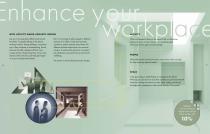
Enhance your workplace with activity based acoustic design Are you in an open-plan office? Look around. And listen. To people talking on the phone, working in teams, having meetings, concentrating on their computer or brainstorming. Sound bounces off walls, ceilings and floors and creates echoes. People raise their voices to be heard and the overall sound level gets higher. It’s a poor working environment. What will people be doing in the space? Talk on the phone, teamwork, focus on their computer or something else? How much time is spent communicating? But it’s not enough to place people in...
Open the catalog to page 4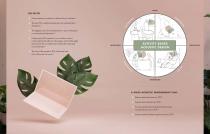
● The top 25% workplace performers are protected from disruptions ⁴ ● Noise exposure correlates to absence due to sickness ³ ● The biggest cause of lost productivity in open workplaces is conversational distractions ⁵ ● It takes around 25 minutes for a co-worker to return to the original task after an interruption, and another eight minutes until the co-worker has reached the same level of concentration ⁶ activity based acoustic design ● The cost of the people is 82% of the total cost of an office over ten years ² a good acoustic environment can : ● Reduce adrenaline levels by 30% ⁷ ● Improve...
Open the catalog to page 5
Our workplace needs spaces for working individually and other zones that encourage social interaction. Quiet, high-focus areas are designed for work tasks that demand undisturbed concentration. Chillout zones offer a comfortable environment for rest and relaxation or low-intensive networking.
Open the catalog to page 6
welcoming areas : We need to absorb sound, hinder echoes and improve speech clarity. Keeping conversations at the reception desk from spreading throughout the space. Let’s be more welcoming, use a sound-absorbing ceiling with good absorption qualities, add lowered sound absorbing free-hanging units directly above the reception desk and wall absorbers on the wall behind the desk. Having meetings, discussions and work sessions are all part of the job, often done in semi-open spaces or completely open spaces. You need to keep sound from spreading, prevent sound levels from escalating and avoid people...
Open the catalog to page 7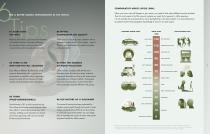
for a better sound environment at the office #4 never compromise on quality Research shows that a good sound environment at the office leads to increased well-being, less tiredness, better communication and concentration and increased job satisfaction. Make sure you choose acoustic materials with an absorption quality of αw = 0.9 or higher – class A. Think as well about indoor air quality, fire safety and sustainability. comparative noise levels (dba) When you know what will happen in your space, you need to think about different acoustic qualities. Then it’s much easier to find the acoustic...
Open the catalog to page 8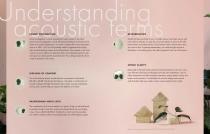
Understanding acoustic terms sound propagation Sound propagation is sound spreading through a space. If you don’t prevent sound propagation, sound will spread, leading to increased sound levels and constant disturbance. You need a ceiling with at least absorption class A or NRC > 0.9. You will probably need to supplement the ceiling with sound-absorbing screens and wall absorbers. Since speech is the most common sound in offices it is important that sound absorbers perform well at frequencies where speech is predominant. Your ceiling should also have a high Articulation Class value. Sound that...
Open the catalog to page 9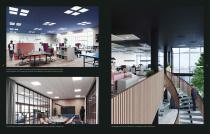
19 A wall-to-wall acoustic ceiling is the easiest way to get a large sound-absorbing surface area into a space. Vertical absorbers such as screens and wall panels can be added for a truly optimal acoustic environment. Sound insulation is important to reduce distractions and ensure speech privacy, especially in meeting rooms. Free hanging units can be an alternative or a complement to wall-to wall solutions.
Open the catalog to page 10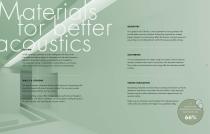
Materials for better acoustics geometry As a general rule of thumb, a more asymmetrical room geometry will provide better acoustic conditions if absorbing materials are already present. slanted or curved surfaces affect the direction of sound waves and ensure they are not reflected back and forth between parallel surfaces. A fully covering suspended acoustic ceiling gives the best results. It provides the highest degree of absorption over the entire frequency spectrum. Suspended ceilings are the ideal way to handle this. If a suspended ceiling is impractical or undesirable you can choose other...
Open the catalog to page 11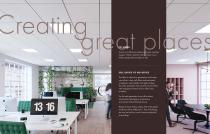
Creating great places to work Tomorrow’s offices are where impromptu meetings happen. Where creativity and innovation occur. Where people talk and ideas to flow. cell office vs no office The office is where four generations work under one culture, where cell offices and permanent workplaces meet mobility and agile working. The older generation may want that corner office with mahogany furniture and an office chair in leather. For the next generation it may all be about communities, belonging in a permissive environment where they feel secure. Research shows that by 2025, 75% of the global workforce...
Open the catalog to page 12All Saint-Gobain Ecophon catalogs and technical brochures
 ecophon focus ™
18 Pages
 ecophon akusto™
14 Pages
 Telehealth
13 Pages
 Ecophon Focus™ Lp
6 Pages
 Ecophon Hygiene™
68 Pages
 Ecophon Acoustic Calculator
20 Pages
 Acoustic design
12 Pages
 Ecophon Solo
24 Pages
 Ecophon Wall Panel
26 Pages
 Ecophon Hygiene system
68 Pages


Archived catalogs
 HANDBOOK - ceiling systems
284 Pages
 Ceiling System Overview
40 Pages
 Ecophon Master Baffle
6 Pages
 EDUCATIONAL PREMISES
44 Pages
 Ecophon Wall Panel™
24 Pages
 Acoustic Design for Health
12 Pages
 ECOPHON HYGIENE
40 Pages
- Light fixture
- Industrial LED light
- Metal light fixture
- Commercial light fixture
- Contemporary light fixture
- Recessed light fixture
- Dimmable light fixture
- Linear light fixture
- White light fixture
- Round light fixture
- Single light fixture
- Acoustic panel
- Commercial acoustic panel
- Rectangular acoustic panel
- Decorative acoustic panel
- Acoustic wall panel
- Square light fixture
- Office acoustic panel
- Methacrylate light fixture