
- Catalogs
- Saint-Gobain Ecophon
- Ecophon Acoustic Calculator

Ecophon Acoustic Calculator

Ecophon Acoustic Calculator
The document introduces the Ecophon Acoustic Calculator, a tool designed to provide accurate acoustic values for both existing and planned rooms. It addresses the limitations of traditional Sabine formula-based calculations and emphasizes the need to consider additional parameters such as speech clarity and sound strength.
Specifications and Procedures
The Ecophon Acoustic Calculator uses an energy model with air flow resistance as input data for absorbers, aiming to align calculated results with real-life measurements and resolve discrepancies between calculated and actual acoustic values.
Activity-Based Acoustic Design
This approach considers activity, people, and space, emphasizing tailored acoustic solutions for specific environments like classrooms, open-plan offices, and hospitals to enhance well-being and performance.
Room Types and Acoustic Parameters
Three room types are identified: Sabine rooms, rooms with suspended sound-absorbing ceilings, and open-plan spaces, each requiring different acoustic considerations. Key parameters include reverberation time (T20), speech clarity (C50), and sound strength (G), as per ISO 3382 standards.
Room Acoustic Design
The goal is to optimize acoustic solutions for specific activities and room types. Ecophon provides target values for traditional classrooms, recommending specific ranges for T20, C50, and G to achieve optimal acoustic conditions.
Effects of Acoustic Treatment
Analysis of various room configurations with and without sound-absorbing elements shows that furniture, wall absorbers, and low-frequency absorbers significantly impact reverberation time, speech clarity, and sound strength, helping to meet target acoustic values.
Comparison with Sabine Formula
The document critiques the Sabine formula, highlighting its limitations in rooms with non-diffuse sound fields and the need for a more accurate calculation model for rooms with sound-absorbing ceilings.
Conclusion
The Ecophon Acoustic Calculator provides a comprehensive model that considers multiple acoustic descriptors, promoting better acoustic environments in educational, office, and healthcare settings.
Reverberation Time and Sound Absorption
Reverberation time, a key descriptor in building acoustics, is defined by ISO 3382-2 as the time for sound to decrease by 60 dB after the source stops. The Sabine formula is commonly used but may not fully capture real-world acoustics.
ISO 354 and Practical Absorption Coefficient (αp)
ISO 354 outlines the method for determining sound absorption properties using the Sabine formula in a reverberation chamber. The practical absorption coefficient (αp) is influenced by factors like air gap height and is valid only for diffuse sound fields.
ISO 11654 and Product Classification
ISO 11654 classifies acoustic absorbers from A to E based on a weighted sound absorption index (αw), which simplifies the practical absorption coefficient but does not fully represent real-world performance.
Air Flow Resistance (AFR)
Air flow resistance, measured according to ISO 9053, is a product-specific property that helps calculate more accurate absorption coefficients, applicable to Activity Based Acoustic Design.
New Model for Sound Decay Calculation
Ecophon has developed a model for calculating sound decay in rooms with absorbing ceilings, accounting for factors like sound scattering and air flow resistance, providing a more accurate representation of room acoustics.
Ecophon Acoustic Calculator
The Ecophon Acoustic Calculator is a free tool that allows users to calculate acoustic values for different spaces without physical measurements, providing instant results and recommendations.
Ecophon and Saint-Gobain
Ecophon, part of the Saint-Gobain Group, focuses on creating healthier indoor environments by improving acoustic conditions. Saint-Gobain is a leader in sustainable habitat solutions, addressing energy efficiency and environmental protection challenges.
Catalog excerpts
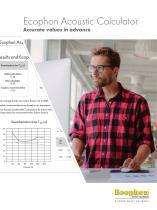
Sabine calculation 0.34 RAC calculation 0.42 Ecophon recommendation £ 0.5 ste: Average bonds over octave bands 1 25 to 4006. ophon recommendations are based on our experience^ om Acoustic Comfort (RAC) calculations for rooms with rrespondence to measurements than Sabine formula.
Open the catalog to page 1
This publication shows products from Ecophon product range and those of other suppliers. The specifications are intended to provide a general guide to which products are most suitable for the preferences indicated. Technical data is based on results obtained under typical testing conditions or long experience in normal conditions. The specified functions and properties for products and systems are only valid on condition that instructions, installation diagrams, installation guides, maintenance instructions and other stated conditions and recommendations have been taken into consideration and...
Open the catalog to page 2
Frequency Hz Measurement perforated gypsym Measurement Ecophon Master™ A Sabine calculation perforated gypsum Sabine calculation Ecophon Master™ A All materials, for instance glass wool, stone wool and gypsum, get different values from Sabine calculations and actual measurements. In this graph you can see calculated and measured results for Ecophon Master™ A, and perforated gypsum. Find out what a room will actually sound like Today almost all room acoustic calculations are based on the Sabine formula. Even though it is known that you often get different values when you compare calculations with...
Open the catalog to page 3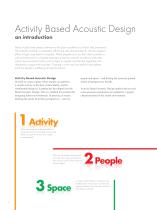
Activity Based Acoustic Design an introduction Many studies have placed attention to the poor conditions in schools and preschools. The stressful situations in open-plan offices are well documented. As are the negative effect of high noise levels in hospitals. Many people carry out their daily activities in such premises and it is of great importance that the acoustic conditions and other indoor environmental factors such as light, air quality and thermal regulation are designed to support the activities. Creating a calm and less stressful atmosphere enhance people’s wellbeing and performance....
Open the catalog to page 4
Room types Three room types with different acoustical behaviour can be identified. We have the Sabine room, the room with a suspended sound-absorbing ceiling and the open-plan space. The Sabine room assumes a diffuse sound field which in turn requires that the sound absorption is quite low and well distributed over all the surfaces. This type of room is well characterised with the use of reverberation time. Further, in the Sabine room speech clarity and sound level are related to the reverberation time. The situation is different for the room with a soundabsorbing suspended ceiling. In this type...
Open the catalog to page 5
Room acoustic design The aim of room acoustic design is to find an optimized acoustic solution for the activity going on in the room and for the actual type of room. In practice this means to find a balance between our three room acoustic parameters that supports the activity as good as possible. Neither of the extremes in the form of an anechoic chamber or a reverberation room is suitable for ordinary work places. The solution is to find in between. Based on field investigations and listening tests, Ecophon recommends the following T20, C50 and G for a traditional classroom: 1 The early reflections,...
Open the catalog to page 6
1. Room without a suspended soundabsorbing ceiling and no furniture 2. Room with a suspended sound-absorbing ceiling but no furniture The reverberation time is long at mid frequencies but decline somewhat towards low and high frequencies. Based on the definition of C50 it can give negative values. This means that all the late reflections contain more energy than the early reflections. Early reflections are important for the perceived speech clarity. All parameters are affected. Still the reverberation time and speech clarity are far from the target values. However, concerning sound strength the...
Open the catalog to page 7
3. Room with a suspended sound-absorbing ceiling and furniture 4. Room with a suspended sound-absorbing ceiling, furniture and wall absorbers Furniture contributes to absorption and sound scattering. In combination with a sound-absorbing ceiling the effect of scattering on reverberation time and speech clarity is significant. But we still do not reach the target values. Adding wall absorbers will have a significant effect on reverberation time and speech clarity but less effect on sound strength. Now we reach the target values for the reverberation time and sound strength at high frequencies....
Open the catalog to page 8
5. Room with a suspended sound-absorbing ceiling, furniture and low-frequency absorbers 6. Room with a suspended sound-absorbing ceiling, furniture, wall absorbers and lowfrequency absorbers An efficient way to improve the absorption in the low frequencies is to add specific low-frequency absorbers above the suspended ceiling. The low-frequency absorbers will especially improve the reverberation time and speech clarity at 125 and 250 Hz. For the sparsely furnished classroom in the example, we can conclude that the combination of a suspended soundabsorbing ceiling, wall absorbers on two adjacent...
Open the catalog to page 9
Comparison with Sabine If we go back to the classroom with a suspended sound-absorbing ceiling but without furniture and do a calculation of the reverberation time according to the Sabine formula, the results indicate that the target values are already fulfilled. This emphasize that if there is a lack of sound diffusion in a rectangular type of room and the absorption is mainly focused on one surface, the results given by the Sabine formula can be very misleading. Even in sparsely furnished rooms measured reverberation times normally differ from the ones calculated by the Sabine formula. Another...
Open the catalog to page 10
New model for calculating room acoustics Calculations and measurements of reverberation time alone are most often used to evaluate rooms. Even though a long tradition of research shows that multiple acoustic descriptors are necessary to secure good room acoustics in for instance educational, office and healthcare facilities. Acoustic descriptors such as reverberation time, speech clarity and sound strength support low noise levels and good speech intelligibility. Therefore, Ecophon has promoted these acoustic descriptors since 2007. Background – Sabine and ISO 3382-1/2 Reverberation time was...
Open the catalog to page 11All Saint-Gobain Ecophon catalogs and technical brochures
 ecophon focus ™
18 Pages
 ecophon akusto™
14 Pages
 Ecophon Office Guide
17 Pages
 Telehealth
13 Pages
 Ecophon Focus™ Lp
6 Pages
 Ecophon Hygiene™
68 Pages
 Acoustic design
12 Pages
 Ecophon Solo
24 Pages
 Ecophon Wall Panel
26 Pages
 Ecophon Hygiene system
68 Pages


Archived catalogs
 HANDBOOK - ceiling systems
284 Pages
 Ceiling System Overview
40 Pages
 Ecophon Master Baffle
6 Pages
 EDUCATIONAL PREMISES
44 Pages
 Ecophon Wall Panel™
24 Pages
 Acoustic Design for Health
12 Pages
 ECOPHON HYGIENE
40 Pages
- Light fixture
- Industrial LED light
- Metal light fixture
- Commercial light fixture
- Contemporary light fixture
- Recessed light fixture
- Dimmable light fixture
- Linear light fixture
- White light fixture
- Round light fixture
- Single light fixture
- Acoustic panel
- Commercial acoustic panel
- Rectangular acoustic panel
- Decorative acoustic panel
- Acoustic wall panel
- Square light fixture
- Office acoustic panel
- Methacrylate light fixture