
- Catalogs
- SAINT-GOBAIN CANALISATION
- Trenchless pipe laying

Trenchless pipe laying

Trenchless pipe laying
Ductile iron pipes are highlighted as a reliable option for trenchless pipe laying, particularly through horizontal directional drilling (HDD), due to their durability and flexibility, making them suitable for challenging environments.
HDD originated in the early 20th century and became prominent in the oil industry by the late 1920s. Advancements in guidance systems and drilling equipment in the 1930s, along with hydraulic improvements in the 1970s, have enhanced its viability.
Saint-Gobain PAM employs three main trenchless techniques: horizontal directional drilling, pipe bursting, and pulling through a casing, utilizing the mechanical strength and flexibility of ductile iron pipes.
HDD consists of three phases: drilling the pilot hole, enlarging it, and pulling the pipe string. It allows pipelines to traverse obstacles like rivers or roads without extensive excavation. Performance is influenced by ground conditions, drilling radius, and pipeline material.
This method replaces damaged pipelines with new ones of the same or slightly larger diameter by bursting the old pipe and pulling in the new one, minimizing site impact and maintaining service continuity.
This involves installing a pipeline within an existing or new sleeve, suitable for rehabilitation or new installations crossing obstacles. Proper centering and anchoring are essential for success.
Trenchless techniques offer reduced social, indirect, and direct costs compared to traditional methods, lower environmental impact, and economic advantages. Ductile iron pipes are recyclable, enhancing environmental benefits.
Trenchless pipe laying with ductile iron pipes is economical, durable, and environmentally friendly, reducing greenhouse gas emissions and providing long-term benefits.
The document details PAM's ductile iron pipes, focusing on applications, specifications, and trenchless pipe laying technology, emphasizing their global recognition for strength, durability, and reliability.
PAM offers Universal Ve pipes with coatings tailored to specific ground conditions and purposes, such as sewage and drinking water distribution, including thick polyethylene, reinforced polyurethane, and ZMU cement mortar.
The Universal Ve self-anchored joint technology supports trenchless operations, offering flexibility and leak tightness. The document outlines angular deflection and allowable curve radius for different pipe diameters, highlighting adaptability.
Tables provide data on allowable pulling forces and lengths for various pipe diameters, showcasing the system's capacity for significant pulling efforts. Information on different drilling rigs and their capabilities is also included.
PAM provides comprehensive service solutions, including pre-project calculations and training for pipe laying teams, with each project receiving detailed technical studies for successful implementation.
Projects adhere to ISO 13470 standards and the French Guide of Practice Fascicule 70, ensuring high-quality and reliable installations.
PAM has extensive experience in trenchless pipe laying, with over 90,000 linear meters of pipes laid using HDD, and lists various international offices, indicating its global presence.
Catalog excerpts
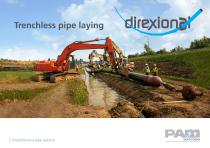
Trenchless pipe laying Comprehensive pipe systems
Open the catalog to page 1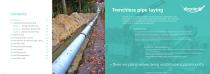
Trenchless pipe laying Introduction 03 01 horizontal directional drilling phase 1 : drilling the pilot hole 04 phase 2 : enlarging the pilot hole 06 phase 3 : pulling the pipe string 08 03 pulling through a casing 12 04 the benefits of trenchless pipe laying 16 05 the PAM offer 18 Ductile iron represents a reliable and advantageous alternative to the materials normally used in horizontal directional drilling. The sturdiness, modularity and durability of cast iron pipes is combined with proven technology to enable pipeline flexibility. A little history The horizontal directional drilling technique...
Open the catalog to page 2
Horizontal directional drilling Phase 1 Drilling hole with bentonite and drill string DRILLING UNIT Truck with hydraulic unit, high pressure pumps, bentonite pumps Horizontal directional drilling enables a pipeline to pass under an obstacle, such as a canal, a river or a road. Unlike horizontal boring technique that require major excavation at both ends, the curved trajectory of horizontal directional drilling enables the pipeline to pass under obstacles starting from ground level. Horizontal directional drilling performance depends on several factors: nature of the ground stratigraphy ...
Open the catalog to page 3
Exit earthworks and pipe Did you know It is common practice to select the final bore diameter using the following data. D = pipe socket outside diameter The bore diameter varies according to the diameter of the pipeline to be installed as well as the drilling length, the nature of the ground, the curve radius, etc. It may be necessary to carry out successive boring operations, using boring tools of increasing diameter, to obtain the correct diameter which is between 1.2 and 1.5 times the pipeline diameter. The boring head is fitted with injection holes, like the drilling head. Injecting bentonite...
Open the catalog to page 4
Horizontal directional drilling Phase 3 Ballasting steps Ballast tube Bentonite Drilling hole Ballasting water PAM has designed and produced pulling heads to DN 1000 Once the boring operation is complete, the tunnel remains filled with bentonite. This acts as an excellent lubricant and facilitates the pulling of pipes by reducing friction and force on the joints. To reduce the pulling resistance of the assembled pipe string upstream, it may be necessary to install a guidance system fitted with support rollers. Furthermore, for pipelines with a diameter greater than 300mm, the hydrostatic thrust...
Open the catalog to page 5
Pipe bursting This technique to replace old pipelines enables a damaged pipe to be replaced by a new pre-assembled Universal Ve type ductile iron pipes of an equivalent or slightly greater diameter, depending on the nature of the old pipeline. This technology is also used to considerably reduce the site impact. The pipes are assembled one by one in a launch pit. The exit pit must be able to contain the extraction machine. A hydraulic device pushes a drill string through the old conduit and on its return, with a bursting head attached, bursts the old pipe with the fragments remaining in situ,...
Open the catalog to page 6
Pulling through a casing This laying method can be chosen for specific rehabilitation techniques (passing through an existing damaged pipe) or when laying new networks crossing a natural obstacle or in the case of trenchless works. When pulling through a casing, you must first define: the centring and guiding of each element within the casing the method used to anchor the elements together to guarantee the integrity of the section being installed the method used to connect the section passing through the casing to the existing network the best pulling mechanism from a technical and economic...
Open the catalog to page 7
The benefits of trenchless pipe laying Lower social costs Lower indirect costs Lower direct costs no interference with traffic fewer road signs needed more technical materials less site security required less damage to the environment no diversion costs for distributors no back-filling or compacting, no need to repair roads and pavements, etc. little or no risk of accidents no need to move street furniture little or no risk of economic consequences for local businesses Savings compared to a traditional site. less noise and air pollution for residents lower equipment and...
Open the catalog to page 8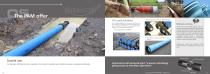
The PAM offer A la carte solutions With coatings adapted to the ground conditions and the purpose your pipelines will serve (sewage, distribution and transfer of drinking water), PAM offers its range of Universal Ve pipes coated with: Thick polyethylene until DN700 ZMU cement mortar until DN700 for rocky ground At the end of its life, PAM pipelines have the significant benefit of being infinitely recyclable through local systems (collection and recovery of scrap metal). This benefit arises from the use of ductile iron, which is produced mainly from recycled materials and is itself 100% recyclable...
Open the catalog to page 10
Angular deflection and curve radius Allowable pulling forces (kN) The maximum allowable pulling forces are established based on the maximum pressure supported by the Universal Ve self-anchored joints. These values are subject to reduction by taking into account the specific dynamic constraints of each individual project (continuous pulling, pulling by pre-assembled section, pulling pipe by pipe). Did you know ' To form a 30° curve, only 10 pipes are required! (*) Allowable pulling forces for pipelines DN 800, DN 900 and DN 1000 The values in the table are for information only. Large diameter...
Open the catalog to page 11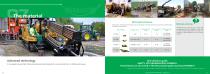
The material Drill performance Depending on the diameter of the pipes to be laid, the length of the path and the nature of the soil, different types of drilling rig must be used. Mass to be pulled in tonnes Maximum pipe string length Advanced technology In the pipeline laying field, PAM uses advanced technology that comes directly from oil drilling techniques. All PAM joints are protected by a metal shell to guarantee that the elastomer liners will be held in place, particularly in the event of accidental rubbing against the vault during pulling. Drill utilisation guide: SAFETY, SITE ORGANISATION,...
Open the catalog to page 12All SAINT-GOBAIN CANALISATION catalogs and technical brochures
 ALPINAL
36 Pages
 BIOGAN
5 Pages
 T-MAX
T-MAX16 Pages
 Pam Academy Brocher
4 Pages
 TT PE / TT PUX range
40 Pages
 ROTATABLE FLANGED FITTINGS
11 Pages
 MUNICIPAL CASTINGS
56 Pages
 HYDROPAM
9 Pages
 NATURAL
20 Pages
 HYDROCLASS
52 Pages
 BLUTOP
32 Pages

- Grating
- Piping
- Fitting
- Manhole cover
- Grating for drain channel
- Metal grating
- Channeling
- Plastic fitting
- Drainage system piping
- Square manhole cover
- Metal manhole cover
- Metal fitting
- Drainage system channeling
- Rainwater down pipe
- Public space grating for drain channel
- Walkway grating
- Metal grating for drain channel
- Cast iron manhole cover
- Round manhole cover
- Plastic channeling