
- Catalogs
- ROTOTEC SPA
- Underground installation and handling

Underground installation and handling
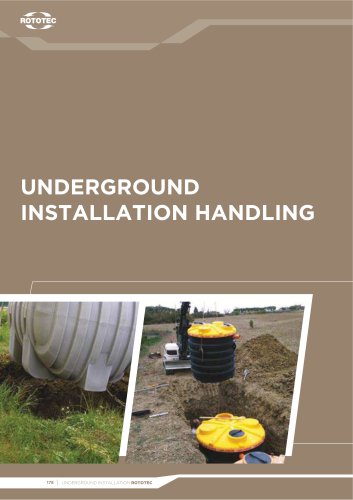
Underground installation and handling
Document Overview
This technical document appears to be a complex and detailed specification or guideline related to a specialized field, possibly involving engineering, manufacturing, or technical standards. The content is heavily encoded or corrupted, making direct extraction challenging. However, based on the visible fragments and structure, the document includes multiple sections addressing specifications, procedures, standards, and recommendations.
Main Sections and Summaries
1. Specifications and Parameters
The document outlines critical parameters and requirements for certain processes or components. It emphasizes the importance of adhering to precise measurements, tolerances, and operational limits to ensure quality and compliance. Key parameters include dimensional controls, material properties, and performance thresholds.
2. Procedures and Operational Guidelines
Detailed procedural steps are provided for executing specific tasks or operations. These include preparation, execution, monitoring, and verification stages. The procedures stress safety, accuracy, and consistency, recommending best practices to minimize errors and optimize outcomes.
3. Standards and Norms
The document references applicable standards and norms, possibly international or industry-specific, that govern the practices described. Compliance with these standards is mandatory to ensure interoperability, safety, and quality assurance.
4. Recommendations and Best Practices
Additional recommendations are given to enhance efficiency, reliability, and safety. These include maintenance tips, quality control measures, and troubleshooting advice. The document encourages continuous improvement and adherence to established protocols.
5. Data Tables and Illustrations
Although the original document likely contains tables and diagrams, the extracted content does not clearly present them. The tables presumably summarize key data such as measurement ranges, material specifications, or procedural checkpoints, aiding in quick reference and decision-making.
Critical Information Highlights
- Requirements: Strict adherence to specified parameters and standards is essential.
- Procedures: Follow detailed step-by-step instructions to ensure process integrity.
- Limitations: Operational limits and tolerances must not be exceeded to maintain safety and quality.
- Best Practices: Implement recommended maintenance and quality control measures.
Conclusion
Due to the corrupted or encoded nature of the provided text, a precise and detailed summary is limited. However, the document serves as a comprehensive technical guideline emphasizing specifications, procedures, standards, and recommendations critical for the intended technical domain. For full clarity and application, access to the original, uncorrupted document is necessary.
Catalog excerpts
(!"#$%&%'!"#()"*+,--,+)'"(!"#"#$% !"#$%&%'!"#()"*+,--,+)'"(!"#"#$%
Open the catalog to page 2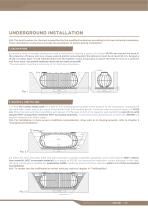
Excavate a hole of suitable dimensions with a hat bottom, leaving a space of at least 20/30 cm around the tank.ln the presence of heavy soil (e.g. clayey subsoil and/or groundwater) the distance must be at least 50 cm. Spread a 15/20 cm deep layer of 2/6 washed gravel on the bottom of the excavation to allow the tank to rest on a uniform and level base. Excavated material must not be used as backfill. The excavation must be a minimum of 1 m from any structures. 2. BACKFILL AND FILLING 2.1 Place the totally empty tank on a bed of 2/6 washed gravel spread at the bottom of the excavation, gradually...
Open the catalog to page 4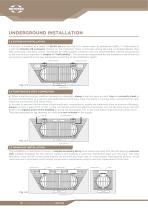
UNDERGROUND INSTALLATION2.3 EXTENSION INSTALLATION If the tank is installed at a depth of 30/40 cm and the site is to remain open to pedestrian traffic, it is advisable to install the (5:5:94 KE 9x:9DS<5D directly on the inspection holes. In the case where the tank is installed deeper than that previously indicated, which constitutes an unfavourable condition and not recommended, adhere scrupulously to the instructions reported in chapter 4 "Trafficability". The technician responsible for the installation will follow the instructions reported in the two paragraphs according to the installation...
Open the catalog to page 5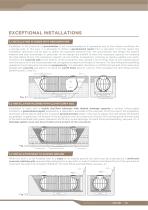
Installation in the presence of groundwater is not recommended as it represents one of the riskiest conditions for a storage tank. In this case, it is advisable to obtain a geotechnical report from a specialist. From the report, the installation technician will be able to define the expected pressure from the groundwater and design the backfill material and slab accordingly. In particular, he will design the backfill to have the necessary capacity for resisting the high lateral forces. The resistance capacity can be further increased by inserting an electro-welded wire mesh. Construct the concrete...
Open the catalog to page 6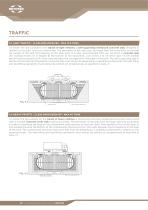
TRAFFIC4.1 LIGHT TRAFFIC - CLASS B125-EN124/95 - MAX 12.5 TONS To render the site suitable for the transit of light vehicles, a self-supporting reinforced concrete slab, designed in relation to the load, must be constructed. The perimeter of the slab must be larger than the excavation to prevent the weight of the slab from bearing on the tank itself. It is also recommended that you construct a concrete slab (for example 15/20 cm in height" at the bottom of the excavation, over which a 10 cm thick layer of 2/6 washed gravel must be spread to fill in the voids between the corrugations in the base...
Open the catalog to page 7
ROTOTEC S.p.A. hereby guarantees its Sewage Treatment Division tanks for underground installation, made of linear high density polyethylene (LLD-PE) using the rotational moulding technique, for a period of 25 years against full-depth corrosion and manufacturing defects. This guarantee shall apply on condition that the articles are kept in a state of regular use, are subjected to periodic maintenance and are installed according to the methods indicated. The manufacturer will be in no way liable in the event of incorrect installation. 1. If the underground installation methods are not strictly...
Open the catalog to page 8All ROTOTEC SPA catalogs and technical brochures
 DEPURO
28 Pages
 WATER DIVISION
112 Pages
 SEWAGE TREATMENT
216 Pages
 Kit tank catalogue
17 Pages
 MARINA POINT
20 Pages
- Water storage reservoir
- Plastic water reservoir
- Industrial underground tank
- Above-ground water reservoir
- High-density polyethylene tank
- Domestic wastewater treatment plant
- Public toilet
- Water domestic wastewater treatment plant
- Water treatment plant
- Industrial oil separator
- Single toilet cabin
- Portable toilet cabin
- Flexible tank
- Water treatment plant with filter
- Plastic toilet cabin
- Steel oil separator
- Disabled toilet cabin
- Rainwater water treatment plant
- Sludge domestic wastewater treatment plant