
- Catalogs
- ROTOTEC SPA
- SEWAGE TREATMENT

SEWAGE TREATMENT
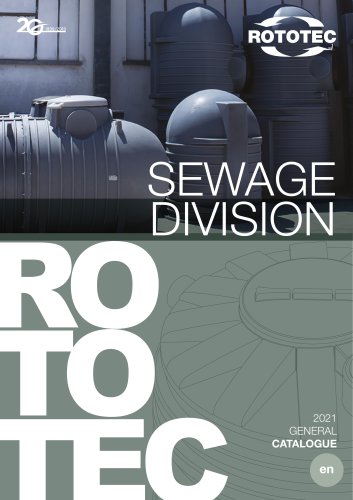
SEWAGE TREATMENT
Rototec S.p.A., part of the System Group, specializes in producing corrugated and smooth tanks using rotational moulding technology. Founded in 2000, the company focuses on high-performance and reliable treatment systems, adhering to European standards. Rototec emphasizes environmental protection and regulatory compliance, utilizing both digital and traditional communication channels.
- Training meetings and technical seminars
- Design support with digital tools
- Prompt delivery and on-site technical support
- After-sales service
Originating from Centraltubi in 1979, the System Group expanded in the 1990s, incorporating companies like Futura and Rototec. It has a strong presence in Europe with facilities in Spain, France, and Romania, and continues to broaden its product range and market sectors.
The catalogue details various sewage treatment solutions, including Imhoff tanks, grease separators, and biological septic tanks. It provides plant solutions and calculations for population equivalents, essential for designing treatment systems.
- Grease Separators: Designed for primary treatment of grey water, these separators remove oils and greases. They are CE marked and comply with UNI EN 1825-1 standards.
- Imhoff and Biological Tanks: Used for biological treatment, these tanks are part of the sewage division's plant solutions.
- Activated Sludge Plants: These plants offer secondary treatment with sludge recirculation.
The document includes detailed specifications for various models of grease separators, including dimensions, volume capacities, and installation guidelines. It also explains the technical characteristics and uses of above-ground and under-sink grease separators.
Rototec's products are certified for watertightness, structural stability, and functional requirements, ensuring compliance with industry standards.
- Function: Separate substances with specific weight less than water through flotation and sedimentation.
- Design: Polyethylene tank with three compartments for inlet, separation, and outlet.
- Efficiency: Optimal at temperatures around 20°C; certified under UNI-EN 1825-1.
- Maintenance: Regular removal of accumulated materials is necessary to maintain efficiency and prevent septic conditions.
- Prohibitions: Avoid toxic substances and rainwater entry.
- Warnings: Ensure proper pipe gradient and biogas vent connection.
- Function: Primary treatment of sewage from toilets, using two compartments for sedimentation and digestion.
- Design: Overlapping compartments with hydraulic communication; CE marked and certified under UNI EN 12566-3.
- Specifications: Reduction in pollutants (COD, BOD5, SS) with high treatment efficiency.
- Maintenance: Regular inspections and sludge removal are necessary to prevent overproduction of biogas and maintain treatment quality.
- Prohibitions: Avoid flushing non-biodegradable materials and rainwater entry.
- Warnings: Ensure proper installation and maintenance procedures are followed.
- Processes: Chemical, physical, and biological processes reduce main reference parameters.
- Installation: Directly on sewage line with recommended pre-treatment for grey water.
- Management: Regular inspections and maintenance by qualified personnel are essential.
The document includes detailed tables listing various models of Imhoff tanks, their dimensions, capacities, and population equivalents, providing a comprehensive guide for selecting the appropriate model based on specific needs.
Septic tanks are reliable devices for the primary treatment of sewage, particularly for small communities. They operate passively, are stable, simple, and cost-effective. The tank design slows sewage flow, allowing sedimentable solids to separate and triggering anaerobic fermentation, which reduces suspended solids. The effluent is conditioned with limited solid concentration.
Septic tanks are primarily used for domestic sewage treatment from toilets, with a daily hydraulic load of 200 liters per person equivalent (PE).
Rototec biological septic tanks are CE marked and certified under UNI EN 12566-1, excluding modular, 2-chamber, and 3-chamber tanks. They meet requirements for hydraulic efficiency, watertightness, nominal capacity, structural behavior, and design.
Septic tanks separate sedimentable solids, reduce organic substances, and store separated materials. Compartmentation enhances treatment efficiency by accumulating solids in the first chamber. Tanks are designed for high purification performance and sludge liquefaction, minimizing disposal costs.
Regular inspections (1-4 times a year) and sludge removal are necessary to prevent uncontrolled anaerobic digestion and malodorous emissions. Leaving some sludge accelerates process restart. The use of Rototec Bio-activator is recommended.
Avoid toxic substances and non-biodegradable materials. Ensure proper drainage and biogas venting. Follow safety regulations during maintenance.
Inspection and sludge removal should be done regularly, depending on the organic load.
DEPURO ONE is a fully biological treatment system for domestic effluent, consisting of a primary sedimentation tank and an oxidation tank. It is CE marked and certified under UNI EN 12566-3. The system offers high sewage treatment efficiency, easy installation, and maintenance, and is environmentally friendly.
DEPURO ONE uses both anaerobic and aerobic processes to treat effluent, transforming nitrogenous compounds into non-polluting forms. It consists of two tanks: a biological tank for sedimentation and digestion, and an oxidation tank for pollutant oxidation.
- TANK 1: An Imhoff type biological tank with two compartments for sedimentation and anaerobic digestion. It reduces over 50% of solid and organic components through gravity separation and cold anaerobic digestion.
- TANK 2: An aerated adhered biomass trickle filter with high surface area plastic media for bacterial growth, facilitating aerobic treatment through micro-bubble air diffusers.
- TANK 3: A second Imhoff tank for sedimentation of surplus sludge, which is recirculated to Tank 1.
- Made of polyethylene using rotational moulding technology.
- CE marked and certified under UNI EN 12566-3 standards.
- High sewage treatment efficiency with pollutant reduction rates: COD 92%, BOD5 95%, SS 96%, Ntot 57%.
- Available in models for 3 to 45 Population Equivalent (PE).
- Regular inspections (1-2 times a year) and sludge removal every 6-8 months are recommended.
- Use of Rototec BIO-ACTIVATOR is advised to enhance biological processes and reduce malodorous emissions.
- Ensure proper functioning of sludge recirculation and blower systems.
- Avoid using toxic substances and ensure only biodegradable products are used.
- Do not flush non-toilet paper materials or drain rainwater into the system.
- Ensure proper pipe slope and biogas venting.
- High treatment efficiency and environmental respect due to recyclable materials.
- Easy installation and maintenance with reduced management costs.
- TANK 2: Regular inspection is required to ensure the trickle filter is functioning properly. The filter media should be covered with a light brown biological sludge. If the sludge is darker or covers the media completely, the tank needs pumping every 6-8 months.
- TANK 3: Excessive sediment can lead to anaerobic digestion, causing biogas production and odor. Regular cleaning and sludge removal are necessary to maintain effluent quality.
- Avoid using toxic substances and ensure only biodegradable products are used.
- Do not flush non-toilet paper materials or allow rainwater into the system.
- Ensure proper siphoning and gradient in pipes, and maintain biogas vent connections.
- Inspect sedimentation tanks and biomass tanks every 6-12 months, and ensure proper functioning of blowers monthly.
- Contact licensed waste disposal companies for sludge removal and cleaning operations.
- Install in a ventilated, weather-protected area, ensuring it is above the plant level to prevent sludge return.
- Ensure proper connection and power supply, and maintain the suction filter every 3 months.
- These plants use bacterial colonies to treat sewage by consuming organic material. They require an aeration system with submerged diffusers to maintain oxygen levels.
- Secondary treatment systems ensure effluent meets specific COD, BOD5, and SS concentrations.
- Details on various models of activated sludge plants, including dimensions, capacities, and blower specifications, are provided.
- Installation diagrams and management guidelines for total oxidation systems are included.
The document provides detailed technical specifications and operational guidelines for sewage treatment systems, specifically focusing on the IFABLOK, ANABLOK, and BIOBLOK models. These systems are designed for the primary and secondary treatment of domestic sewage using modular tanks for underground installation.
The treatment plants ensure efficient sewage treatment, maintaining effluent concentrations within specified limits. The systems are designed to handle a daily hydraulic load of 200 liters per population equivalent (PE), with the flexibility to adjust for different loads.
The IFABLOK system uses submerged diffusers to disperse fine air bubbles, ensuring adequate oxygen concentration and mixing to keep solids in suspension. It is suitable for primary and secondary treatment of domestic sewage.
The ANABLOK system features primary sedimentation and anaerobic sludge digestion, followed by secondary treatment through an anaerobic percolating filter. It uses plastic bulk fill material to support bacterial growth, ensuring efficient effluent purification.
The BIOBLOK system is a Moving Bed Biofilm Reactor (MBBR) that combines primary sedimentation with aerobic digestion. It uses a filter media to support bacterial growth, with air supplied by external compressors to facilitate aerobic digestion.
Septic tanks are used for primary treatment, facilitating sedimentation and anaerobic fermentation. Compartmentation enhances treatment efficiency by separating solids and reducing sludge formation.
Regular inspections (1-4 times a year) are recommended to manage sludge accumulation and prevent malodorous emissions. The use of Rototec Bio-activator is advised to enhance biological processes.
Users are advised against using toxic substances and flushing inappropriate materials. Proper installation and maintenance of drainage systems are crucial to ensure optimal operation.
The coalescing filter is a fine micro-bubble polyurethane filter within a stainless steel grid, designed to aggregate fine oil particles into larger droplets, facilitating their separation from effluent.
The installation diagram includes a sampling chamber, coalescing filter type oil separator, and a recommended grit separator. These systems are used for treating surface drainage water from hardstandings, car parks, and garages.
Oil separators with coalescing filters enhance the removal of light substances like oils and hydrocarbons. They are recommended where strict discharge limits are in place. A grit separator is advised upstream to prevent clogging.
Rototec oil separators are CE marked and comply with UNI EN 858-1 standards, ensuring watertightness, structural stability, and functional requirements.
Regular inspections and cleaning are crucial to prevent overflow and maintain efficiency. The coalescing filter should be cleaned every 1-2 months, and accumulated pollutants should be removed every 6-12 months.
Avoid using toxic substances and ensure proper drainage and venting. After maintenance, refill the tank with clean water.
The document lists various models with specifications such as diameter, height, inlet/outlet pipe dimensions, and capacities, tailored for different hardstanding areas and flow rates.
Some models include an integrated bypass that activates when the inlet flow exceeds design capacity, directing excess flow to the outlet to prevent filter overload.
The document provides technical details on balancing tanks and treatment plants for car washes, focusing on the regulation of rainwater flow and the treatment of effluents from car washes. It includes specifications, procedures, and standards for installation and operation.
Balancing tanks are used for temporary storage of rainwater to regulate discharge flow into public sewers or natural watercourses. They are essential in areas with high soil impermeability to prevent overloads during heavy rainfall. The tanks are equipped with submersible pumps and manual valves to control discharge rates.
The document lists various models of balancing tanks with different capacities and dimensions. It also details the delivery pump kits, including power, flow rate, and head specifications.
The treatment plants are designed to handle runoff from car washes, which may contain pollutants like suspended solids, oils, and hydrocarbons. The treatment process involves multiple phases: grit separation, oil separation, and biological treatment. The document specifies the treatment efficiency and the final effluent concentrations.
Different models of treatment plants are detailed, each designed for a specific number of cars per day. The components include grit separators, oil separators, and various types of trickle filters. The document provides dimensions and capacities for each component.
These systems are compact and efficient, requiring minimal operator intervention. They include filtration lines with quartzite and activated charcoal beds for effective pollutant removal.
Lift stations are used to transfer effluent to higher-level stations. They are necessary when discharge levels are lower than sewerage systems. The document describes the components and technical characteristics of these stations.
- PICO SOL Lift Stations: Designed for small volumes, featuring vortex and grinder impeller pumps with capacities ranging from 120 to 305 liters.
- ENNE SOL Lift Stations: Suitable for larger volumes, with capacities from 903 to 3000 liters, offering vortex, 2-channel, and grinder impeller options.
- TEKNOSOL Lift Stations: Available in single and dual pump configurations, with rapid connection-release-extraction systems, suitable for volumes from 400 to 3000 liters.
- Multi-Channel Impeller Pumps: Ideal for clear and turbid water without solid matter.
- Vortex Impeller Pumps: Suitable for low head pumping of sewage with solid or stringy matter.
- Grinder Impeller Pumps: Designed for sewage with solid matter, capable of reducing solids into small fragments and handling high pressure.
The document provides detailed specifications for various sewage pumps and lift stations. It includes models such as SM650L, SM590, NRG09, and SM1100/65, with parameters like power (KW), current (A), dimensions (mm), weight (Kg), flow rate (lt/min), and head (mt).
Sewage lift stations are designed to lift and transfer effluent to higher-level stations. They are essential when the discharge level is lower than the treatment plant or sewerage pipes. The stations consist of a polyethylene storage tank with a submerged electric pump, connected by a chain for easy removal. Dual pump models are available for high or variable flow rates.
Electric panels for single and dual pump lift stations are described, with options for manual or automatic start-up via float switches. They include visual and audible alarms for fault signaling. Power supply options are single-phase (230 V) or three-phase (400 V).
Maintenance should be performed by trained technicians with the pump disconnected from the power supply. Regular inspections every 6 to 12 months are recommended to check sediment levels, seals, and the pumping system. Proper pump selection during the design phase is crucial for efficient operation.
Important safety warnings include ensuring proper venting, avoiding dry starts, and maintaining the pump in a vertical position. Risks of electric shock are highlighted, with instructions to disconnect power before maintenance and ensure proper grounding.
The document describes various chambers such as sampling, dosing siphon, non-return valve, siphon, and chlorinator chambers. Each has specific functions like preventing backflow, distributing effluent, or disinfecting final effluent.
Guidelines for underground installation emphasize compliance with safety regulations, checking materials upon delivery, and ensuring all documentation is present. Handling instructions include using lifting eyes and avoiding impacts.
The document provides comprehensive technical details and operational guidelines for sewage lift stations and associated components, emphasizing safety, maintenance, and proper installation practices.
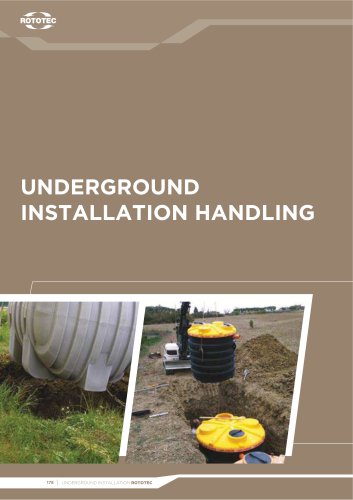
Underground tanks are not suitable for storing industrial waste or liquids incompatible with polyethylene. They should not be used for storing diesel fuel.
Use appropriate transport and lifting equipment. Avoid harsh movements during transport. Only lift empty tanks using suitable cables or straps, ensuring the lifting angle is never less than 45°.
- Excavation: Excavate a hole with a flat bottom, leaving space around the tank. Use washed gravel for a uniform base.
- Backfill and Filling: Place the tank on gravel, fill with water, and backfill with gravel. Use topsoil for the final layer, avoiding sharp materials.
- Extension Installation: Install extensions on inspection holes for tanks installed at certain depths.
- Pump/Biogas Vent Connection: Install vents to prevent vacuum formation and connect pipes for biogas venting.
- Manhole Installation: Manholes over 50kg must be supported by a concrete slab, not directly on the tank.
For installations in groundwater, clayey soils, or sloping ground, obtain a geotechnical report and follow specific guidelines for backfill and structural support.
For light vehicle traffic, construct a self-supporting reinforced concrete slab. For heavy vehicles, use a reinforced concrete containment structure.
Rototec guarantees tanks for 25 years against corrosion and defects, provided they are installed and maintained correctly. The guarantee excludes installation costs, damage from misuse, and other specified conditions.
Various accessories are available, including threaded extensions, covers, gaskets, and blowers, each with specific applications and installation instructions.
The document provides detailed specifications for various products including compressor blowers, connecting pipes, electric timer panels, diffusers, chlorine tablets, filter media, and bio-activators. Each product is described with its dimensions, power requirements, and specific applications.
These are available in different models (HP40, HP60, HP80, HP150, HP200) with varying voltage, frequency, power, flow rate, noise level, weight, and dimensions. They are designed for specific flow rates and noise levels.
Made from HDPE, these pipes are used for connecting storage tanks to various systems. They come in different diameters ranging from 40mm to 250mm.
These panels control and protect diaphragm blowers in sludge treatment plants. They feature a 24-hour segment timer for automatic operation.
Includes diaphragm type and disc type diffusers designed for uniform air distribution in sludge plants. They are characterized by microbored rubber surfaces.
Composed of trichloroisocyanuric acid, these tablets provide long-lasting disinfection over 30-60 days.
Developed for percolating filter beds, these media have a high specific surface area and void index, made from black isotactic polypropylene.
Available in single-dose sachets and concentrated forms, these activators speed up biological processes in wastewater treatment plants.
The document outlines the terms for orders, pricing, payment, ownership, claims, shipping, guarantees, and force majeure. It emphasizes the importance of following installation instructions, especially for underground tanks.
Rototec offers a range of other products including sewage treatment systems, stormwater runoff systems, water tanks, rainwater harvesting systems, portable toilets, and construction site equipment.
All disputes are subject to the jurisdiction of the Urbino Law Courts. Contact details for Rototec S.p.A are provided for further inquiries.
Catalog excerpts

SEWAGE DIVISION
Open the catalog to page 1
2021 SEWAGE DIVISION CATALOGUE
Open the catalog to page 2
Rototec S.p.A. is a dynamic company in continuous expansion present throughout Italy and abroad. The company was founded in 2000 as part of the System Group, a leader in the production of complete pipeline systems (pipes, fittings, specials,...). It was soon specializing in the production of corrugated and smooth tanks in linear polyethylene manufactured using rotational moulding technology. Over the years, Rototec S.p.A. has always felt the need to distinguish itself on the Italian and international markets, investing its resources in research and in updating its own production to meet European...
Open the catalog to page 6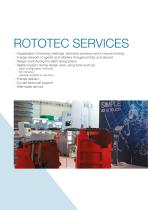
ROTOTEC SERVICES > Organisation of training meetings, technical seminars and in-house training > A large network of agents and retailers throughout Italy and abroad > Design work during the plant sizing phase > Digital support during design work using tools such as: . plant configuration software . bim libraries . website updated in real time > Prompt delivery > On-site technical support > After-sales service
Open the catalog to page 8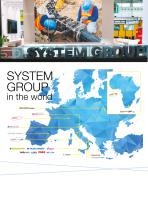
SYSTEM GROUP in the worlc
Open the catalog to page 9
ROTOTEC & SYSTEMGROUP System Group was created in a small town inland of Mi Plastic Romania). The group further reinforced its Pesaro (Lunano) as a result of an idea by entrepreneur Alvaro Boscarini who, in 1979, had founded Centraltubi for the production of polyethylene pipes. The group was formed at the start of the 1990's when Centraltubi was joined by Futura, a company operating in the pipe fittings, accessories and specials market. These were to be the first steps on the road to success which, in the following years, saw the birth of five other important businesses: Sa.Mi Plastic (smooth...
Open the catalog to page 10
p. 12 SEWAGE DIVISION p. 190 UNDERGROUND INSTALLATION p. 198 ACCESSORIES p. 208 OTHER PRODUCTS
Open the catalog to page 12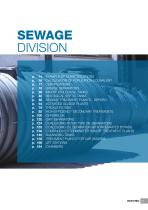
EXAMPLE OF PLANT SOLUTIONS CALCULATION OF POPULATION EQUIVALENT CERTIFICATIONS GREASE SEPARATORS IMHOFF BIOLOGICAL TANKS BIOLOGICAL SEPTIC TANKS SEWAGE TREATMENT PLANTS - DEPURO ACTIVATED SLUDGE PLANTS TRICKLE FILTERS HIGH EFFICIENCY SECONDARY TREATMENTS DEPURBLOK GRIT SEPARATORS COALESCING FILTER TYPE OIL SEPARATORS COALESCING OIL SEPARATOR WITH INTEGRATED BYPASS CONTINUOUS STORMWATER RUNOFF TREATMENT PLANTS BALANCING TANKS TREATMENT PLANTS FOR CAR WASHES LIFT STATIONS CHAMBERS
Open the catalog to page 14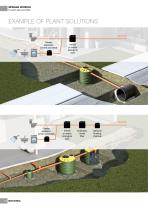
SEWAGE DIVISION PLANT SOLUTIONS Grease separator (where provided) Imhoff or septic biological tank OUTLET Grease separator (where provided) Imhoff or septic biological tank Anaerobic trickle filter Optional flushing chamber
Open the catalog to page 15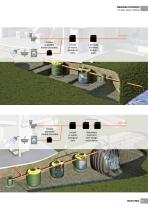
Grease separator (where provided) OUTLET Imhoff or septic biological tank Low-load activated sludge plant Imhoff or septic biological tank Secondary treatment with sludge recirculation
Open the catalog to page 16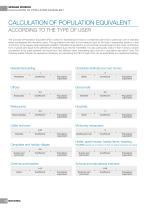
SEWAGE DIVISION CALCULATION OF POPULATION EQUIVALENT The concept of Population Equivalent (PE) is useful for expressing the load on a treatment plant from a particular user in standard terms comparable with domestic users. The equivalence can refer to the hydraulic load, to the load in suspended solids or, more commonly, to the organic load expressed as BOD5. Population Equivalent is a conventional concept based on the mean contribution from a typical user equal to 60 g/BOD5 per inhabitant (Law Decree 152/2006). It is also particularly useful in that it allows a simple comparison to be made between...
Open the catalog to page 17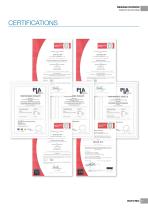
SEWAGE DIVISION CERTIFICATIONS
Open the catalog to page 18
GREASE SEPARATORS
Open the catalog to page 20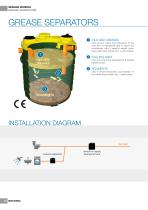
SEWAGE DIVISION GREASE SEPARATORS inlet zone in which the turbulence of the inlet flow is dampened and in which the substances with a specific weight lower than water (oils, foams, etc...) accumulate. STILLING AREA zone into which the separated and treated effluent flows. 3 area in which temporary accumulation of the solids (food waste, etc...) takes place. INSTALLATION DIAGRAM Grease separator Imhoff or septic biological tank
Open the catalog to page 21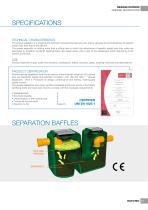
SEWAGE DIVISION GREASE SEPARATORS SPECIFICATIONS TECHNICAL CHARACTERISTICS The grease separator is a physical pre-treatment process that removes oils, foams, greases and all substances of specific weight less than that of the effluent. The grease separator is nothing more than a stilling tank in which the substances of specific weight less than water are separated by floatation (surface). Sedimentation also takes place, with a part of the suspended solids depositing at the bottom of the tank. Primary treatment of grey water from kitchens, washbasins, bidets, showers, baths, washing machines and...
Open the catalog to page 22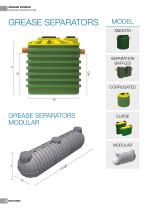
SEWAGE DIVISION GREASE SEPARATORS GREASE SEPARATORS MODEL SMOOTH SEPARATION BAFFLES GREASE SEPARATORS MODULAR
Open the catalog to page 23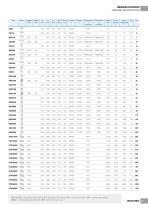
SEWAGE DIVISION GREASE SEPARATORS Sizing: PE. = population equivalent: 0 = diameter; H = height; HI = inlet pipe height; HO = outlet pipe height; 0E/U = inlet/outlet pipe diameter; NS = limit flow rate (l/s). ROTOTEC
Open the catalog to page 24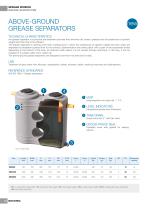
ABOVE-GROUND GREASE SEPARATORS TECHNICAL CHARACTERISTICS the grease separator is a physical pre-treatment process that removes oils, foams, greases and all substances of specific weight less than that of the effluent. The grease separator is nothing more than a stilling tank in which the substances of specific weight less than water are separated by floatation (upward flow to the surface). Sedimentation also takes place, with a part of the suspended solids depositing at the bottom of the tank. Its reduced width allows it to be carried through doorways. In this way, it can be installed in a suitable...
Open the catalog to page 25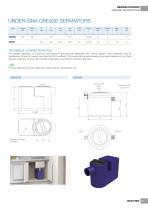
SEWAGE DIVISION GREASE SEPARATORS UNDER-SINK GREASE SEPARATORS Item TECHNICAL CHARACTERISTICS The grease separator is a physical pre-treatment process that separates oils, foams, grease, heavy sediment and all substances of specific weight less than that of the effluent. The under-sink grease separator has been designed to be fitted directly under the kitchen sink of small restaurants, small beach cantinas, little bars. USE Primary treatment of grey water from kitchen sinks, washbasins, etc...
Open the catalog to page 26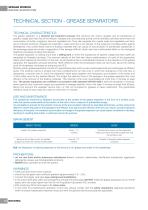
SEWAGE DIVISION GREASE SEPARATORS TECHNICAL SECTION - GREASE SEPARATORS TECHNICAL CHARACTERISTICS The grease separator is a physical pre-treatment process that removes oils, foams, greases and all substances of specific weight less than that of the effluent. Greases and oils produced during normal domestic activities derive from the consumption of butter, margarine, lard and vegetable oils. They also originate from waste meat and vegetables and from some cosmetic products. Greases are insoluble in water and have a low density. In the presence of surface-active agents (detergents), they create...
Open the catalog to page 27All ROTOTEC SPA catalogs and technical brochures
 DEPURO
28 Pages
 WATER DIVISION
112 Pages
 Kit tank catalogue
17 Pages
 MARINA POINT
20 Pages
- Water storage reservoir
- Plastic water reservoir
- Industrial underground tank
- Above-ground water reservoir
- High-density polyethylene tank
- Domestic wastewater treatment plant
- Public toilet
- Water domestic wastewater treatment plant
- Water treatment plant
- Single toilet cabin
- Portable toilet cabin
- Flexible tank
- Water treatment plant with filter
- Plastic toilet cabin
- Steel oil separator
- Disabled toilet cabin
- Rainwater water treatment plant
- Sludge domestic wastewater treatment plant