
- Catalogs
- ROTHO BLAAS
- 2016 FALL PROTECTION SYSTEMS

- Company
- Products
- Catalogs
- News & Trends
- Exhibitions
2016 FALL PROTECTION SYSTEMS
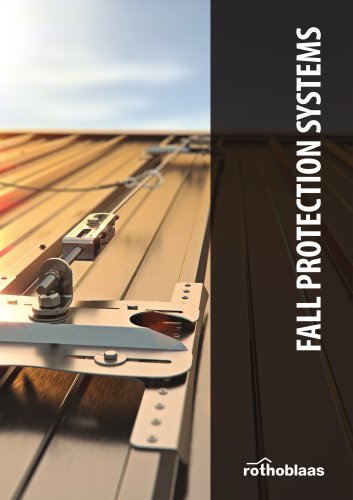
2016 FALL PROTECTION SYSTEMS
- HOOK Series: Includes HOOK20, HOOK50, HOOK100, and HOOK140, all designed for use on wood, concrete, and steel structures. They offer a static strength of 13 kN and are suitable for surfaces with inclinations less than 5°.
- KITE: A versatile anchor point made from stainless steel, suitable for multiple environments. It is lightweight, easy to install, and provides a static strength of 12 kN.
- AOS Series: Features a 360° swivel eyelet for freedom of movement, available in various heights and designed for use on wood, concrete, and steel structures. The AOS series supports up to 4 operators depending on the system.
- VARIO: Designed for flat green roofs, this system does not require drilling, thus preventing thermal bridges and maintaining waterproofing.
- DIASAFE: Suitable for flat roofs with slopes up to 5°, this system also avoids drilling to maintain structural integrity.
- POINT Series: Offers quick installation for both wood and concrete structures, with additional safety features for wood installations.
- INDUSTRY-21: An unobtrusive anchor point for seamed metal sheets, ensuring minimal visual impact.
- Mobile Anchoring System: A temporary solution for doors, windows, and skylights, allowing safe access without structural damage.
- Anchor systems are available in different sizes and materials, including stainless steel, galvanized steel, and aluminum.
- Specific codes are assigned to each product, indicating weight, material, and packaging details.
- Compliance with standards such as EN 795 B, EN 14122-3, and EN 13374 is highlighted.
- CPE is prioritized over Personal Protective Equipment (PPE) for safeguarding health and safety.
- Temporary and permanent protections are available, compliant with standards EN 13374 and EN 14122-3.
- Products include parapet barriers and skylight nets, designed to prevent falls and ensure freedom of movement.
- Available in modular designs with various accessories for easy installation.
- Different versions cater to specific architectural needs, with options for temporary and permanent installations.
- Compliance with EN 13374 for class A and B certifications.
- Horizontal and lateral fall protection nets are available in materials like stainless steel and polypropylene.
- Designed for easy installation and adaptability to various structures.
- Certified under EN 1263-1 and other relevant standards.
- PPE includes slings, ropes, helmets, and connectors for fall arrest and positioning.
- Emphasis on proper maintenance and inspection to ensure safety and functionality.
- Equipment must withstand specific loads and be checked regularly for signs of wear and damage.
- Regular inspections are crucial to identify cuts, abrasions, and other damages that could compromise safety.
- Equipment should be protected from UV degradation, corrosion, and mechanical wear.
- Annual audits by experienced personnel are recommended to ensure compliance and safety.
- Situation 1: Reduced angle results in optimal load containment.
- Situation 2: Larger angle increases load, requiring attention to the connecting element.
- Situation 3: Heavy and continuous angle leads to excess load.
- Fall arrest systems aim to reduce fall distance, absorb fall energy, and maintain an appropriate position to limit suspension effects.
- Restraint systems prevent operators from reaching fall-risk areas.
- Fall protection systems must ensure arresting forces do not exceed 6 kN.
- UNI EN 341:1993 - Descenders for rescue
- UNI EN 354:2003 - Cords
- UNI EN 355:2003 - Energy absorbers
- UNI EN 361:2003 - Full body sling
- Helmets: Lightweight with chin straps, certified to EN 397.
- Kits: Profi Kit and Base Kit include ropes, bags, and protective gear.
- Slings: Different models with multiple attachment points, certified to EN 361 and EN 813.
- SICUROPE: Single and double arm cords with energy absorbers, certified to EN 355.
- ARRESTER: Fall protection and positioning device, certified to EN 12841A/B.
- Connectors: Steel and aluminum options with various certifications.
- Includes pulleys, seats for suspension work, rescue triangles, and anchor points.
- Products are made from materials like aluminium and stainless steel, with specific weights and packaging details provided.
- Three types of aluminium alloy tripods are described, each with different height ranges, base opening diameters, and lifting capacities.
- Accessories include retractable devices, lifting sheaves, and rescue loops.
- Certifications include EN 795/B:2012 and TS 16415:2012.
- Devices for foot, hand, and ventral locking are detailed, with specifications on rope diameter compatibility and weight.
- Certifications include EN 12841/B and EN 567.
- Includes duct fans with specifications on motor power, noise level, and air flow.
- Accessories like air hoses and connectors are also listed.
- Various types of gloves are described, including cut-resistant and nitrile-coated gloves.
- Certifications include EN 388 and EN 420.
- Details on countersunk screws and turned washers, including dimensions and mechanical characteristics.
- Installation guidelines and minimum distances for shear loads are provided.
- Describes systems for safe access to roofs, including vertical anchor lines, walkways, and ladder hooks.
- Custom design services are available for specific site needs.
- Various products are certified under standards such as EN 353-1:2002 and CNB/P/11.073.
- SKR and SKS Anchors: Available in sizes ranging from 8mm to 16mm, these anchors are suitable for concrete grades C20/25 to C50/60. They feature hexagonal or countersunk flat heads and are certified for seismic performance and fire resistance.
- ABS Anchors: These anchors are designed for both cracked and uncracked concrete, with a focus on dense materials. They include electrogalvanized carbon steel components and are torque-controlled for secure fastening.
- AB1 and AB7 Anchors: These models offer options for standard and extra-long configurations, with stainless steel and electrogalvanized carbon steel options. They are suitable for high-performance applications in various concrete grades.
- Ensure minimum spacing and edge distances are maintained to achieve optimal performance.
- Follow torque specifications for each anchor type to ensure proper installation and load-bearing capacity.
- Refer to ETA guidelines for installations with reduced spacing or near edges.
- Tension and Shear Values: Detailed tables provide recommended and characteristic values for tension and shear loads in both cracked and uncracked concrete.
- Safety Factors: Admissible values are calculated using material safety factors and additional partial factors for external actions.
- Fire Resistance: All anchors are rated for fire resistance up to R120.
- Characteristic values are based on ETA and ETAG001 design methods.
- For installations in concrete with better grades or limited thickness, consult ETA guidelines.
Catalog excerpts

FALL PROTECTION SYSTEMS
Open the catalog to page 1
Packaged quantities may vary. No liability is assumed for printing, technical data and translation errors. Pictures partially completed with accessories not included. Images for illustration purposes only. This catalogue is the exclusive property of Rotho Blaas srl and may not be copied, reproduced or published, totally or in part, without prior written consent. Any violation will be prosecuted according to law. The values provided must be verified by the designer in charge. All rights reserved. Copyright © 2016 by rothoblaas
Open the catalog to page 3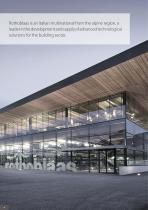
Rothoblaas is an Italian multinational from the alpine region, a leader in the development and supply of advanced technological solutions for the building sector.
Open the catalog to page 4
ABOUT US Specialists in the wood capentry sector, with a full range of products and solutions, we are the perfect partner for designers and builders. WATERPROOFING SOUNDPROOFING FALL PROTECTION TOOLS AND MACHINES
Open the catalog to page 5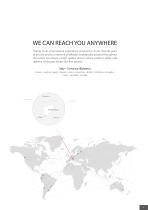
WE CAN REACH YOU ANYWHERE Thanks to an international experience achieved in more than 20 years of activity and to a network of affiliates strategically located throughout the world, we ensure a high quality service where product safety and delivery timing are always the first priority. Italy - Cortaccia (Bolzano) France - Austria - Spain - Russia - Latvia - Argentina - Brazil - Colombia - Ecuador Chile - Australia - Canada Munich Switzerland Rotho Blaas
Open the catalog to page 7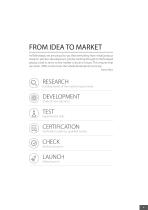
FROM IDEA TO MARKET At Rothoblaas we are proud to say that everything from initial product research, product development, product testing through to the finalised product and its entry to the market is done in house. This ensures that we retain 100% control over the whole development process. Robert Blaas Building needs of the market requirements. DEVELOPMENT Study of new solutions Experimental trials Verification audits by qualified bodies Quality assurance LAUNCH Market launch
Open the catalog to page 9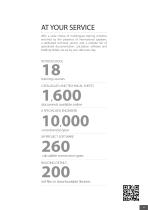
AT YOUR SERVICE With a wide choice of multilingual training schemes enriched by the presence of international speakers, a dedicated technical service and a website full of specialised documentation, calculation software and building details, we are by your side every day. training courses CATALOGUES AND TECHNICAL SHEETS documents available online 6 SPECIALISED ENGINEERS MYPROJECT SOFTWARE calculable connection types dxf files in downloadable libraries
Open the catalog to page 11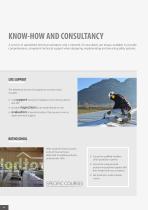
KNOW-HOW AND CONSULTANCY A service of specialised technical assistance and a network of consultants are always available to provide comprehensive, competent technical support when designing, implementing and servicing safety systems. SITE SUPPORT The telephone and on-site support by our technicians includes: real support during the installation of anchoring devices and PPE possible inspections to be made directly on site evaluation of special situations that require a more indepth technical support. ROTHOSCHOOL Wide range of training courses and technical seminars dedicated to updating industry...
Open the catalog to page 12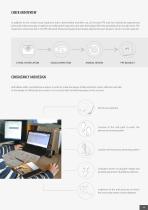
CHECK AND REVIEW In addition to the normal visual inspection that is done before and after use, all 3rd-class PPE must be checked by experienced personnel at least annually. In addition to notifying the inspection due date, Rothoblaas offers the possibility of an annual review. The inspection is documented in the PPE (Personal Protective Equipment) booklet attached to each product, which must be retained. VISUAL INSPECTION CONSULTANCY AND DESIGN Rothoblaas offers comprehensive advice in order to make the design of fall protection system effective and safe. In the design of a fall protection system,...
Open the catalog to page 13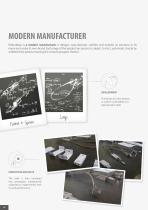
MODERN MANUFACTURER Rothoblaas is a modern manufacturer: it designs, manufactures, certifies and markets its solutions in its name and under its own brand. Each stage of the production process is subject to strict, systematic checks by notified third parties ensuring the smooth progress thereof. DEVELOPMENT The design of a new product or system is preceded by its representative draft PROTOTYPES AND TESTS The draft is then translated into prototypes, subsequently subjected to experimental tests to verify performance
Open the catalog to page 14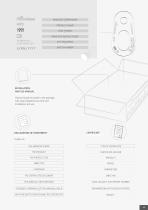
MANUFACTURER NAME PRODUCT NAME USER SYMBOL "READ THE INSTRUCTIONS" EN STANDARDS BATCH NUMBER INSTALLATION AND USE MANUAL Practical Guide included in the package, with clear, detailed instructions for installation and use CERTIFICATE HOLDER THE ANNUAL CHECK METHOD DATE, VALIDITY, TEST REPORT NUMBER THE BODY CARRYING OUT THE ANNUAL CHECK INFORMATION ON THE BODY NOTIFIED WITH THE INSTITUTION ISSUING THE CERTIFICATE
Open the catalog to page 15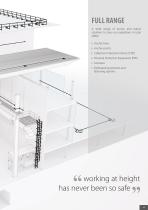
FULL RANGE A wide range of access and transit solutions to carry out operations in total safety: Anchor lines Anchor points Collective Protection Device (CPD) Personal Protection Equipment (PPE) Accesses Dedicated accessories and fastening systems working at height has never been so safe 17
Open the catalog to page 17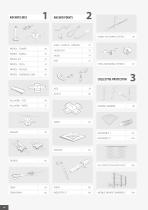
ANCHOR LINES ANCHOR POINTS 2 MOBILE ANCHORING SYSTEM STEEL ANCHORING SYSTEMS LOOP - LOOP XL - KRAKEN PATROL - TOWER PATROL - SHIELD PATROL - STEEL PATROL - OVERHEAD LINE PATROL - FACADE ALLinONE - SYST ALLinONE - VARIO PARAPET BARRIER MOBILE PARAPET BARRIERS FALL PROTECTION SAFETY NETS
Open the catalog to page 18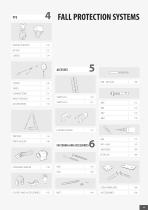
4 FALL PROTECTION SYSTEMS REACH TRUCKS LADDER HOOKS TRIPODS ROPE ASCENT CONFINED SPACES
Open the catalog to page 19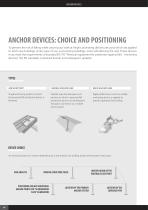
ANCHOR DEVICES ANCHOR DEVICES: CHOICE AND POSITIONING To prevent the risk of falling while carrying out work at height, anchoring devices are used, which are applied to both new buildings of any type of use, and existing buildings, when refurbishing the roof. These devices must meet the requirements of standard EN 795 "Personal equipment for protection against falls - Anchoring devices," the EN standards contained therein and subsequent updates. TYPES ANCHOR POINT FLEXIBLE ANCHOR LINE RIGID ANCHOR LINE Single anchoring system to which the personal fall protection device is fastened. Flexible...
Open the catalog to page 20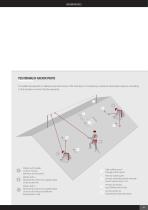
ANCHOR DEVICES POSITIONING OF ANCHOR POINTS To enable the operator to safely access and move in the roof area, it is necessary to observe some basic aspects, according to the situation in which he/she operates: Worker with double cord for moving between anchor points Worker with a fall protection device of a guided type on an anchor line Worker with a fall protection device of a guided type on an anchor line and additional fall protection cord Safe roofing access through anchor point Path for reaching the primary anchoring system through anchor points (max. 2 m) Primary anchoring (e.g. flexible...
Open the catalog to page 21All ROTHO BLAAS catalogs and technical brochures
 SPIDER-en-technical-data-sheet
15 Pages
 SHS-en-technical-data-sheet
2 Pages
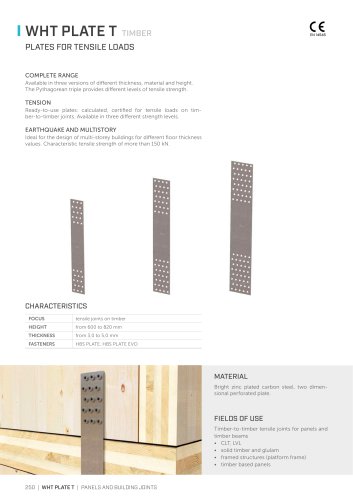 WHT PLATE T
4 Pages
 TITAN V
6 Pages
 TITAN S
13 Pages
 AIR TIGHTNESS
60 Pages
 HANDBOOK FOR TIMBER FRAME BUILDINGS
140 Pages
 Screws for wood
276 Pages
 Tools for wooden construction
178 Pages
 WOOD CONNECTORS AND TIMBER PLATES
352 Pages
 Waterproofing
180 Pages
 SOUNDPROOFING SOLUTIONS
68 Pages
 structural-renovation
8 Pages
 wooden-buildings
196 Pages

Archived catalogs
 Acoustic insulation products
24 Pages
 Post Bases
28 Pages
 Terraces-and-facades
80 Pages
 2013 fall-protection
68 Pages
 rothofixing catalogue
260 Pages
- Waterproofing membrane
- Roll waterproofing membrane
- Plastic waterproofing membrane
- Roof waterproofing membrane
- Building fastening system
- Metal fastening system
- Interior fastening system
- Asphalt waterproofing membrane
- Stainless steel mounting clip
- Panel fastening system
- Industrial vapor barrier
- Polyester waterproofing membrane
- Exterior fitting fastening system
- Bituminous waterproofing membrane
- Sound-absorbing underlay
- Foundation waterproofing membrane
- Steel fastening system
- Synthetic waterproofing membrane
- Plastic vapor barrier