
- Catalogs
- Rosenberg Ventilatoren
- Operation and Maintenance Manual for Air Handling Units

Operation and Maintenance Manual for Air Handling Units

Operation and Maintenance Manual for Air Handling Units
Catalog excerpts

Operation and Maintenance Manual for Air Handling Units
Open the catalog to page 1
Operation and Maintenance Manual Important Note This operation and maintenance manual contains important technical and safety-related instructions. Please read these instructions carefully before installation as well as before any work is to be performed on the air handling units. The units are to be installed and used according to the rules in our instructions. If the installation is carried out contrary to these instructions, and any deficiency/damage occurs resulting from an improper modification, handling, or other usage then all entitlements for compensation or warranty are void. The buyer...
Open the catalog to page 2
Operation and Maintenance Manual 5.4 Hydraulic connection for heat exchangers 25 8.2.2 Startupdirect driven, free running fans 37 8.2.3 Startup direct driven, spiral housing fans 38
Open the catalog to page 3
Operation and Maintenance Manual 8.14 Special instructions for using the fan motor crane 91 9 Special instructions for weatherproof units 94 9.1 Special instructions fort he handling 94 9.3 Sealing of modules above each other 96 9.4.2 Attachment roof at vertical duct connectors 99 10 Special instructions for hygienic devices 102 11 Special notes for air handling units in explosion-proof design 109
Open the catalog to page 4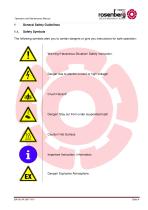
Operation and Maintenance Manual General Safety Guidelines Safety Symbols The following symbols alert you to certain dangers or give you instructions for safe operation: Warning! Hazardous Situation! Safety instruction. Danger due to electric current or high voltage! Crush Hazard! Danger! Stay out from under suspended load! Important Instruction, Information. Danger! Explosive Atmosphere.
Open the catalog to page 5
Operation and Maintenance Manual Safety Instruction Rosenberg-RLT units are designed and constructed to the latest technical standards available at the time of delivery. Comprehensive material, functionality and quality controls ensure high benefits and long life of the unit. Nonetheless hazardous situations can arise when the units are used by untrained personnel or not used as intended. For the individual components the operations manuals of the corresponding component manufacturer are to be used. Read this Operation Manual carefully before unpacking, before assembly work and before every routine...
Open the catalog to page 6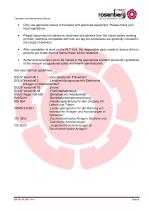
Operation and Maintenance Manual • Only use approved means of transport and approved equipment. Please check your local regulations. • Please disconnect all electronic machines and devices form the mains before working on them (switches compatible with lock out tag out procedures are generally included in the scope of delivery) • After completion of work on the RLT-Unit, the responsible party needs to ensure that no persons are inside the unit before these will be restarted. • Authorized personnel are to be trained in the appropriate accident prevention guidelines of the relevant occupational...
Open the catalog to page 7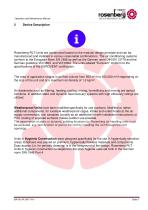
Operation and Maintenance Manual Device Description Rosenberg-RLT-Units are constructed based on the modular design principle and can be manufactured and installed in various reasonable combinations. The air conditioning systems conform to the European Norm EN 1886 as well as the German norm DIN EN 13779 and the German guideline VDI 3803 and VDI 6022. The units labeled “Eurovent” conform to the specifications of the EUROVENT-certification. The area of application ranges in air flow volume from 500 m³/h to 100.000 m³/h depending on the size of the unit and at a maximum air density of 1,3 kg/m³....
Open the catalog to page 8
Operation and Maintenance Manual Unit Model with 40 mm insulation thickness Outside dimensions Unit Model Recommended air volume From Supply Air Exhaust Air H Units Units to v= 1,5 m/s v= 2,5 m/s 730 mm 500 m³/h 2200 m³/h 3700 m³/h 850 mm 1800 m³/h 3100 m³/h 5200 m³/h 730 mm 1800 m³/h 3300 m³/h 5500 m³/h 1050 mm 2700 m³/h 5000 m³/h 8300 m³/h 1050 mm 3000 m³/h 6500 m³/h 10900 m³/h 1350 mm 4000 m³/h 8600 m³/h 14300 m³/h 1350 mm 4000 m³/h 10800 m³/h 18000 m³/h 1680 mm 8000 m³/h 13700 m³/h 22800 m³/h 1680 mm 9000 m³/h 16200 m³/h 27000 m³/h 1980 mm 10000 m³/h 19300 m³/h 32100 m³/h 1980 mm 12000 m³/h...
Open the catalog to page 9
Operation and Maintenance Manual Unit Model with 60 mm insulation thickness 2.1 Information on materials and sealing All metallic materials used are provided with an additional corrosion protection (galvanizing, coating) or are themselves corrosion-resistant. The formation of the protective outer layer is a long-running process. Numerous elements are machined and handmade of galvanized steel. Despite the greatest care in the entire manufacturing process, scratches can only be avoided to a limited extent and discolorations can occur at the cutting edges. These are harmless and state of the art...
Open the catalog to page 10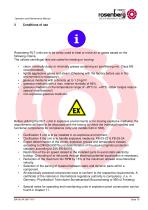
Operation and Maintenance Manual Rosenberg-RLT-units are to be solely used to treat or move air or gases based on the following criteria. The utilized centrifugal fans are suited for treating or moving: • • • • • • clean, minimally dusty or minimally grease containing air (prefiltering min. Class M5 recommended) lightly aggressive gases and steam (Checking with the factory before use in this environment is necessary!) gaseous mediums with a density up to 1,3 kg/m³. gaseous mediums with a max. relative humidity of 95%. gaseous mediums in the temperature range of –20°C to +40°C. (other ranges require...
Open the catalog to page 11
Operation and Maintenance Manual Rosenberg-RLT-units are to be visually inspected upon delivery for damages. This should be done before unloading the individual modules from the transport vehicle. Furthermore the bill of lading should be checked to make sure all parts are in the shipment. Missing parts or damages are to be immediately noted on the bill of lading and confirmed by the driver of the transport vehicle. 4.2 Transportation Smaller components of the Rosenberg-RLT-Units are shipped on pallets and can be handled with forklifts or pallet jacks. Larger components are affixed to wooden transport...
Open the catalog to page 12All Rosenberg Ventilatoren catalogs and technical brochures
 AIR CURTAINS
80 Pages
 WORLD OF AC FANS
316 Pages
 SupraBox COMFORT 800 to 5000
51 Pages
 Series SupraBox COMFORT
25 Pages
 AIR CURTAINS
84 Pages
 AIRBOX air handling units
77 Pages
 EC FANGRID
2 Pages
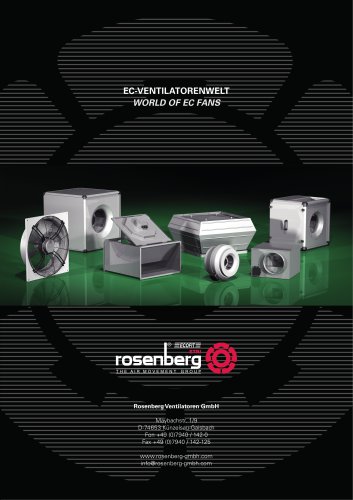 WORLD OF EC FANS
182 Pages
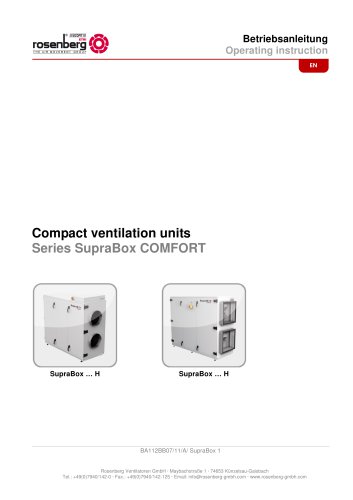 Compact ventilation units
26 Pages
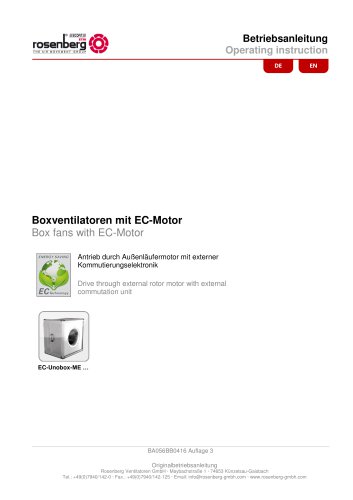 Box fans with EC-Motor
28 Pages
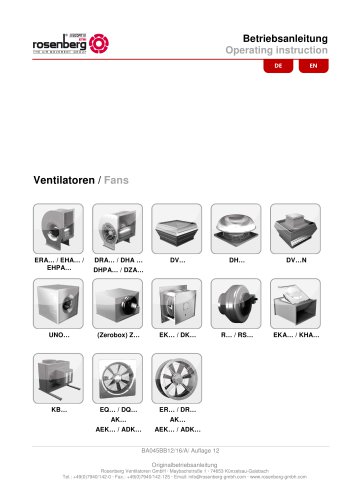 FANS
FANS23 Pages
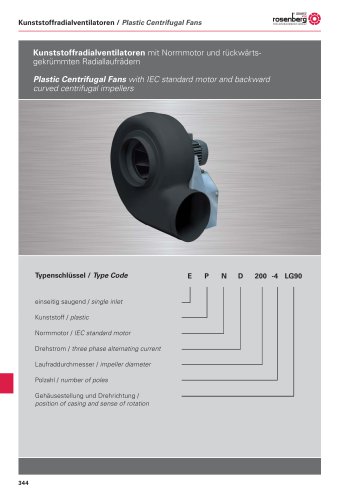 Fans made of plastic (EPND)
18 Pages
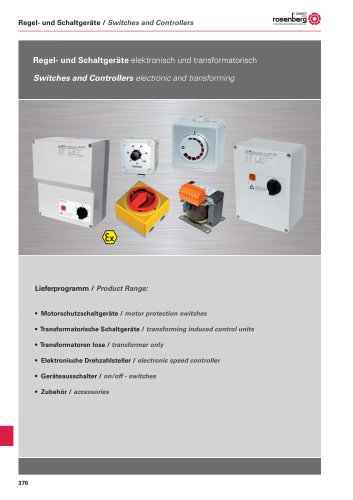 Switches and Controllers
40 Pages
 Ex fans
120 Pages
 World of fans (Standard fans)
450 Pages
 The Rosenberg Group
20 Pages
 RosenbergVentilatoren GmbH
20 Pages
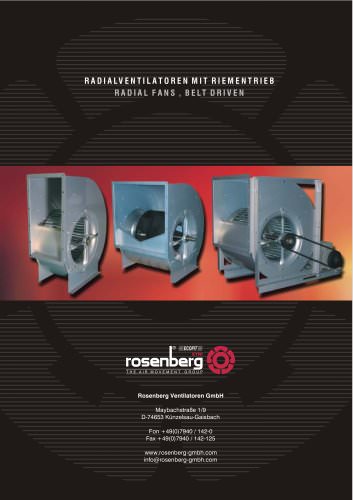 Radial Fans(Belt driven)
125 Pages
 Axial Fans for cooling
47 Pages
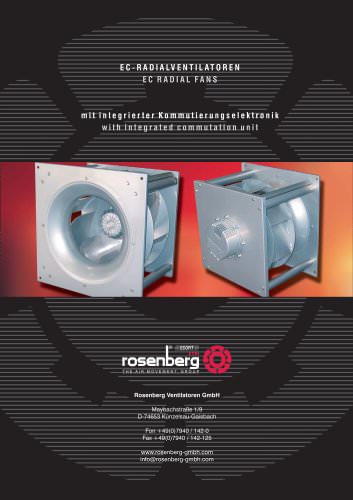 EC-Radial Fans
37 Pages
 AND/B Axial Flow Fans
44 Pages
 Free Blowing fans
85 Pages
 AIR HANDLING UNITS
36 Pages
 AXIAL FLOW FANS
80 Pages
 Rosenberg Brochure
8 Pages




Archived catalogs
 WORLD OF FANS
450 Pages