

2019 Outdoor

2019 Outdoor
- Traditional Installation: This method is not linked to the building structure, preventing cracking or breaking, especially in areas exposed to sunlight and outdoor conditions. It allows easy maintenance and inspection of facilities underneath, such as water pipes and electricity systems. It provides increased soundproofing and thermal insulation, achieves flat paving without drainage slopes, and is ideal for areas with structural weight issues due to its low weight (47kg/m2). The spacing between tiles facilitates water drainage, and it prevents water leakage between the material and waterproof agent. It has a lower installation cost as it does not require highly qualified staff, is easy and clean to install without adhesive glue, and is easily demountable and reusable.
- Elevated System Installation: This system uses supports or plots to overcome limitations of traditional outdoor installation methods. It shares similar advantages with traditional installation, such as not being linked to the building structure, easy maintenance, increased soundproofing, and thermal insulation. It also allows for flat and continuous paving without drainage slopes and is ideal for structurally sensitive areas like balconies.
- Dry Installation: Outdoor 20 can be installed on gravel, grass, or sand without glue. This method is quick, ecological, highly aesthetic, immediately passable, and easily removable, avoiding legal installation issues.
- Traditional Adhesive Installation: This method is suitable for areas with vehicular traffic, commercial and industrial sites, and garage access ramps. It withstands high traffic stress, does not absorb stains, and is easy to clean, even with a pressure hose.
- Do not wet tiles before installation to avoid deformation.
- Ensure walls are smooth before installation; use mortar and allow 48 hours to set.
- Apply adhesive with a notched trowel.
- Leave a minimum gap of 0.5 mm to prevent dimensional issues.
- Avoid tapping tiles during installation to prevent misalignment.
- Handle tiles carefully to avoid chipping.
- Grout with a rubber trowel once dry and clean before it sets.
- Use porcelain tiles with water absorption below 0.5% for extreme weather conditions.
- Level surfaces with a 2% slope to prevent water stagnation and ice formation.
- Use appropriate adhesive and waterproof joints to prevent water infiltration.
- Include expansion joints every 6-9 m² and respect structural joints.
- Ensure complete adhesion with no voids under tiles.
- Meet minimum anti-slip requirements for outdoor pavements.
1. Product Specifications:
- Use only group BI porcelain tiles for outdoor installations, especially in extreme weather conditions, due to their low water absorption rate of less than 0.5%.
2. Surface Preparation:
- Level the surface with a levelling compound or mortar before installation, ensuring a 2% slope to prevent water stagnation and ice formation.
- Install a waterproofing and drainage system on terraces and open areas.
3. Adhesive and Grouting:
- Use cement with low water absorption and impermeable grout to prevent water ingress and potential ice damage.
- Maintain a minimum joint width of 1.5 mm.
4. Expansion Joints:
- Install expansion joints every 6-9 m² and respect existing structural expansion joints.
5. Installation Technique:
- Use a toothed trowel and rubber hammer to ensure tiles are fully compacted with no gaps underneath.
6. Anti-Slip Requirements:
- Ensure exterior flooring meets minimum anti-slip standards, which vary by country.
7. Material Suitability:
- Use appropriate materials for permanently wet areas, complying with technical specifications.
General Sale Terms:
- Merchandise is shipped at the buyer's risk.
- Catalogue colors are indicative and subject to variation.
- Claims are not accepted for installed materials.
- Payments are made directly to Roig Ceramica SA, with a 30-day notice for price changes.
- Legal disputes are handled in Castellon, Spain.
Useful Information:
- The catalogue's technical data is subject to change for product improvement.
- All content is copyright protected, and reproduction requires permission from Roig Cerámica, S.A.
- Anti-Slip Flooring: Information on tiles designed to prevent slipping, suitable for areas where safety is a concern.
- Rectified Products: Details on tiles that have been mechanically finished to ensure precise dimensions and uniformity.
- Outdoor Recommended Products: A selection of tiles specifically recommended for outdoor environments due to their durability and resistance to weather conditions.
- General Sale Terms: The document outlines the terms and conditions applicable to the sale of these products.
- Useful Information: Additional information that may assist in the selection and use of the tiles.
Catalog excerpts

INDICE INDEX SOMMAIRE VERZEICHNIS ALFABETICO ALPHABETICAL ALPHABETIQUE ALPHABETISCH TIPOLOGIA TYPOLOGY TYPOLOGIE TYPOLOGIE • OUTDOOR 20 • DDS • PORCELAIN TILES
Open the catalog to page 4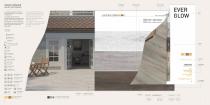
Simbologia* Symbology* Imagen de pieza Tile image Serie y colores Serie and colors La reproduccion de los colores es aproximada debido a los sistemas de impresion. Los codigos de precios y las referencias deben verificarse ya que pueden haber errores tipograficos. El fabricante se reserva el derecho de modificar las caracteristicas del packing segun las condiciones del pedido. *Simbologia *Symbology Revestimiento Wall tiles Pasta blanca White body color Pavimento Floor tiles Pavimento coordinado Co-ordinated floor tile Mate Matt Brillo Gloss Porcelanico Porcelain tile Antihielo Frost resistance Masa...
Open the catalog to page 5
Axis GREY Axis BLACK DOVER WHITE MATERIA BLANCO MATERIA GRIS Axis WHITE MATERIA ANTRACITA CONTRACT WHITE CONTRACT GREY SYNERGY BROWN CONTRACT GRAPHITE VENICE GRAFITO VENICE NATURE FLOW NATURE ICON NATURE BLUENORTE GRIS DOVER GREY BELFORT GRAFITO BLUENORTE GRIS MUSTANG WHITE MUSTANG GREY MUSTANG ANTHRACITE MUSTANG MINK MUSTANG NOCE MATERIA BEIGE CHRONO WHITE ETERNAL STONE GREY SYNERGY PEARL SYNERGY GREY SYNERGY BLACK SYNERGY SAND CHRONO GREY ETERNAL 60x60cm RC STONE GRAPHITE 20x20cm RC ETERNAL STONE DARK MATERIA MARFIL Axis CREAM LIVERMORE PEARL LIVERMORE GREY LIVERMORE BLACK LIVERMORE CALCITA...
Open the catalog to page 6
Outdoor 20 es un gres porcelánico de 20mm de espesor especialmente ideado para su uso en exterior. Su elevada resistencia a la carga de rotura y las tensiones, así como sus extraordinarias prestaciones antideslizantes, hacen de Outdoor 20 el gres ideal para ambientes externos, tanto públicos como privados. Outdoor 20 is a 20mm thick porcelain tile especially designed for outdoor use. Its high resistance to breaking load and stress, as well as its extraordinary slip-resistant features, make Outdoor an ideal tile for outdoor areas, both public and private. Outdoor 20 est un grès cérame de 20 mm...
Open the catalog to page 7
Outdoor 20 ofrece numerosas ventajas respecto a otros materiales naturales que se han utilizado tradicionalmente en exterior. 2. ADVANTAGES Outdoor 20 offers many advantages compared to other natural materials that have traditionally been used outdoors. Outdoor 20 offre des nombreux avantages par rapport à d’autres matériaux naturels qui ont été utilisés traditionnellement à l’extérieur. Outdoor 20 bietet zahlreiche Vorteile gegenüber anderen natürlichen Materialien, die traditionell in Außenbereichen benutzt worden sind. 1. No tiene absorción de agua. 2. Resiste a los ataques químicos. 3. Resiste...
Open the catalog to page 8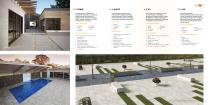
• Passageways • Pools • Walls C 3. DONDE Su extraordinaria resistencia, su facilidad de instalacion y su sofisticado diseno permiten la colocacion de Outdoor 20 en practicamente cualquier espacio exterior y, por que no, interior. La imaginacion es el limite. AMBITO DOMESTICO • Jardines • Pasadizos • Patios • Piscinas • Terrazas • Muros • Escaleras ESPACIOS PUBLICOS • Hoteles (zonas comunes, piscinas, terrazas, etc.). • Balnearios. • Areas residenciales. • Areas industriales. • Pavimento urbano. • Playas (sobre arena). • Zonas con trafico rodado leve (sobre baldosas colocadas,...
Open the catalog to page 9
C 4. COLOCACION SISTEMA SOBRE-ELEVADO Otro de los aspectos revolucionarios de Outdoor 20 es su sistema de colocacion sobre soportes portantes o plots. Este ingenioso sistema permite superar todas las limitaciones que ofrecia la colocacion externa con metodos tradicionales. SISTEMA SOBRE-ELEVADO • No va ligado a la estructura de la edificacion, evitando posibles fisuras y roturas (ventaja importante para las partes expuestas a la luz solar y la intemperie). • Facilidad de mantenimiento e inspeccion de las instalaciones que hay debajo, permitiendo utilizar la parte inferior para las canalizaciones de...
Open the catalog to page 10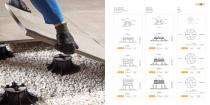
AUTO-NIVELANTE SELF-LEVELLING SELBSTNIVELLIERENDE AUTONIVELANT REGULABLE REGULABLE REGULIERBAR REGULABLE FIJO FIXED FESTER FIXE
Open the catalog to page 12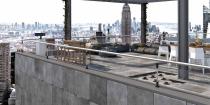
ETERNAL STONE DARK 100x100cm RC 22
Open the catalog to page 13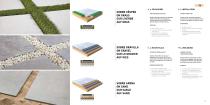
OUT00OR SOBRE CESPED ON GRASS SUR L’HERBE AUF GRAS SOBRE GRAVILLA ON GRAVEL SUR LE GRAVIER AUF KIES SOBRE ARENA ON SAND SUR SABLE AUFSAND C 4. COLOCACION OTROS SISTEMAS: EN SECO Outdoor 20 puede colocarse con facilidad sobre gravilla (5-6cm de gravilla de una granulometria de 4-8mm), hierba (gravilla sobre la hierba) o arena. VENTAJAS • No requiere de colas. • Cotocacion rapida, ecotogica y de alto nivet estetico. • Inmediatamente transitabte, y facitmente removibte (evitando probtemas legates de cotocacion). < 4. MIS EN PLACE AUTRES SYSTEMES: EN SEC Outdoor 20 peut etre mis en place facilement...
Open the catalog to page 14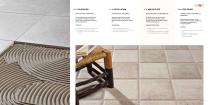
C 4. COLOCACION OTROS SISTEMAS: TRADICIONAL Tecnica adhesiva para pavimentacion con transito de vehiculos, lugares comerciales e industriales, rampas de acceso a garajes, etc. VENTAJAS • Soporta las tensiones de alto transito. • No absorbe manchas; se timpia facitmente, inctuso con una manguera a presion. * 4. INSTALLATION OTHER SYSTEMS: TRADITIONAL Adhesive method for paving with vehicular traffic, commercial and industrial sites, garage access ramps, etc. ADVANTAGES • Withstands high traffic stress. • Does not absorb stains; easy to clean, even with a pressure hose. < 4. MIS EN PLACE AUTRES...
Open the catalog to page 16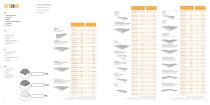
4. COMPLIMENTARY PIECE 4. PIECE COMPLEMENTAIRE 4. ZUSATZTEILE Precio Price BORDE WIN STEP WIN BORDE WIN BORD WIN Formato / Size Precio (A x L) Price PELDANO NAT STEP NAT STUFE NAT MARCHE NAT *Consultar / Check/Nous consulter/Prufen ** Izquierda y derecha /Left and right/Droite et gauche /Links und rechts *Precio por 2 unidades/ Price for 2 units/ Prix pour les 2 pieces/Preis pro 2 stuck *Consultar / Check/Nous consulter/Prufen ** Izquierda y derecha /Left and right/Droite et gauche /Links und rechts ***Precio por 2 unidades/Price for 2 units/ Prix pour les 2 pieces/Preis pro 2 stuck BORDE...
Open the catalog to page 17All Rocersa catalogs and technical brochures
 Mitra-Trevi
4 Pages
 BLACK SHEEP
3 Pages
 MOD
MOD9 Pages
 ETERNAL STONE
9 Pages
 Outdoor
32 Pages
 CATALOGUE NEWS COVERINGS'19
53 Pages
 2019 Wall Tiles
113 Pages
 Xplora
7 Pages
 Tuscan
7 Pages
 Tempora
7 Pages
 Soho
Soho9 Pages
 Renoir
5 Pages
 Moon
Moon7 Pages
 Make Up
15 Pages
 Light
Light5 Pages
 Legacy
7 Pages
 Kalos
Kalos9 Pages
 Illusion
5 Pages
 Hardwood
9 Pages
 Hackney
9 Pages
 Exa
Exa7 Pages
 Custom
7 Pages
 Aruba
Aruba9 Pages
 VIKER
VIKER11 Pages
 PORCELANICO_LQ
288 Pages
 Catálogo OLD STATION
4 Pages
 Catálogo MUSTANG
4 Pages
 Catálogo BURLINGTON
4 Pages
 Catálogo CHRONO
4 Pages
 Catálogo AXIS
4 Pages
 Catálogo EVERGLOW
4 Pages
 Catálogo MITRA - TREVI
4 Pages
 Catálogo FLOW
4 Pages
 Catálogo CONCERT
4 Pages
 Catálogo MUSE
4 Pages
 Catálogo ATMOSPHERE
13 Pages
 Catálogo NORTHBAY
4 Pages
 Catálogo DOVER
13 Pages
 WOOD COLLECTION
3 Pages
 Catálogo CITADEL
4 Pages
 Catálogo LIVERMORE
24 Pages