
- Catalogs
- Rieder Facades GmbH
- formparts


- Company
- Products
- Catalogs
- News & Trends
- Exhibitions
formparts
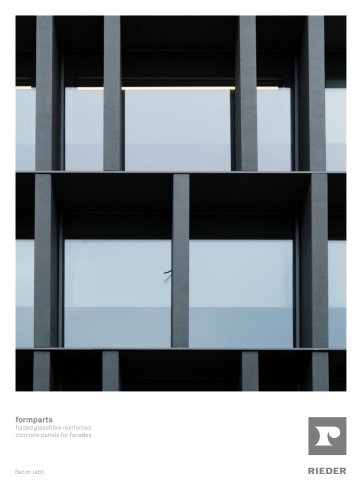
formparts
This document discusses the use of folded glassfibre reinforced concrete panels, known as formparts, for building facades. These panels are used in various architectural projects, including the citizenM Hotel in London, Florentinum Business Office in Prague, and the Life Sciences Building at the University of Vilnius.
Specifications
The formparts are designed for non-visible fastening using an intelligent system with integrated anchors. They are pre-assembled in a factory to ensure quality and allow for rapid on-site assembly. Despite their length, they require only two fastening points per element, reducing the need for sub-construction materials.
Design and Flexibility
These panels are manufactured using the 'industrial manufacture' concept, allowing them to be formed into 3D elements while maintaining a thickness of 13 mm. They offer a monolithic appearance and a variety of design possibilities, including L-cross-section, U-cross-section, round arches, and special shapes. The panels can be combined with large-format concrete skin facade panels and are available in lengths up to 4.5 meters.
Product Characteristics
The panels are available in 12 through-coloured options with a sandblasted surface. They are classified as non-combustible building material class A1 according to DIN 4102, with a dead load of 26 - 31.5 kg/m². Fixing options include rivets, screws, undercut anchors, and special solutions.
Technical Support and Services
Rieder offers comprehensive support for architects and planners throughout all project stages, from planning to implementation. Their R2R (Rendering to Realisation) approach ensures a holistic solution for building envelopes, including design elaboration, facade optimization, static calculations, and logistics concepts.
Additional Information
For precise color specifications, original concrete skin color samples should be used. The natural material of concrete results in a unique surface appearance, enhancing its vivid character. Further details can be found in the technical manual or on the Rieder website.
Catalog excerpts

formparts folded glassfibre reinforced concrete panels for facades Beton lebt.
Open the catalog to page 1
Unitised facades made of concrete It’s through the ‘industrial manufacture‘ concept that fibreC glassfibre reinforced concrete panels can be formed into 3D elements whilst maintaining a thickness of only 13 mm. The elements with a monolithic appearance provide architectural concrete’s high flexibility and a whole range of design possibilities. The curved elements are cut-to-measure as an individual piece; they are available as a L-cross-section or U-cross-section respectively, as round arch and also in special shapes. The shaped parts can be combined with the large-format concrete skin facade...
Open the catalog to page 3
polar white off-white ivory Technical data Forms L-formpart / U-formpart / round arch / special formpart Processing width max. 1300 mm Length up to 4500 mm depending on geometry Colours 12 colours, through-coloured Surface: FE ferro (sandblasted) Product characteristics Building material class A1 (according to DIN 4102), non-combustible Dead load / mass per unit area 26 - 31.5 kg/m² (depending on colour) liquide black Fixing Rivets, screws, undercut anchor, special solutions More colours, surfaces and forms are available on request. Rieder’s facade specialists and the company’s established network...
Open the catalog to page 4All Rieder Facades GmbH catalogs and technical brochures
 Product Range
2 Pages
 Textures datasheet
10 Pages
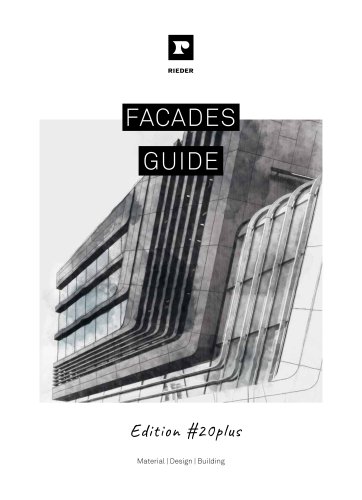 Facades Guide
53 Pages
 öko skin Characteristics
4 Pages
 öko skin
4 Pages
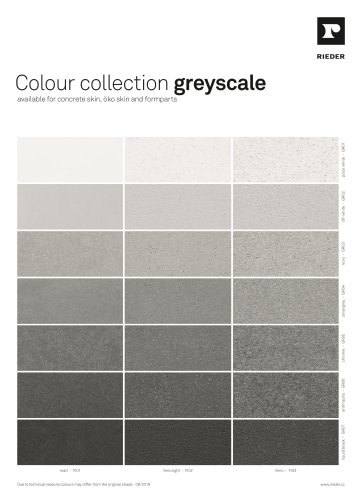 Colour collections
4 Pages
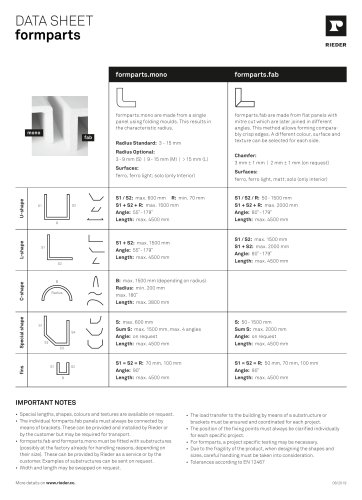 formparts datasheet
1 Page
 LEED v4
8 Pages
 Lookbook 2015
39 Pages

Archived catalogs
 concrete solutions
12 Pages
 Green Initiatives
3 Pages
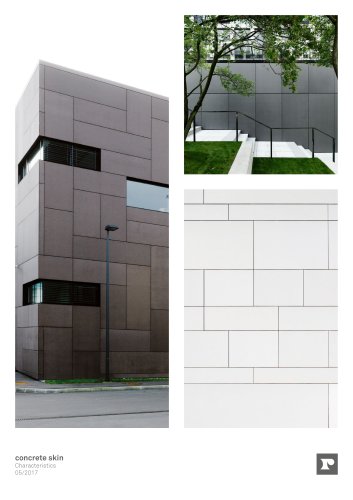
 concrete skin
4 Pages
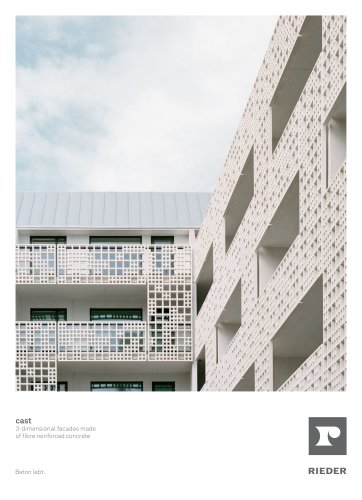 cast
cast4 Pages
 fins
fins2 Pages
- Rainscreen cladding
- Panel rainscreen cladding
- Smooth rainscreen cladding
- Gray cassetta
- Sustainable rainscreen cladding
- Home panel
- Vertical cladding
- Ventilated facade rainscreen cladding
- Textured cladding
- Composite cladding
- Large-format cladding
- Brown cassetta
- Building panel
- White cassetta
- Beige cassetta
- Black cassetta
- Plain panel
- Weather-resistant cladding
- Custom cassetta
- Silver-colored cassetta