

Q-Air – detailed physical properties

Q-Air – detailed physical properties
The document outlines the calculation of the centre of glass heat transmission (Ug) using the EN673:2011 standard. It provides boundary conditions with internal and external temperatures set at 20°C and 0°C, respectively. Various Q-Air models are listed with their respective Ug values, ranging from 0.16 W/m2K for Q-AIR6K to 0.49 W/m2K for Q-AIR3E and Q-AIR3.
The Ug value is influenced by temperature changes and glass deflection. The document provides a detailed analysis using FEM for Q-Air 5, showing how Ug values vary with outdoor temperatures from -40°C to 50°C. The analysis uses Berkeley Lab Window 7.4 software for calculations.
Solar gain is dependent on the angle of incidence, which varies seasonally. The document discusses how this affects the g-value, with calculations for different geographical locations like Ljubljana, Berlin, and Oslo. It highlights that multipane glass units like Q-Air 5 show a decrease in g-value during summer.
Linear thermal transmittance values are calculated according to SIST EN ISO 10211:2008. The document provides estimated and calculated ψ-values for various Q-Air models, with values ranging from 0.015 W/mK for Q-AIR3 to 0.027 W/mK for Q-AIR3L and Q-AIR3E.
The document includes datasheets for different glass combinations, detailing their light transmission (LT) and solar heat gain (g) values. For instance, Q-Air 3 and Q-Air 3E have g-values ranging from 0.12 to 0.32 and LT values from 0.20 to 0.55.
Q-Air models offer sound insulation ranging from 35 dB to 55 dB. Thicker models like Q-Air 5 and Q-Air 6 provide higher sound insulation (Rw of 43 dB), with potential improvements up to 55 dB. Thinner models like Q-Air 3L and Q-Air 3E offer at least 35 dB.
Catalog excerpts
Q-Air – detailed physical properties o o o o o o Centre of glass heat transmission (Ug) Temperature dependency of the centre of glass Ug value Angular dependency of solar heat gain (g – value) Linear heat transmittance value (ψ - values) Light transmission (LT), solar heat gain (g) datasheets Sound insulati
Open the catalog to page 1
Table of contents Centre of glass heat transmission (Ug) Temperature dependency of the centre of glass Ug value 4 Seasonal dependency of the solar gain (g) Linear heat transmittance value (ψ - values) Light transmission (LT), solar heat gain (g) datasheets Sound insulation
Open the catalog to page 2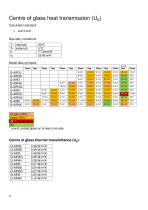
Centre of glass heat transmission (Ug) Calculation standard: • Boundary conditions: Ti (internal) Te (external) hi he Krypton 95% * Argon 90% * Air * Air * Low-E coated glass on at least one side.
Open the catalog to page 3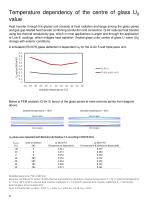
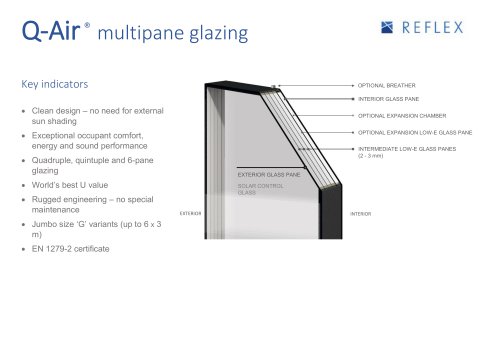
Temperature dependency of the centre of glass Ug value Heat transfer through the glazed unit consists of heat radiation exchange among the glass panes and gas-gap related heat transfer combining conduction and convection. Q-Air reduces heat transfer using low thermal conductivity gas, which in most applications is argon and through the application of Low-E coatings, which mitigate heat radiation. Sealed glass units’ centre of glass U value (Ug) change with exterior conditions. A simulated (EN 673) glass deflection’s dependent Ug for the Q-Air 5 and triple pane unit: 0,9 0,8 0,7 0,6 0,5 0,4 0,3...
Open the catalog to page 4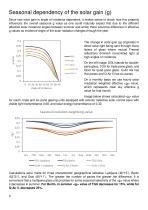
Seasonal dependency of the solar gain (g) Since real solar gain is angle of incidence dependent, it makes sense to check how this property influences the overall seasonal g value as one could naturally expect that due to the different effective solar incidence angles between summer and winter there would be difference in effective g values as incidence angle of the solar radiation changes through the year. 0,4 0,35 0,3 DGU The change in solar gain (g) originates in direct solar light being sent through many layers of glass where mutual Fresnel reflections diminish transmitted light at high angles...
Open the catalog to page 5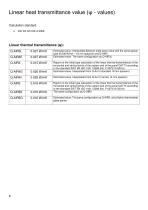
Linear heat transmittance value (ψ - values) Calculation standard: • Linear thermal transmittance (ψ): Estimated value. Interpolated between triple-pane value with the same spacer type (0.038 W/mK – 18 mm spacers) and Q-AIR5 Estimated value. The same configuration as Q-AIR3L Report on the initial type calculation of the linear thermal transmittance of the horizontal and vertical joints of the system and of the panel QATT3 according to the standard SIST EN ISO 10211:2008 (No. P 0073/15-520-5) Estimated value. Interpolated from Q-Air 5 (standard 18 mm spacers) Estimated value. Interpolated from...
Open the catalog to page 6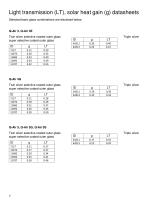
Light transmission (LT), solar heat gain (g) datasheets Selected basic glass combinations are disclosed below. Q-Air 3, Q-Air 3E Twin silver selective coated outer glass super selective coated outer glass ID 7127 11672 11682 11692 11707 Q-Air 4G Twin silver selective coated outer glass super selective coated outer glass ID 7127 11672 11682 11692 11707 Q-Air 5, Q-Air 5G, Q-Air 5S Twin silver selective coated outer glass super selective coated outer glass ID 7127 11672 11682 11692 11707 Triple silver
Open the catalog to page 7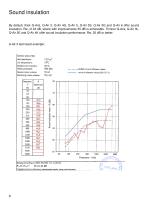
Sound insulation By default, thick Q-Airs, Q-Air 3, Q-Air 4G, Q-Air 5, Q-Air 5S, Q-Air 5G and Q-Air 6 offer sound insulation, Rw, of 43 dB, where with improvements 55 dB is achievable. Thinner Q-Airs, Q-Air 3L, Q-Air 3E and Q-Air 4K offer sound insulation performance, Rw, 35 dB or better. A-Air 3 test result example:
Open the catalog to page 8All REFLEX catalogs and technical brochures
 REFLEX
40 Pages
 Q-Air program
2 Pages
 Sound insulating glas
1 Page
 Sun protection glass
1 Page
 Thermal insulating glass
1 Page


- Architectural glass
- Building glass panel
- Patterned glass panel
- Transparent glass panel
- Laminated glass panel
- Joinery glass panel
- Facade glass panel
- Safety glass panel
- Tempered glass panel
- Insulating glass panel
- Double-glazed glass panel
- Solar control glass panel
- Structural glass panel
- Textured glass panel
- Fire protection glass panel
- Low-e glass panel
- Sun protection glass panel
- Enameled glass panel
- Solar shading glass panel