
- Catalogs
- Rathscheck Schiefer
- Symmetrical Cladding


Symmetrical Cladding

Symmetrical Cladding
Slate has been a preferred material for roofs and façades for thousands of years due to its durability, robustness, ease of handling, and aesthetic appeal. Modern architecture has seen a resurgence in the use of slate, particularly with innovative cladding systems that offer economic efficiency, ease of installation, and unique aesthetics.
The symmetrical cladding system, developed by Rathscheck, is designed to meet modern demands for highly insulated back-ventilated façades. It offers high economic efficiency, straightforward installation, and an aesthetically pleasing appearance. This system allows for creative design opportunities, including the use of slate on both façades and roofs without the need for vertical and horizontal overlaps.
The symmetrical cladding system can be installed using two main techniques: the cramp technique and the undercut technique. The cramp technique involves hanging slate tiles onto an aluminum subframe using stainless steel cramps, allowing for thermal expansion and accommodating various slate sizes up to 60 x 60 cm. The undercut technique provides an invisible fixture by using undercut anchors, allowing for a seamless surface appearance.
Rathscheck ensures high-quality slate through rigorous testing and quality control processes. The slate used is sourced from the best deposits and is subject to continuous quality checks. Slate is an environmentally friendly material, known for its long durability and minimal maintenance requirements. It is also supported by Environment Product Declarations (EPD) that confirm its ecological value.
Slate offers good value for money due to its durability and the development of efficient processing methods. It is compatible with modern building materials and provides a timeless aesthetic. Slate is a natural, robust, and versatile material that harmonizes with various architectural styles, making it a solid choice for both roofs and façades.
Rathscheck provides comprehensive consultation services and resources, including an online slate portal and expert advice, to assist with planning and project realization. They emphasize the natural perfection of slate and its role in sustainable building practices.
Catalog excerpts

Symmetrical Cladding SLATE IN THE MODERN FACADE DESIGN
Open the catalog to page 1
The Symmetrical Cladding for the modern façade design. For thousands of years slate has already been used as material for roofs and façades. Durable, robust, easy to handle and aesthetic – this is how nature made it. Innovative rectangular types of cladding and new façade systems take care of a renaissance of slate in modern architecture. Today straight alignments and variable formats adapting themselves to every building geometry are in the focus. Economic efficiency, laying without problems and unique aesthetics – these are today’s demands on highly insulated back-ventilated façades. The symmetrical...
Open the catalog to page 2
Predestined for the modern architecture Symmetrical Cladding. Courage for the extraordinary. High economic efficiency, a laying technique without problems and an aesthetic overall image speak for a slate façade in symmetrical cladding. Do contrasts attract attention to each other? „The combination of slate in its natural state with its outstanding building-physical characteristics and an absolutely straight-lined architecture opens new creative leeways for design. To me as a planner highly interesting opportunities are offered to create something extraordinary.“ Symmetrical Cladding Symmetrical...
Open the catalog to page 3
Extraordinary opportunities The Symmetrical Cladding redefines the slate façade. In contrast to all the other types of slate Hardly any waste is practically created laying no vertical and horizontal overlap since the subframe allows the use of of the slate stones is required at the slate tiles of any size up to 60 x 60 cm symmetrical cladding. and thus optimally adapts to any building geometry. At the same time the face When carried out in cramp technique joints generate straight-lined modern the façade system is based on a variable aluminium subframe where the slate tiles of a thickness of 1...
Open the catalog to page 4
Laying technique without problems The Symmetrical Cladding with visible fixture. Cramp technique The slate stones are simply hung with stainless steel cramps into an aluminium subframe. InterSIN® blue-grey, natura split The system is so designed that thermal expansions are caught. Any slate formats up to a size of 60 x 60 cm with a thickness of only one centimetre facilitate the perfect adjustment to the geometry of the building. Three colours of slate with different surfaces offer freedom to planners for extravagant designs of façades. Optimal system structure for accepting common thicknesses...
Open the catalog to page 5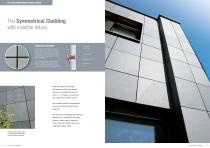
For the undisturbed surface effect The Symmetrical Cladding with invisible fixture. Undercut technique At the undercut technique at a slab of slate, at least 10 mm thick, an undercut blind hole drilling, approx. 7 mm deep, is worked into its rear side and the anchor is inserted free of expanding force and positively locking. One of the advantages of the invisible undercut anchor is the variety of the formats and the joint widths. Thus the façade can be designed completely freely. The principle Façade panel Serrated head screw Panel holder Base With the undercut technique the fastening of the...
Open the catalog to page 6
The Rathscheck Quality System Sustainable building Living and dwelling in harmony with nature. Slate is not always slate. Our mine Katzenberg in Mayen. Here the valuable Moselschiefer ® is exploited. Only the best rock layers are further processed for coping stones and are awarded the rating Moselschiefer ®. Our InterSIN®production in Spain: The largest slate mine of the world. Sustainable building is a stipulation For centuries important references Environment Product Declarations form of the time. The goals are economi- have testified the quality and stability the data basis for the ecological...
Open the catalog to page 7
Everything speaks for slate What you should know about slate ... www.rathscheck.com The comprehensive online slate portal. Straight from the movies – enjoy slate With interesting movies we provide you with extraordinary insights Into the fascinating world of the slate, a rock that with its charisma and durability distinctively speaks for itself. Discover with slate the special connection between human being and nature. Experience the careful exploitation of the valuable natural resource. Be inspired by the creative handling with slate and modern architecture. You may also ask for the films as...
Open the catalog to page 8
Slate. Naturalness in Perfection. Our expert consultants are available for a personal consultation for you free of charge. Because we see ourselves not only as slate producers but also as competent partners around the architecture with the natural building material slate. We help you with the planning, advise you concerning all the issues and look after you during the realisation of your project. by Rathscheck. Subject to alterations. 07/12 Rathscheck Schiefer und Dach-Systeme St.-Barbara-Straße 3 D-56727 Mayen-Katzenberg Germany Phone Fax [email protected] www.rathscheck.com
Open the catalog to page 9All Rathscheck Schiefer catalogs and technical brochures
 Rectangular Coverings
17 Pages
 Slate
Slate13 Pages

- Panel rainscreen cladding
- Decorative cassetta
- Gray cassetta
- Roofing
- Insulated cladding
- Ventilated facade rainscreen cladding
- Textured cladding
- Stone cladding
- Stone look cladding
- Roof tile look roofing
- Cassette cladding
- Vertical cladding
- Natural finish cladding
- Waterproof roofing
- Stone roofing
- Brushed cladding
- Slate roofing
- Concrete look cladding
- Slate cladding