- Catalogs
- RainWater Harvesting
- New 2012 leaflet on Rainwater Harvesting


New 2012 leaflet on Rainwater Harvesting

New 2012 leaflet on Rainwater Harvesting
Water shortages are becoming increasingly common due to climate change, population growth, and higher appliance demands. The average person uses 150 litres of tap water daily, but this can be reduced to 75 litres by using rainwater for non-potable purposes.
Regulatory Pressure
Building Regulations, the Code for Sustainable Homes, and BREEAM have set targets to reduce mains water consumption. Rainwater harvesting is essential to meet these standards.
Steps to Implement Rainwater Harvesting
- Calculate the required tank size using available tools.
- Choose between direct feed or gravity feed systems and obtain a quote.
- Consult with a contractor or architect to determine tank placement.
- Ensure a competent installer sets up the system.
- Order the necessary equipment online or by phone.
- Utilize free support for installation assistance.
- Reduce mains water usage by up to 50% and save on water bills.
Product Offerings
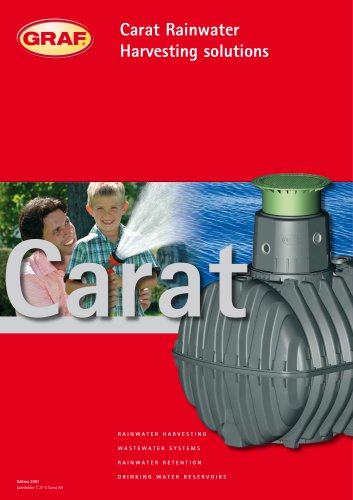
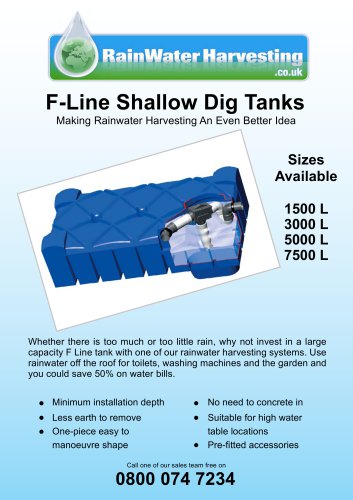
RainWater Harvesting Limited offers a variety of tank styles and sizes, including the popular Carat tanks, which are easy to transport and install. Shallow-dig tanks are also available for specific site conditions.
Storm Water Management
Rainwater harvesting systems also help manage stormwater through soakaways and surface water removal using 300-litre crates.
How Rainwater Harvesting Works
Rainwater is collected from roofs, filtered, and stored in tanks. It is then pumped to where it is needed, with automatic mains water backup if rainwater runs out. Overflow is directed to a soakaway or main drain.
System Types
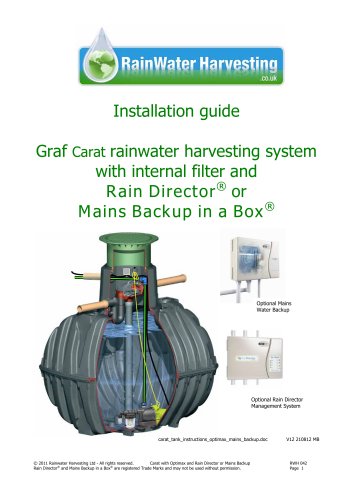
- Direct Feed: Uses a pressure-sensitive pump to supply rainwater directly to appliances. Includes Rain Backup in a Box® for mains backup.
- Gravity Feed: Pumps rainwater to a header tank, reducing pump activity and power usage. The Rain Director® system is WRAS-approved and offers computer-controlled mains backup.
Contact Information
For best prices and further information, visit www.rainwaterharvesting.co.uk, call 0800 074 7234, or email [email protected].
Catalog excerpts

Easy to install complete systems Save Mains Water, Save Money, Reduce water shortages We stock a variety of tank styles and sizes which you can order alone or as complete systems, which is the most cost-effective way of ordering. We’re facing water shortages. Climate change means that reservoirs are low even in winter. Population growth and appliance requirements result in ever-increasing demands on water resources. An average of 150 litres of tap water per person is currently used every day, but using rainwater for WCs, washing machines, and all outdoor use can reduce this to 75 litres. Our best sellers are the Carat tanks, injection-moulded in Germany for uniform strength. They come in two sections making them easy to transport and position; 2,700 and 3,750 litre tank shells are small enough to get through a standard 80 cm door. There are 4 sizes: 2700 litres L2080xW1565xH2010mm 3750 litres L2280xW1755xH2200mm 4800 litres L2280xW1985xH2430mm 6500 litres L2390xW2190xH2710mm The GRAF Carat Official Pressure is on. Targets have now been set to reduce mains water consumption. Building Regulations, the Code for Sustainable Homes and BREEAM now regulate how much water we should be using. Rainwater harvesting is key to meeting these standards. Don’t take a rain check… do it now! 1. Calculate the size of the tank you need. Download the calculator from our website or email us the details. 2. Decide between direct feed or gravity feed and get a quote from us for the equipment you need. For shallow-dig locations, a one-piece tank is ideal as it is only 1 metre in depth. 1500 litres L2100xW1250xH1015mm 3000 litres L2450xW2100xH1050mm 5000 litres L2890XW2300xH1265mm 3. Consult your contractor or architect and decide where to bury the tank; the low temperature underground prevents bacterial action and staleness. Shallow-dig Tank 5. Order online or by phone; we’ll deliver the tank, equipment and instructions ready to fit. 6. We provide free e-mail and phone support for you or your installer. Planners now favour rainwater harvesting not only to save water but also to attenuate storm water. For soakaways, surface water removal and further storm water attenuation, why not use our 300 litre crates. We can quickly calculate the number of crates required for a given volume and surface area. 4. Your installer will be competent to install the tank and plumbing it to the washing machine, toilets and outdoor taps. All pipe fittings are standard. 7. When you’re up and running, you will be reducing the amount of mains water you use by up to 50%, beating any hosepipe bans and (if metered) saving on water bills. Storm water management For best prices, order online at: www.rainwaterharvesting.co.uk Phone us on 0800 074 7234 or email us at: [email protected] RainWater Harvesting Limited, Harrier A, Southgate Way, Orton Southgate, Peterborough PE2 6YQ RWH097 Feb 2012 www.rainwaterharvesting.co.uk
Open the catalog to page 1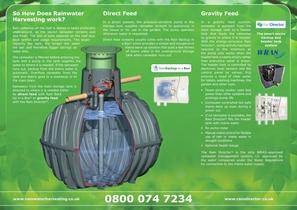
So How Does Rainwater Harvesting work? Rain collected off the roof is stored in tanks preferably underground, as the stored rainwater remains cool and fresh. The size of tank depends on the roof size, local rainfall and usage requirements. The larger capacity the tank, the longer the water will last and therefore bigger savings on water bills. The rainwater is filtered before entering the tank and a pump in the tank supplies the water to where it is needed. If the rainwater runs out, backup from the mains water is automatic. Overflow rainwater from the tank and debris goes to a soakaway or to...
Open the catalog to page 2All RainWater Harvesting catalogs and technical brochures
 Rain Activ
2 Pages
 F-Line Shallow Dig Tanks
2 Pages
 rain backup in a box
3 Pages
 HydroForce
2 Pages
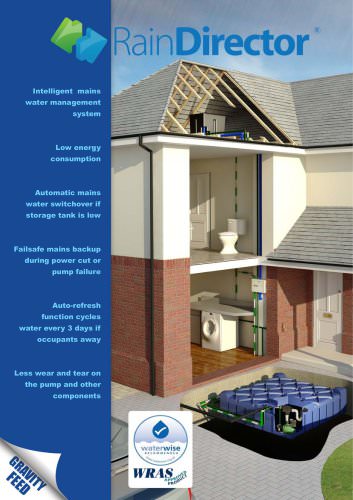 Rain Director® brochure
3 Pages
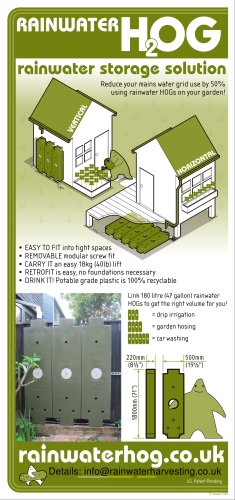 Rainwater H2OG
1 Page