

The Passive Fire Protection Handbook

The Passive Fire Protection Handbook
- Promat PROMASEAL® Silicone Sealant is packaged in 310ml cartridges. The number of cartridges required can be calculated using a specific formula based on joint dimensions.
- The sealant is silicone-based, with an oxime cure system, and offers a joint movement capability of ±25%.
- It is suitable for application temperatures ranging from +5 to +30°C and service temperatures from -30 to +150°C.
- Fire rating up to 120 minutes according to BS 476: Part 20: 1987.
- For effective adhesion, surfaces must be clean and primed. The sealant can be applied to various materials including masonry, concrete, and metal.
- Installation involves ensuring the surfaces are free from dust and grease, and the sealant is applied to both sides of the gap if necessary.
- Fire performance is tested according to BS 476: Part 20: 1987, achieving up to 240 minutes of fire resistance.
- Certifire Approval No CF 424 and CF 425 ensure compliance with fire safety standards.
- For high movement joints, Promat PROMASEAL® Expansion Joint Strip is recommended.
- For installations with expected service movement, pointing around services with silicone sealant is advised.
- Fire Compound is mixed with water and can be used for sealing around service penetrations in walls and floors.
- It provides a gas-tight seal and is compatible with all known building products.
- Loadbearing systems can support temporary foot traffic up to 1.5kN/m².
- For wall applications, a stiffer mix is recommended, while a pouring grade mix is suggested for other applications.
- Temporary or permanent shuttering may be required for floor applications, with additional reinforcement for spans over 600mm.
- Maximum opening sizes for various penetrations are specified, with limitations on the size of gaps around services.
- Plastic pipes must be fitted with suitable fire protective collars or wraps.
- Specifications: Tested according to BS 476: Part 20: 1987, providing up to 120 minutes of fire protection.
- Advantages: Simple installation, reusable, waterproof, maintenance-free, non-toxic, and resistant to vermin and rot.
- Installation: Installed by laying in courses to fill gaps around penetrations, ensuring a good seal with smaller pillows where necessary. Overlap by at least 50mm is required.
- Technical Data: Available in various sizes, with specific fire resistance ratings based on installation method and orientation.
- Specifications: Provides up to 240 minutes of fire resistance, tested according to BS 476: Part 20: 1987.
- Advantages: Easy to install, lightweight, flexible, water-resistant, and suitable for various pipe sizes.
- Installation: Wrapped around pipes and secured with adhesive tabs, then grouted into position using Promat PROMASEAL® Fire Compound.
- Technical Data: Available in sizes to suit pipes up to 160mm in diameter, with specific fire resistance ratings based on pipe size and wall/floor thickness.
- Specifications: Fire resistant seals for movement joints, providing up to 240 minutes of fire resistance.
- Advantages: Allows joint movement, simple dry fixing, water-resistant, and resistant to most chemicals.
- Installation: Compressed and inserted into joint gaps, with specific strip sizes based on joint width and fire resistance requirements.
Catalog excerpts
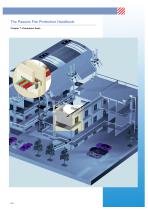
The Passive Fire Protection Handbook Chapter 7: Penetration Seals
Open the catalog to page 1
The Passive Fire Protection Handbook Chapter 7: Penetration Seals IMPORTANT NOTE: Because of the diversity of applications and the on-going test programmes, the following notes on this section are of a general nature only and it is essential to confirm that the system specified or being installed is approved for use. Please contact the Promat Technical Services Department to confirm correct specification. FLOORS, SLABS OR WALLS In every application discussed in this handbook, irrespective of whether it is using a Promat product or system, the importance of sealing any gaps in fire resisting constructions...
Open the catalog to page 2
The Passive Fire Protection Handbook Chapter 7: Penetration Seals Failure Criteria Failure is measured in terms of integrity and insulation. Stability (or structural adequacy) is not recorded for service penetrations. Integrity failure occurs when cracks, holes or openings occur through which flames or hot gases can pass. This is measured in different ways, depending upon the standard used. a) Using a cotton pad, held against any gap, to see if the cotton pad ignites within 10 seconds; or b) If the gap is equal to or greater than 150mm x 6mm; or c) If a 25mm diameter probe can pass through a...
Open the catalog to page 3
The Passive Fire Protection Handbook Chapter 7: Penetration Seals Fire resistance period? Wall, floor, linear gap? Insulation requirement? Mechanical strength? Thermal expansion ● Frequency of change to services Fire rated Electrical cables With damper Single cables Cable trays Steel or cast iron ● Intumescent systems in lightweight constructions ● Smoke or toxicity in populated zones ● Rigid seals in ‘dynamic’ barriers ● Dusty or friable materials in clean-room applications ● Large spans and thermal expansion
Open the catalog to page 4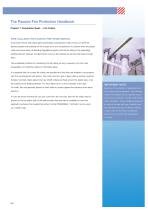
The Passive Fire Protection Handbook Chapter 7: Penetration Seals – Fire Collars FIRE COLLARS FOR PLASTIC PIPE PENETRATION It has been shown that plastic pipes penetrating compartment walls or floors or other fire barriers present the potential for fire to pass from one compartment to another when the plastic melts and burns away. All Building Regulations specify that the fire rating of the separating building element between compartments must not be impaired by services that pass through them. The acceptable methods of maintaining this fire rating will vary, however by far the most acceptable...
Open the catalog to page 5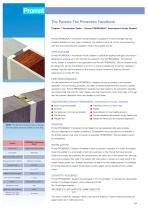
The Passive Fire Protection Handbook Chapter 7: Penetration Seals - Promat PROMASEAL® Intumescent Acrylic Sealant Promat PROMASEAL® Intumescent Acrylic Sealant is supplied in a 310ml cartridge and has excellent adhesion to most types of surfaces. The sealant cures in air to form a non-hardening, tack-free seal, preventing the passage of smoke, toxic gases and fire. APPLICATIONS Promat PROMASEAL® Intumescent Acrylic Sealant is suitable for sealing small gaps and holes in applications requiring up to 240 minutes fire resistance. Promat PROMASEAL® Intumescent Acrylic Sealant is suitable for most...
Open the catalog to page 6
The Passive Fire Protection Handbook Chapter 7: Penetration Seals - Promat PROMASEAL® Intumescent Acrylic Sealant Certifire Approval No CF 431 Table 7a Promat PROMASEAL® Intumescent Acrylic Sealant - Approval Matrix Wall and Floor Installations Promat PROMASEAL® Intumescent Acrylic Sealant Product Name Minimum Seal Depth (mm) Backing Material Integrity (mins) Insulation (mins) Hardwood/ aerated blockwork Softwood/ aerated blockwork Steel/ aerated blockwork Steel/ aerated blockwork Brick/autoclaved aerated concrete Autoclaved aerated concrete/autoclave aerated concrete Autoclaved aerated concrete/autoclave...
Open the catalog to page 7
The Passive Fire Protection Handbook Chapter 7: Penetration Seals - Promat PROMASEAL® Silicone Sealant Promat PROMASEAL® Silicone Sealant is a silicone-based fire protection sealant, supplied in 310ml cartridges. Adhesion is excellent to most types of surface. The sealants cure in air to form a non-hardening, tack-free seal, preventing the passage of smoke, toxic gases and fire. APPLICATIONS Promat PROMASEAL® Silicone Sealant is suitable for sealing small gaps and holes in applications requiring up to 240 minutes fire resistance. Promat PROMASEAL® Silicone Sealant would be required for service...
Open the catalog to page 8
The Passive Fire Protection Handbook PROMASEAL® Silicone Sealant base Cure system 4mm/day approx. 10mm/6 days approx. Skin over time (23oC, 50%RH) Overpaint times Application temperature range Service temperature range Joint length (m) x joint width (mm) x sealant depth (mm) Joint movement capability Chapter 7: Penetration Seals - Promat PROMASEAL® Silicone Sealant QUANTITY REQUIRED Promat PROMASEAL® Sealants are packaged in 310ml cartridges. To calculate the approximate number of cartridges required, use the following formula: 310 This does not allow for wastage. Please note that joint length...
Open the catalog to page 9
The Passive Fire Protection Handbook Chapter 7: Penetration Seals - Promat PROMASEAL® Sealants PENETRATION SEALS Promat PROMASEAL® Intumescent Acrylic or Silicone Sealant are ideal for sealing small gaps with or without penetrating elements. Supplied in a 310ml cartridge. They are also ideal for sealing around metal pipes, cables, conduits, bus ways and ducts which penetrate walls or floors. They bond to masonry, concrete, calcium silicate board, plasterboard, 3 metal and cable coverings and remains flexible after curing to accommodate thermal movement. PROMASEAL® Silicone Sealant is suitable...
Open the catalog to page 10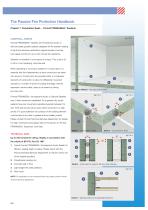
The Passive Fire Protection Handbook Chapter 7: Penetration Seals - Promat PROMASEAL® Sealants CONTROL JOINTS Promat PROMASEAL sealants are intumescent acrylic or ® silicone based gunable sealants designed for fire resistant sealing of joints and services penetrations against spread of smoke, toxic gases and fire for up to 240 minutes fire resistance. Adhesion is excellent to most types of surface. They cure in air to form a non-hardening, tack-free seal. When specifying or sourcing a sealant for a control joint, it is essential that the characteristics of each control joint are taken into account....
Open the catalog to page 11All Promat catalogs and technical brochures
 PROMASEAL®-GT
2 Pages
 PROMATECT®-XW
24 Pages
 Promat
30 Pages
 PROMATECT®-L500
6 Pages
 Promat DURASTEEL®
32 Pages
 PROMASEAL®
32 Pages
 VICUCLAD®
2 Pages
 PROMAFOUR
6 Pages
 Promat PROMAFOUR-SUPALUX®
4 Pages
 MONOLUX®
2 Pages
 FLAMEBRAKER?
3 Pages
 Promat PROMATECT®-250
2 Pages
 VERMICULUX®
2 Pages
 Promat PROMAFORM®
1 Page
 Promat DALFRATEX®
6 Pages
 Promat PROMATECT® -HD
3 Pages
 PROMAT® SYSTEMGLAS
12 Pages
 Promat TLFR Board®
6 Pages
 Promat TL Board®
8 Pages
 Promat TD Board®
20 Pages
 Promat DURAWALL®
16 Pages
 Promat MASTERBOARD®
6 Pages
 PROMAT SUPALUX®
32 Pages
Archived catalogs
 Promat MASTERBOARD®
6 Pages