
- Catalogs
- Pietrucha Group
- PolGrid geogrids and geocomposites

PolGrid geogrids and geocomposites

PolGrid geogrids and geocomposites
The document provides an overview of PolGrid Geogrids, manufactured by the Pietrucha Group, which specializes in geosynthetic products for civil engineering. These geogrids are used for soil reinforcement and stabilization in various construction projects.
PolGrid Geogrids offer immediate stabilization and separation, increased load-bearing capacity, and cost savings. They are environmentally friendly, reducing CO2 emissions and extending the lifespan of asphalt.
The geogrids provide immediate stabilization and reinforcement of road structures. They prevent aggregate shifts and horizontal displacement, acting as a separator between road foundations and subsoil.
Manufactured using a 130-meter automated line, PolGrid Geogrids are made from thermoplastic polypropylene. The process involves extruding, perforating, and stretching the material, ensuring high quality and consistent technical parameters.
PolGrid Geogrids are used in various applications, including road substructures, temporary roads, forest roads, railway tracks, and embankments. They are suitable for projects requiring high load-bearing capacity.
The product range includes biaxial geogrids and geocomposites, which combine geogrids with non-woven geofabric for enhanced reinforcement and separation.
The document lists several completed projects in Poland, showcasing the application of PolGrid Geogrids in road construction, railway reinforcement, and other infrastructure projects.
The FAQ section addresses the manufacturing process, importance of technology, definition of geosynthetics, key parameters for choosing geogrids, and the impact of aperture shape on performance.
Catalog excerpts
The PolGrid Geogrids Soil reinforcement and stabilization
Open the catalog to page 1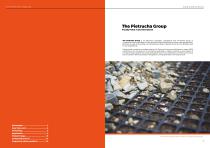
The Pietrucha Group Proudly Polish, Truly International The Pietrucha Group is an efficiently managed, competitive and innovative group of companies which specializes in the manufacturing and distribution of top-class geosynthetic products as well as providing a comprehensive range of geotechnical services broadly used in civil engineering. Geosynthetic products manufactured by the Pietrucha Group are delivered to nearly 3500 customers in 34 countries on 5 continents, especially in regions sensitive to the impact of climate change. Despite the scope and global reach of our operations, the Pietrucha...
Open the catalog to page 2
The PolGrid Geogrids Advantages The Pietrucha Group is the manufacturer of the PolGrid geogrids, specialized geosynthetics widely used Geogrids are used in transport construction projects and other geothechnical works. PolGrid products in the civil engineering projects to stabilize and reinforce land or to separate the substrate layers with are quick and easy to install and allow for the reduction of the use of materials, thus saving investment varying graining. Immediate stabilization and separation The semi-stiff composite aggregate scheme allows for the reinforcement of aggregate, even on...
Open the catalog to page 3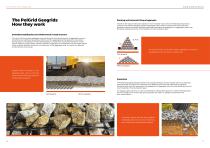
The PolGrid Geogrids How they work Blocking and horizontal fixing of aggregate Thanks to the rigid construction based on non-movable nods, which immediately responds to pressure, the PolGrid geogrids prevent aggregate shifts. Used to reinforce the road structure, geogrids prevent horizontal displacement and penetration (propagation) of aggregate grains into the weak substrate and the loss of stability of the foundation layer. Immediate stabilization and reinforcement of road structure The semi-stiff composite aggregate scheme allows for the reinforcement of aggregate, even on extremely low load-bearing...
Open the catalog to page 4
The PolGrid Geogrids Technology The PolGrid Geogrids Application Tar roads The key feature of the PolGrid products is their rigid construction with stiff and integrated nods. The structure has no interconnecting junctions and the strength of the geogrid node is equal to the strength of the rib. PolGrid is manufactured on an automated 130 meter long technological line and it involves extruding a thermoplastic polypropylene plate, then perforating the calibrated plate and finally stretching the material in both directions. Reinforcement of aggregate substrate layers, reinforcement of embankments...
Open the catalog to page 5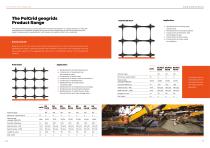
The PolGrid geogrids Product Range ■■ Reinforcement of railway track substructure ■■ Reinforcement of road foundations ■■ Construction of temporary and technological roads ■■ Construction of forest roads ■■ Construction of access roads to windfarms The diverse PolGrid product range allows for the optimal selection of a given product to meet the requirements of individual projects and constructions. Depending on the functionality and the project requirements, a geosynthetic with a given composition and form is selected. Biaxial geogrids Geogrids with stiff nods without any interconnecting junctions....
Open the catalog to page 6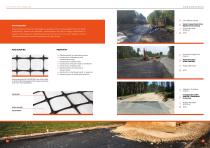
Góra Śląska, Poland Forest inspectorate Góra Śląska forestry Siciny Geocomposites combine the advantages of a geogrids and non-woven geofabric for even higher reinforcement, filtration and separation. Geocomposites are used on boggy substructures or together with materials of unfavorable grain size. The type of the non-woven geofabric may be individually selected to meet the requirements of a given project. Application ■■ Reinforcement of road substructures ■■ Construction of temporary and technological roads ■■ Construction of forest roads ■■ Construction of access roads to windfarms ■■ Construction...
Open the catalog to page 7
Completed projects Warsaw, Poland Express road S2 Polgrid BX 30/30 and separating non-woven fabric 50.000 m2 2014 Gubin, Poland Construction of a forrest road Polgrid 30/30 20.000 m2 2012 Inczew, Poland Construction of technical roads and access roads to windfarms and working platforms Polgrid 30/30 180.000 m2 2013 Brzezinka Średzka, Poland Reinforcement of a railway track substructure Polgrid BX 30/30 and separating non-woven fabric 7.000 m2 2013 Głubczyce, Poland Construction of technical roads and access roads to windfarms Polgrid 30/30 200.000 m2 2013 Rzepin, Poland Geosynthetic layer under...
Open the catalog to page 8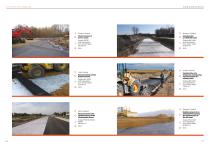
Chojna, Poland Srokowo, Poland Modernization of forrest roads Polgrid 30/30 and separating non-woven fabric 30.000 m2 Polgrid BX 30/30 and separating non-woven fabric 30.000 m2 Łódź, Poland Reconstruction of the Stylowa Street Polgrid BX 30/30 and separating non-woven fabric 10.000 m2 2015 Kalisz, Poland Reconstruction and reinforcement of the Wrocławska Street Polgrid FSR BX 20/20 150PP 48.000 m2 2014 Kunów, Poland Construction of a temporary road during reconstruction of a railway track Polgrid BX 30/30 and separating non-woven fabric 7.000 m2 2014 Rzeszów, Poland Reinforcement of an embankment...
Open the catalog to page 9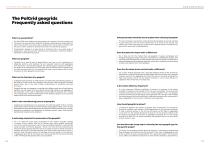
The PolGrid geogrids Frequently asked questions What is a geosynthetic? The ISO 10318 norm defines the geosynthetic as a product of which at least one component is produced from polymer (polyester, polypropylene, polyethylene or nylon), has the form of a sheet, strip or spatial form, and is used in contact with the soil (or other material) in geotechnical and civil engineering projects. Geosynthetics belong to a large family of materials with a very wide range of applications, used primarily for reinforcement, stabilization, draining, filtration, separation and preventing erosion. What are geogrids?...
Open the catalog to page 10All Pietrucha Group catalogs and technical brochures
 FloodWarden_folder
10 Pages
 SuperLock
5 Pages
 The EcoLock System
15 Pages

- Fencing
- Residential fence
- Contemporary fence
- Industrial barrier
- Commercial fence
- Industrial garden fence
- Drainage channel
- Public space barrier
- Sustainable fence
- Public space drainage channel
- Decking
- Fencing with bars
- Industrial fence
- Public space fence
- Rectangular fence
- Slot drainage channel
- Straight fence
- Wooden deck board
- Commercial decking
- Wood look decking