

Roof Tiles

Roof Tiles
Italian roofing tiles are a key feature of the country's architectural charm, contributing significantly to both monumental and residential structures with their distinctive terracotta colors and varied pitches.
Pica has been a leader in the Italian building industry for 50 years, offering a wide range of roofing solutions, including fourteen types of tiles and four types of concave tiles. The company focuses on quality through careful material selection and advanced technology, providing comprehensive consultancy services.
These tiles are characterized by their Mediterranean style, easy installation, low permeability, and frost resistance. They are available in engobe colors for enhanced durability.
The Pantile offers a classical aesthetic suitable for modern architecture, with features like low permeability and frost resistance.
Ideal for simple, high-pitched roofs, this tile is versatile with a variable gauge, low permeability, and frost resistance.
Combining flat and concave elements, this tile is perfect for renovation projects, offering high mechanical strength and innovative engobe techniques.
As the oldest roofing system, these tiles provide classical beauty and functionality, available in three formats for compatibility and low permeability.
The document details various roof tiles like Antica Tuscania and Coppo Rosso Liscio, noted for frost-proof nature and color compatibility. They are designed for easy installation with high bending strength and an average breaking load of 110 kg/cm2.
Installation involves specific procedures for proper ventilation and durability, recommending timber battens or composition mortar fillets as support structures. Detailed instructions emphasize air circulation and proper tile alignment.
Maintaining the same pitch across the roof and placing the first row of tiles on higher battens is crucial for alignment. Specific materials and dimensions for mortar fillets are recommended to facilitate water runoff and ventilation.
Tables provide dimensions and weights for different tile types, while figures illustrate support elements and correct installation techniques for various tile styles.
Proper under-tile ventilation is essential to prevent moisture accumulation and ensure thermal stability. Guidelines for tile installation promote durability and aesthetic continuity.
Catalog excerpts

rture rture ure ure ue ue / / / roofing tile roofing t roofing t > coperture coperture o o o o o o > p p perture p p p p / / / ile > roofing tile roofi ro le > ng tiles ngtes COPERTURE /ROOFING TILES size="-2">
Open the catalog to page 1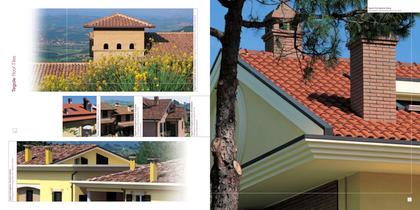
PortugueseInterlockingRoofTile:AnticaTuscania RoofTiles TegolaPortogheseAnticaTuscania Tegole Pantile:Red > TegolaPortogheseAnticaMontefeltro PortugueseInterlockingRoofTile:AnticaMontefeltro TegolaOlandeseRossa TegolaPortogheseAnticaTuscania PortugueseInterlockingRoofTile: AnticaTuscania TegolaPortogheseVecchiaUrbino PortugueseInterlockingRoofTile:VecchiaUrbino >
Open the catalog to page 9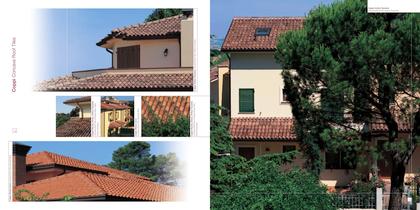
ConcaveRoofTile:AnticaTuscania ConcaveRoofTiles CoppoAnticaTuscania Coppi > CoppoRosato,Rosso,AnticaTuscania ConcaveRoofTile:AntiqueRose,Red,AnticaTuscania CoppoRosato,Rosso,AnticaTuscania ConcaveRoofTile:AntiqueRose,Red,AnticaTuscania CoppoRossoLiscio ConcaveRoofTile:SmoothRed ConcaveRoofTile:SmoothRed CoppoRossoLiscio >
Open the catalog to page 11All PICA catalogs and technical brochures
 Tegola Marsigliese
3 Pages
 Rustico
1 Page
 Sabbiato
1 Page
 Tegola Olandese
2 Pages
 Tegola Portoghese
3 Pages
 MANO ROSATO 2,5X12X25
1 Page
 MATTONE DUCALE 5,5X12X25
1 Page
 MANO GIALLO 3,5X12X25
1 Page
 pica
pica8 Pages
 zenith
2 Pages
 facing bricks
30 Pages
 ROOFING TILE
24 Pages
 roofing tiles high-performance
34 Pages
 contemporary
33 Pages
 zoni & david
48 Pages
 Flooring
17 Pages


Archived catalogs
 Facing Bricks
17 Pages
 Linea cotto zoni
31 Pages
 Linea Cotto David
19 Pages
- Clay roof tile
- Industrial brick
- Outdoor cladding brick
- Facade brick
- Solid brick
- Contemporary cladding brick
- Terracotta cladding brick
- Brick look cladding brick
- Glued cladding brick
- Flat roof tile
- Large roof tile
- Smooth roof tile
- Masonry brick
- Red roof tile
- Decorative cladding brick
- Brown roof tile
- Hollow brick
- High-resistance cladding brick
- Red brick