
- Catalogs
- Panel Sándwich Group
- Five Ribs Sandwich Panel

Five Ribs Sandwich Panel
Five Ribs Sandwich Panel
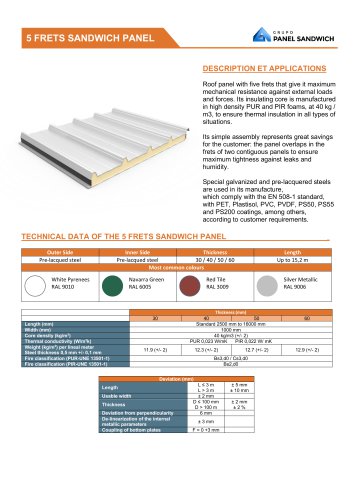
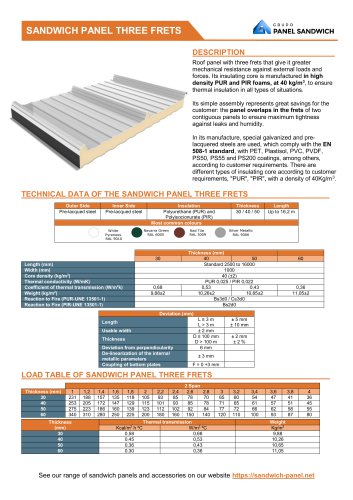
The 5 Frets Sandwich Panel is constructed with pre-lacquered steel on both outer and inner sides, available in thicknesses of 30, 40, 50, and 60 mm, and lengths up to 15.2 meters. Common colors include White Pyrenees (RAL 9010), Navarra Green (RAL 6005), Red Tile (RAL 3009), and Silver Metallic (RAL 9006). The standard width is 1000 mm, with a core density of 40 kg/m3. Thermal conductivity is 0.023 W/mK for PUR and 0.022 W/mK for PIR. The weight per square meter varies slightly with thickness, ranging from 11.9 to 12.9 kg/m2. Fire classifications are Bs3,d0 / Cs3,d0 for PUR and Bs2,d0 for PIR.
Length deviations are ±5 mm for panels ≤ 3 m and ±10 mm for panels > 3 m. Usable width deviation is ±2 mm, and thickness deviation is ±2 mm for D ≤ 100 mm and ±2% for D > 100 mm. Deviation from perpendicularity is 6 mm, and de-linearization of internal metallic parameters is ±3 mm. Coupling of bottom plates is F = 0 +3 mm.
The panel is designed for roofing, featuring five frets for enhanced mechanical resistance. It uses high-density PUR and PIR foams for thermal insulation. The panel's design allows for simple assembly, overlapping at the frets to ensure tightness against leaks and humidity. It is manufactured with galvanized and pre-lacquered steels compliant with EN 508-1 standards, with various coatings available.
The load table provides data for different thicknesses and spans, indicating the panel's capacity to withstand loads. For example, a 30 mm thick panel can handle loads ranging from 303/315 to 28/44 depending on the span.
Thermal transmission values are provided for each thickness, with 30 mm panels having a thermal transmission of 0.68 W/m2 ºC and a weight of 8.46 kg/m2, decreasing with increased thickness.
Proper overlap between adjacent plates is crucial to prevent condensation, with EPDM joints providing protection. Panels are fixed to the structure using self-drilling screws with cappellotti for maximum tightness. Although polyurethane is not hydrophilic, completing the installation with appropriate finishes is recommended for long-term protection.
Catalog excerpts
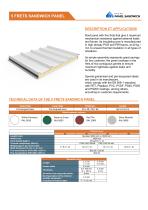
PANEL SANDWICH DESCRIPTION ET APPLICATIONS Roof panel with five frets that give it maximum mechanical resistance against external loads and forces. Its insulating core is manufactured in high density PUR and PIR foams, at 40 kg / m3, to ensure thermal insulation in all types of situations. Its simple assembly represents great savings for the customer: the panel overlaps in the frets of two contiguous panels to ensure maximum tightness against leaks and humidity. Special galvanized and pre-lacquered steels are used in its manufacture, which comply with the EN 508-1 standard, with PET, Plastisol, PVC, PVDF, PS50, PS55 and PS200 coatings, among others, according to customer requirements. Outer Side Inner Side Thickness Length Pre-lacqued steel Pre-lacqued steel 30 / 40 / 50 / 60 Up to 15,2 m
Open the catalog to page 1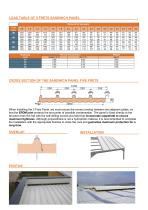
Thermal transmission When installing the 3 Frets Panel, we must ensure the correct overlap between two adjacent plates, so that the EPDM joint protects the encounter of possible condensation. The panel is fixed directly to the structure from the fret with the self-drilling screws provided that incorporate cappellotti to ensure maximum tightness. Although polyurethane is not a hydrophilic material, it is recommended to complete the installation with the appropriate finishes to close the core and guarantee maximum protection for a long time. INSTALLATION PHOTOS
Open the catalog to page 2All Panel Sándwich Group catalogs and technical brochures
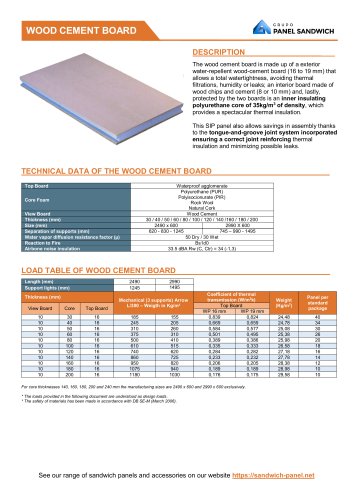 Wood Cement Board
2 Pages
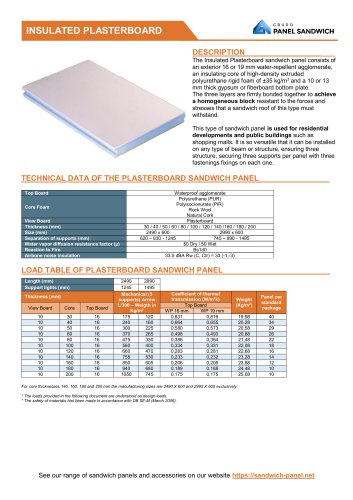 Insulated Plasterboard
2 Pages
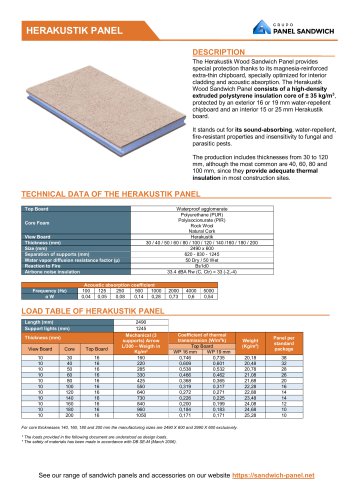 Herakustik Panel
2 Pages
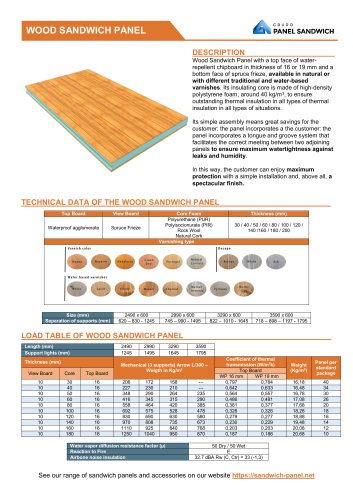 Wood Sandwich Panel
2 Pages
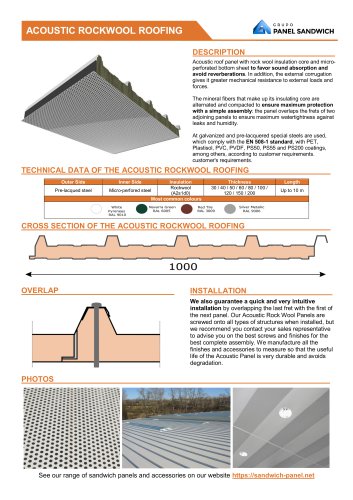 ACOUSTIC ROCKWOOL ROOFING
2 Pages
 Rockwool Acoustic Wall Panel
2 Pages
 FIREPROOF ROCKWOOL SIDING
2 Pages
 Outside Insulated Wall Panel
2 Pages
 Sandwich Panel Three Frets
2 Pages
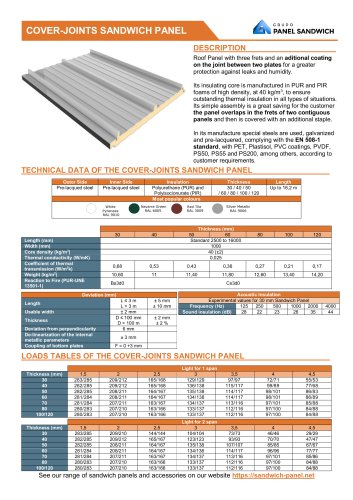 COVER-JOINTS SANDWICH PANEL
2 Pages
 METAL TILE SANDWICH PANEL
2 Pages
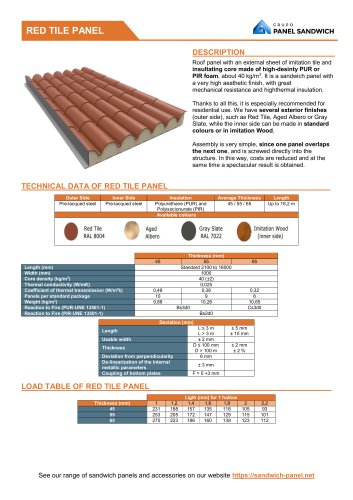 RED TILE PANEL
2 Pages
- Rainscreen cladding
- Panel rainscreen cladding
- Metal cladding
- Profiled sheet
- Smooth rainscreen cladding
- Steel sheet metal
- Gray cassetta
- Facade profiled sheet
- Sustainable rainscreen cladding
- Vertical cladding
- Metal roofing
- Metal facing sandwich panel
- Roof acoustic sandwich panel
- Facade acoustic sandwich panel
- Custom cassetta
- Wall sandwich panel
- High-resistance sandwich panel
- Ribbed sheet metal
- Wood look cladding