
- Catalogs
- Oyster Next Srl
- AudioPanel SonusTile

- Company
- Products
- Catalogs
- News & Trends
- Exhibitions
AudioPanel SonusTile
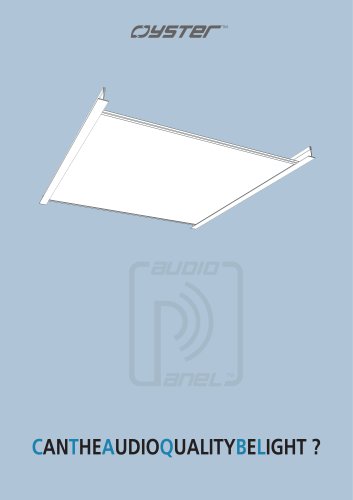
AudioPanel SonusTile
SonusTile is an innovative audio panel designed for public address installations, particularly suitable for false ceilings in offices, hotels, supermarkets, and other commercial spaces. It offers superior audio quality and privacy compared to traditional systems, without the need for a box or metal grids.
Specifications
The SonusTile series includes models CP31 and CP32, both featuring high shock resistance and lightweight construction using aviation-grade materials. Key specifications include:
- Nominal impedance: 4 Ohm (CP31), 8 Ohm (CP32)
- Sensitivity: 90 dB (CP31), 92 dB (CP32)
- Maximum sound pressure: 100 dB SPL (CP31), 105 dB SPL (CP32)
- Frequency response: 60 Hz to 20,000 Hz
- Rated power: 50 Watt (CP31), 100 Watt (CP32)
- Temperature range: -10°C to +60°C
Installation and Design
SonusTile can be easily installed by replacing a mineral fiber panel in the ceiling, requiring no additional holes. The design ensures a clean aesthetic without visible metal grids.
Technology and Performance
The SonusTile utilizes an electro-acoustic transducer to vibrate a thin, rigid panel, creating multiple sound sources that provide clear sound with reduced coloration and a wide stereo image. This technology allows for uniform audio coverage with fewer speakers, making it ideal for multi-channel home theater systems.
Applications
SonusTile is suitable for various environments, including offices, retail spaces, healthcare, education, leisure, and transport.
Environmental Considerations
Oyster, the manufacturer, is committed to developing new technologies and efficient production methods with a focus on environmental protection.
Catalog excerpts
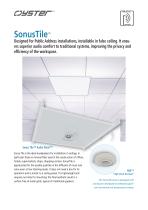
Designed for Public Address installations, installable in false ceiling. It ensures superior audio comfort to traditional systems, improving the privacy and efficiency of the workspace. Sonus Tile™ Audio Panel™ Sonus Tile is the ideal loudspeaker for installation in ceilings, in particular those in mineral fiber used in the construction of offices, hotels, supermarkets, shops, shopping centers. SonusTile is appreciated for the quality qualities in the diffusion of music and voice even at low listening levels. It does not need a box for its operation and is similar to a ceiling panel. It is lightweight...
Open the catalog to page 2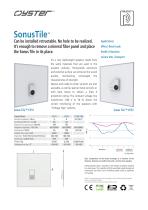
Can be installed retractable. No hole to be realized. It’s enough to remove a mineral fiber panel and place the Sonus Tile in its place. Sonus Tile™ CP31 Específicas Nominal impedance: Ohm Sensitivity(2,83V @ 1 m): dB Maximum sound pressure: dB SPL Frequency response (- 3dB): Hz Rated power: Watt Radiant area active: cm2 Dispersion: Solid Horizontal/Vertical Dimensions: LxAxP mm Weight: Kg Temperature of use: °C It’s a very lightweight speaker, made from the same materials that are used in the aviation industry. Honeycomb aluminum and external surface can enhance the sound quality, maintaining...
Open the catalog to page 3
How it works The fundamental difference between the Audio Panel and conventional speakers is the way sound is generated and radiated. The Oyster Audio Panel consists essentially of a thin, rigid panel whose surface is vibrated by an electro-acoustic transducer, the carefully designed position of which makes the panel structure vibrate optimally. The panel can be considered as an object capable of vibrating pseudo-randomly, which in operation is similar to a piano or a string musical instrument. Because at a given moment, different areas of the panel are excited with different amplitudes and phases,...
Open the catalog to page 4All Oyster Next Srl catalogs and technical brochures
 Omnibox
3 Pages
 Oyster SoundMasking
12 Pages
 AudioPanel SIGN
4 Pages
- Interior speaker
- Home speaker
- Rectangular home theater
- Metal speaker
- Multimedia speaker
- Amplifier
- Aluminum loudspeaker
- Audio amplifier
- Exterior speaker
- Commercial speaker
- Wall-mounted audio system
- Wall-mounted stereo speaker
- Ceiling-mounted speaker
- Invisible speaker
- Indoor home automation system
- Home home automation system
- 2.1 speaker
- Multifunction home automation system
- Square home theater
- Commercial home automation system