
- Catalogs
- OMD office of mobile design
- SchoolsBrochure

SchoolsBrochure
1 / 2 PagesView full catalog
SchoolsBrochure
Product catalog summary
Introduction
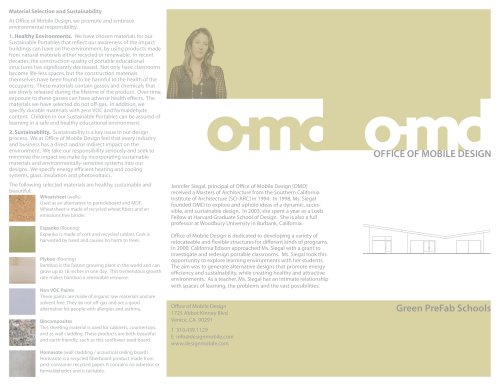
Jennifer Siegal, principal of the Office of Mobile Design (OMD), founded the firm in 1998 to explore dynamic, accessible, and sustainable design. With a background in architecture and a fellowship at Harvard, Siegal is also a professor at Woodbury University. OMD focuses on developing relocatable and flexible structures, particularly for educational environments.
Project Overview
In 2000, California Edison funded a project for OMD to redesign portable classrooms, aiming to enhance energy efficiency and sustainability while creating healthy and attractive learning spaces. This initiative reflects Siegal's commitment to improving educational environments.
Material Selection and Sustainability
OMD emphasizes environmental responsibility by selecting materials that are natural, recycled, or renewable. The firm addresses the decline in construction quality of portable educational structures by choosing materials that do not off-gas harmful chemicals, ensuring a safe learning environment.
Key Materials
Sustainability Practices
OMD integrates sustainable materials and systems into their designs, including energy-efficient heating and cooling, glass, insulation, and photovoltaics, to minimize environmental impact.
Jennifer Siegal, principal of the Office of Mobile Design (OMD), founded the firm in 1998 to explore dynamic, accessible, and sustainable design. With a background in architecture and a fellowship at Harvard, Siegal is also a professor at Woodbury University. OMD focuses on developing relocatable and flexible structures, particularly for educational environments.
Project Overview
In 2000, California Edison funded a project for OMD to redesign portable classrooms, aiming to enhance energy efficiency and sustainability while creating healthy and attractive learning spaces. This initiative reflects Siegal's commitment to improving educational environments.
Material Selection and Sustainability
OMD emphasizes environmental responsibility by selecting materials that are natural, recycled, or renewable. The firm addresses the decline in construction quality of portable educational structures by choosing materials that do not off-gas harmful chemicals, ensuring a safe learning environment.
Key Materials
- Expanko: Made from cork and recycled rubber, harvested sustainably.
- Biocomposites: Used for cabinets and countertops, these materials are both aesthetically pleasing and eco-friendly.
- Homasote: A recycled fiberboard product used for wall cladding and acoustical ceiling boards.
- Plyboo: Bamboo flooring, a rapidly renewable resource.
- Non VOC Paints: Solvent-free paints made from organic materials, suitable for allergy sufferers.
- Wheatsheet: An alternative to particleboard, made from recycled wheat fibers.
Sustainability Practices
OMD integrates sustainable materials and systems into their designs, including energy-efficient heating and cooling, glass, insulation, and photovoltaics, to minimize environmental impact.
See more
All OMD office of mobile design catalogs and technical brochures
 homes brochure
2 Pages
Related Searches
- Industrial house
- Contemporary house
- Prefab house
- Eco-friendly house
- Two-story house
- Industrial prefab building
- Contemporary building
- Commercial building
- Modular house
- Metal building
- Industrial modular building
- Eco-friendly building
- Wooden building
- Metal house
- Housing development building
- Container
- Commercial container
- School building
*Prices are pre-tax. They exclude delivery charges and customs duties and do not include additional charges for installation or activation options. Prices are indicative only and may vary by country, with changes to the cost of raw materials and exchange rates.
About ArchiExpo
ArchiExpo is a marketplace that offers B2B players a complete experience, from product sourcing to purchase. ArchiExpo is an entity of VirtualExpo Group.
Are you a buyer?
Are you a supplier?