

EM-BOX

EM-BOX
Catalog excerpts
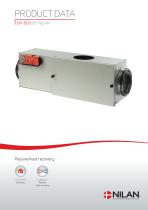
PRODUCT DATA EM-BOX BY NILAN Passive heat recovery Passive heat recovery
Open the catalog to page 1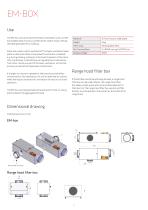
EM-BOX Use The EM-box can be connected to Nilan’s ventilation units. An EMbox enables heat recovery via the home’s cooker hood, utilising the heat generated from cooking. When the cooker hood is switched off, the basic ventilation takes place via the hood. When more powerful extraction is needed, e.g. during cooking, a damper in the hood is opened. At the same time, the damper in the EM-box will regulate the air extraction from other rooms as a part of the basic ventilation, so that the primary air extraction takes place via the hood. If a larger air volume is needed for the hood to provide effective...
Open the catalog to page 2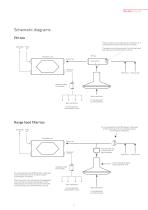
Schematic diagrams EM-box The servomotor is controlled by the ventilation unit. Is activated when the extraction hood is activated. Discharge air The damper control the extraction from the bathroom and utility room while the hood is running. Ventilation unit Extract air Grease filter Utillity room Heating surface (if mounted) Basic ventilation Basic ventilation Forced operation on hood operation Forced operation distributed on rooms Range hood filter box Discharge air On normal operation the DTBU damper is fully open and the hood is part of the ventilation system, providing basic ventilation....
Open the catalog to page 3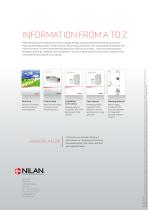
PRODUKTDATA EM-BOX BY NILAN MONTAGEVEJLEDNING CTS602 LIGHT BY NILAN BRUGERVEJLEDNING CTS602 LIGHT BY NILAN Passiv varmegenvinding Passiv varmegenvinding Product data General information about the solution and its benefits. Technical information to ensure correct choice of solution. Installation instructions Detailed guide for installation and initial adjustment of the solution. User manual Drawing material Detailed guide for regulation of the solution to ensure optimum day-to-day operation. Nilan is happy to make 2D CAD drawings available for integrated planning with the solution. Visit us at...
Open the catalog to page 4All Nilan A/S catalogs and technical brochures
 COMBI S 302 POLAR TOP BY NILAN
16 Pages
 VP 18 M2
16 Pages
 COMPACT P - CTS602 HMI
32 Pages
 COMFORT CT300/POLAR
20 Pages
 COMPACT P - SERIES
44 Pages
 Indoor Climate
36 Pages
 Heating Elements
8 Pages
 VPM 120-560 brochure
6 Pages
 VPM 600 3200 brochure
24 Pages
 Nilan Calculator brochure
8 Pages
 Compact p
16 Pages
 Em-box by NILAN
4 Pages
 Comfort 600
8 Pages
 Comfort 450
8 Pages
 Comfort 300 top
8 Pages
 Comfort 300
8 Pages
 Comfort 250 top
6 Pages
 The future is decentralised
16 Pages
 CTS 6000
4 Pages
 Comfort CT300
8 Pages

- Residential heat pump
- Air source heat pump
- Mechanical ventilation unit
- Ventilation controller
- Air/water heat pump
- Commercial heat pump
- Residential ventilation unit
- Home ventilation unit
- Analysis software
- Reversible heat pump
- Hot water heat pump
- Steel structure software
- Industrial calculation software
- Centralized ventilation unit
- Heat-recovery ventilation unit
- Heat recovery unit
- Commercial ventilation unit
- Compact ventilation unit