


BENTOFIX®

BENTOFIX®
Bentofix® is a geosynthetic clay liner (GCL) designed for structural waterproofing, utilizing high-quality sodium bentonite. It is known for its needle-punched technology, which enhances the internal and external shear strength of GCLs, making them suitable for a wide range of applications.
Bentofix® consists of two outer geotextile layers and a core of sodium bentonite. The needle-punching process bonds these layers, creating a robust barrier that combines synthetic and natural materials. The Thermal Lock process further enhances the durability and hydraulic performance of the GCLs.
- Immediate Sealing: The powdered sodium bentonite provides immediate sealing performance without additional priming.
- Self-Sealing and Re-Healing: The bentonite can swell to fill punctures and rehydrate after desiccation, maintaining the barrier's integrity.
- Enhanced Contact with Concrete: Bentofix® BFG is designed to ensure direct contact with concrete surfaces, preventing fluid flow and sealing cracks.
Bentofix® is suitable for various applications, including landfill caps, environmental protection under infrastructure, dams, water containment, structural waterproofing, secondary containment, mining, and tunnels.
Bentofix® products meet several standards, including BS EN 13562:2000 and BS 8102:2009, and are BBA certified for waterproofing systems.
Bentofix® GCLs offer a reliable and innovative solution for waterproofing needs, combining advanced material science with practical engineering applications.
Catalog excerpts

Geosynthetic Clay Liners (GCLs) for structural waterproofing The Inventor of needle-punched Geosynthetic Clay Liners. Material science - Engineering - Innovation ®
Open the catalog to page 1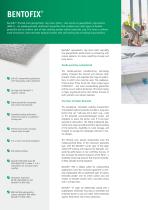
BENTOFIX® Bentofix® Thermal Lock geosynthetic clay liners (GCLs) - also known as geosynthetic clay barriers (GBR-C) - are needle-punched, reinforced composites that combine two outer layers of durable geotextile and an uniform core of high-swelling powder sodium bentonite clay. This forms a uniform, multi-directional, shear-resistant hydraulic barrier with self-sealing and re-healing characteristics. Bentofix® geosynthetic clay liners (GCL) exemplify how geosynthetics perform best: by interacting with natural elements to create something stronger and more secure. Needle-punching revolutionised...
Open the catalog to page 2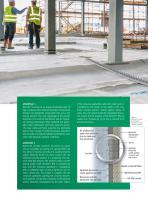
ADVANTAGE 1 Bentofix® consists of an evenly distributed layer of high-swelling sodium bentonite powder encapsulated between two geotextile components that act as the sealing element. The main advantage of the powder bentonite is its uniform distribution and its immediate sealing performance. When hydrated and permeated under confinement with fresh water the bento-of the nonwoven geotextile swells into small cracks or imperfections and moulds to the profile of the reinforced concrete element, sealing against ingress of water. Also, the sodium bentonite impregnated nonwo-ven ensures that all overlaps...
Open the catalog to page 3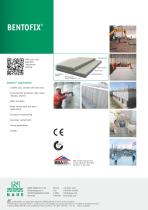
Order your free Bentofix® information package Bentofix® Applications: - Landfill caps, closures and base seals - Environmental protection under roads, railways, airports - Dams and dykes - Water containment and pond applications - Structural waterproofing - Secondary containment - Mining applications - Tunnels BBA certified waterproofing systems (Bentofix® BFG 5000 + Bentofix® X2 BFG 5300) NAUE GmbH & Co. KG Gewerbestrasse 2 32339 Espelkamp-Fiestel Germany Phone +49 5743 41-0 Fax +49 5743 41-240 E-Mail [email protected] Internet www.naue.com and Bentofix® are registered trademarks of NAUE GmbH &...
Open the catalog to page 4All NAUE catalogs and technical brochures
 Secugrid® HS
4 Pages
 Combigrid®
4 Pages
 Secugrid® PET/PP
4 Pages
 CARBOFOL® geomembranes
4 Pages
 geotextile introduction
4 Pages
 SECUTEX® Soft Rock
4 Pages
 MINING and GEOSYNTHETICS
11 Pages
 BENTOFIX® X
4 Pages
 LANDFILL Engineering
13 Pages
 Civil engineering
32 Pages
 Tunnel construction
16 Pages
 NAUE_Renewable_wind_energy
8 Pages
 Secugrid® PDF
3 Pages
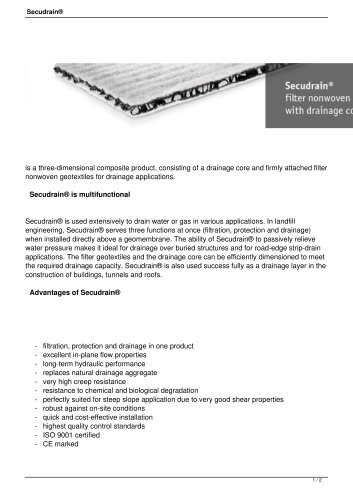 Secudrain® PDF
2 Pages
 Combigrid® PDF
2 Pages
 Bentofix® PDF
3 Pages
 Carbofol® PDF
3 Pages


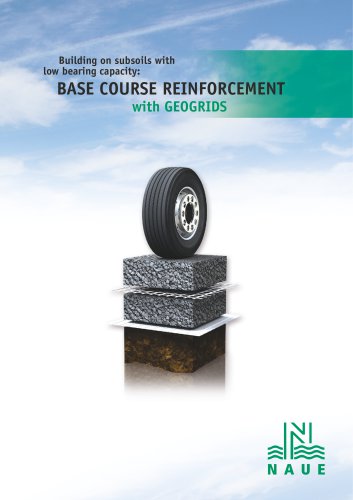

- Building fastening system
- Design software
- Metal fastening system
- Concrete structure software
- Industrial calculation software
- Industrial geogrid
- Steel fastening system
- Reinforcement geogrid
- Non-woven geotextile
- Plastic geotextile
- Industrial geomembrane
- Protection geotextile
- Filtration geotextile
- Drainage geotextile
- Polypropylene geotextile
- Reinforcement geotextile
- Woven geotextile
- Foundation geogrid
- Polyester geogrid