
- Catalogs
- Monodraught
- Hybrid Thermal Mixing Ventilation Systems

Hybrid Thermal Mixing Ventilation Systems

Hybrid Thermal Mixing Ventilation Systems
The document focuses on Hybrid Thermal Mixing (HTM) Ventilation Systems, particularly their application in educational facilities under the Priority School Building Programme (PSBP). It covers the system's design, functionality, and adherence to specific regulations and standards.
The PSBP is a government initiative for rebuilding or refurbishing schools in urgent need of repair, managed by the Education Funding Agency (EFA). It includes two phases: the initial phase to be completed by 2017 and PSBP2, running from 2015 to 2021.
This specification guides the design of PSBP schools, emphasizing adequate ventilation. Key requirements include a minimum ventilation of 3 l/s per person, a daily average of 5 l/s per person, and a capacity for 8 l/s per person for night-time purge during summer, with acoustic requirements of 35 dB(A) for mechanical ventilation noise.
HTM systems provide natural and hybrid ventilation, featuring mixed tempered air for winter and boosted ventilation for summer. They include intelligent control systems with low energy consumption, automatic switching between operational modes based on season and air quality, and compliance with PSBP criteria through CFD analysis.
The system offers ideal environments for classrooms with mixed tempered air and secure night-time cooling, exceptionally low power consumption, full acoustic testing with a sound reduction index of 31 dB, and an automatic control strategy based on seasonal conditions.
The HTM system includes a rated voltage of 230 V AC and frequency of 50 Hz, exemption from EU regulations due to low energy consumption, and options for electric heater battery and BACnet BMS interconnection.
HTM systems can be installed for cross flow or single-sided ventilation strategies, automatically providing night-time cooling and modulating dampers for optimal ventilation temperatures.
A case study demonstrates the HTM system's performance in a classroom setting, highlighting temperature and CO2 levels during different seasons.
The HTM wall controller allows for manual and automatic control of ventilation settings, including a diagnostic mode for system checks.
HTM systems offer a cost-effective, energy-efficient solution for school ventilation, meeting PSBP requirements and providing a comfortable learning environment.
The document provides a detailed analysis of Monodraught's HTM ventilation system, focusing on its natural and hybrid ventilation performance, winter performance, and compliance with environmental specifications for educational facilities.
Monodraught uses the ModeIIT Building Modeller and MacroFlo Air Movement modules to demonstrate the system's natural ventilation capabilities during non-heating seasons, automatically regulating airflow based on classroom conditions.
The HTM system operates in hybrid mode during peak summer periods, using a low-energy fan to boost fresh air supply, modeled using the ApacheHVAC System Simulation Interface.
During heating seasons, the HTM system tempers incoming fresh air, mixing it with recirculated room air to maintain a supply air temperature of approximately 13°C, even when external temperatures are 0°C.
Monodraught developed a performance model using IES-VE software, incorporating data from tests and monitoring to accurately represent the HTM system, considering occupancy, solar gain, and heat gains.
The document lists construction data, including U-values, thermal mass, infiltration rates, and occupancy details, critical for modeling and ensuring compliance with environmental specifications.
A climatic test chamber evaluated the HTM system's performance, recording temperatures in different zones to ensure effective air mixing and ventilation rates.
The document outlines requirements for achieving a passive internal environment, optimizing daylight and ventilation, and ensuring thermal comfort, with Monodraught's systems designed to meet these specifications.
The HTM system ensures adequate fresh air supply, mixing ventilation air to avoid cold draughts, maintaining air speeds below 0.3 m/s in winter, minimizing energy loss, and ensuring easy maintenance access.
Catalog excerpts

Hessle High School- Courtesy of DLA Architects Hybrid Thermal Mixing Ventilation Systems High-performance, low carbon ventilation
Open the catalog to page 1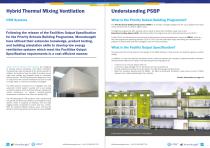
Hybrid Thermal Mixing Ventilation Understanding PSBP What is the Priority School Building Programme? The Priority School Building Programme (PSBP) is a centrally managed programme set up to address the needs of the schools most in need of urgent repair. Following the release of the Facilities Output Specification for the Priority Schools Building Programme, Monodraught have utilised their extensive knowledge, product testing, and building simulation skills to develop low energy ventilation systems which meet the Facilities Output Specification requirements in a cost efficient manner. Through...
Open the catalog to page 2
Why Choose Hybrid Thermal Mixing? Ideal Environment • The HTM is able to provide the ideal environment to school classrooms/ areas. • The HTM system is designed to provide mixed tempered air during winter, boosted levels of ventilation during summer and secure night time cooling. • The HTM system works in conjunction with natural ventilation provided by manual or automatic windows/louvres. • The HTM system can be used in single sided or cross flow ventilation strategies. Exceptionally Low Power Consumption • The HTM system has an exceptionally low specific fan power. • The HTM system comprises...
Open the catalog to page 3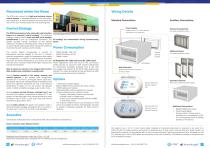
Placement within the Room Wiring Details The HTM units connect to a high level external volume control damper. A standard position for the units within each classroom is that the systems are mounted at the rear of the room furthest away from the teaching wall. Standard Connections Control Strategy Auxiliary Connections Power Supply The HTM incorporates a fully automatic control system based on a seasonal control strategy. The seasonal strategy is determined by time and date but is weather compensated to pick up unseasonal conditions. The All settings are customisable during commissioning system...
Open the catalog to page 4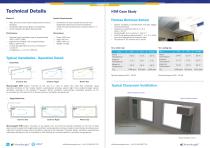
Technical Details • ABS, aluminium and rubber sealed volume control Composite high density glass wool cladding • Acrylic capped semi-gloss fascia panels • Daytime hybrid ventilation rate of approximately • Night time ventilation rate of approximately • U-value through external air shut off damper = Typical Installation - Operation Detail • Cross Flow: Summer Day Summer Night Winter Day Monodraught HTM system mounted at the rear of a room to assist with cross flow ventilation using openable windows on the facade. System automatically provides secure night time cooling through natural ventilation...
Open the catalog to page 5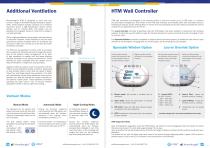
Additional Ventilation Monodraught’s HTM is designed to work with and control a range of VENTSAIR Façade Ventilation System (VAF). These systems typically comprise of an external aluminium louvre, a high specification volume control damper and an internal grille. The system can be specified to suit glazed frames or fitted with a flange to suit wall openings. HTM wall controllers are designed to be mounted within a zone and control up to 2 HTM units, in a primary and secondary arrangement. Two version of the HTM wall controller are available. Both wall controllers house a temperature and CO2 sensor...
Open the catalog to page 6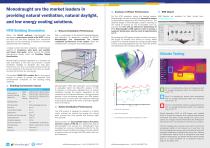
Monodraught are the market leaders in providing natural ventilation, natural daylight, and low energy cooling solutions. HTM Building Simulation 2. Natural Ventilation Performance Within the IES-VE software, Monodraught has developed a performance model of the HTM, utilising the data that has been collected from component tests and on site monitoring, to produce an accurate representation for modelling. With a combination of the ModeIIT Building Modeller and MacroFlo Air Movement modules of IES‑VE, Monodraught can demonstrate the natural ventilation performance of the system within the modelled...
Open the catalog to page 7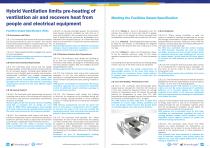
Hybrid Ventilation limits pre-heating of ventilation air and recovers heat from people and electrical equipment Facilities Output Specification (FOS) 2.6 Environment and Fabric 2.6.1. The Contractor shall ensure that external envelope and structure should be used to achieve the internal environment required based on a passive approach. The principles being for a passive approach to assist the achievement of the internal environment by: 2.8.16.3. In naturally ventilated spaces, the Contractor shall provide mixing of ventilation air with room air to avoid cold draughts in the occupied zone during...
Open the catalog to page 8
Halifax House, High Wycombe @MonodraughtLtd @cool_phase ty\(jir\ttriv\(j delivered. v\a^jro}iu^
Open the catalog to page 9All Monodraught catalogs and technical brochures
 natural ventilation
24 Pages
 Building Simulation
5 Pages
 Air-Precision
13 Pages
 iNVent 2
7 Pages
 Monodraught Natural Cooling
11 Pages
 Monodraught Natural Ventilation
15 Pages
 Monodraught Natural Lighting
13 Pages
 Cool-phase
16 Pages
 Windcatcher X-Air
4 Pages
 VENTSAIR
2 Pages
 Sola-boost
4 Pages
 SUNPIPE
2 Pages
 Schools Brochure
40 Pages
 Healthcare Brochure
32 Pages


- Industrial suspended ceiling
- Ventilation grill
- Metal ventilation grill
- Rectangular ventilation grill
- Metal suspended ceiling
- Industrial air diffuser
- Aluminum ventilation grill
- Square ventilation grill
- Ceiling-mounted air diffuser
- Strip suspended ceiling
- Circular displacement air diffuser
- Steel suspended ceiling
- Square air diffuser
- Interior ventilation grill
- Industrial roof vent
- Ventilation damper
- Linear air diffuser
- Metal ventilation damper
- Slot air diffuser
- Round ventilation grill