
- Catalogs
- Monodraught
- Healthcare Brochure

Healthcare Brochure

Healthcare Brochure
This document underscores the significance of natural ventilation and daylight in healthcare environments, aligning with Florence Nightingale's principles of maintaining pure air for patient care. It highlights the NHS's impact on carbon emissions and the necessity for sustainable building practices.
The introduction emphasizes the role of natural ventilation and daylighting in reducing carbon emissions and enhancing energy efficiency in healthcare facilities, with a preference for passive ventilation solutions by the NHS.
The document reviews regulations and guidelines such as Building Regulations Part F and L2A, NHS HTM standards, and BREEAM Healthcare, advocating for natural ventilation and daylighting to improve energy efficiency and sustainability.
Royal Chelsea Hospital and Blackberry Hill Hospital are highlighted for their use of Monodraught WINDCATCHER systems, focusing on energy savings and sustainability.
Healthcare facilities must balance energy efficiency with patient and staff comfort, supported by key legal and guidance documents promoting natural ventilation and daylighting.
Natural ventilation is crucial for infection control, with the WHO associating high ventilation rates with reduced airborne disease transmission.
Design strategies focus on long-term sustainability, integrating natural ventilation and daylighting to reduce energy costs and carbon emissions.
Monodraught's products, such as WINDCATCHER, SUNPIPE, and COOL-PHASE, are featured as effective solutions for natural ventilation and daylighting in healthcare settings.
The document concludes by reinforcing the role of natural ventilation and daylighting in creating sustainable, energy-efficient healthcare environments, aligning with NHS goals and regulatory requirements.
Higher ventilation rates are crucial for reducing airborne infections, with WHO recommendations to maximize natural ventilation. Building Regulations Part F mandates limiting pollutants and moisture to prevent health hazards.
Part L of the UK Building Regulations focuses on energy efficiency and sustainability, aiming for zero carbon buildings. Part F addresses ventilation requirements, ensuring buildings limit pollutants and moisture.
The NHS strategy emphasizes natural ventilation and daylighting to reduce energy use, with mechanical solutions limited to core areas.
This standard classifies indoor air quality based on ventilation rates per occupant, guiding ventilation standards.
The NHS Heatwave Plan for England addresses overheating risks, recommending cool areas in healthcare facilities.
Monodraught systems provide secure night-time cooling with minimal energy costs, managing airflow to prevent overcooling.
The SOLA-BOOST system enhances natural ventilation with solar-powered fans, increasing ventilation rates on sunny days.
Monodraught's COOL-PHASE system offers passive cooling and heat recovery, storing energy in phase change materials.
Examples include the Norwich & Norfolk University Hospital and MT Vernon Treatment Centre, utilizing Monodraught systems for natural ventilation and daylighting.
The EPBD mandates energy performance standards for buildings, requiring energy certification and regular inspections.
DSM tools model building energy performance, offering more accurate assessments than simpler models like SBEM.
Monodraught WINDCATCHER systems provide natural ventilation by capturing wind and directing airflow into buildings.
The Monodraught system utilizes passive stack ventilation, enhanced by the venturi effect, for effective air exchange.
Case studies include Frenchay Hospital and New Brentwood Resource Centre, where SUNPIPE systems enhance natural lighting.
BREEAM emphasizes sustainable design, awarding credits for natural ventilation and daylighting, with Monodraught products meeting these standards.
The Carbon Trust advises on reducing carbon emissions, highlighting the benefits of natural ventilation and daylighting.
The document discusses optimizing ventilation rates to maintain indoor air quality, using CO2 concentration as a control measure.
Concerns about heat loss through ventilation in winter are addressed, suggesting that proper design can balance heat loss with incidental gains.
Local authorities monitor urban air quality, with action plans required for areas with poor air quality. Monodraught WINDCATCHERS® offer a solution by drawing in cleaner air from roof level.
Ventilation rates can be adjusted based on occupancy, with a minimum requirement to maintain CO2 levels around 1000 ppm.
The Sandbanks ward at Poole Hospital was refurbished to enhance patient privacy and create a modern environment.
Overheating is addressed by Part L2A of the Building Regulations, advocating for natural ventilation to maintain thermal comfort.
Daylight is recognized for its health benefits, improving patient recovery times and staff satisfaction.
The COOL-PHASE® system provides passive cooling and heat recovery, designed for zero carbon operation.
Tests on WINDCATCHER systems showed effective ventilation and night cooling, with tracer gas decay methods used to measure performance.
The document discusses the effectiveness of Monodraught's natural ventilation systems and other sustainable technologies.
The University of Hertfordshire tested the WINDCATCHER system, demonstrating effective air change rates.
Monodraught has been involved in research programs focusing on PCM, evaporative cooling, and solar-powered air conditioning.
Monodraught collaborates with universities to assess and improve their products, with numerous papers published.
Monodraught is committed to continuous product development and supporting new engineers in sustainable energy solutions.
Catalog excerpts
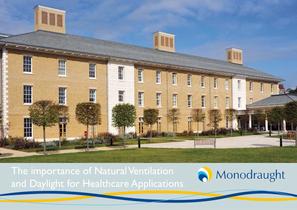
1 The importance of Natural Ventilation and Daylight for Healthcare Applications
Open the catalog to page 1
Contents Page 3 Preface Page 4 Front cover story - Royal Chelsea Hospital Page 5 Front cover story - Royal Chelsea Hospital Page 6 Introduction Page 7 The Regulations Page 8 Blackberry Hill Hospital Page 9 Blackberry Hill Hospital Page 10 Health, Comfort and Sustainability Page 11 Ventilation Guidance Page 12 Avoiding Overheating Page 13 Maintaining a Sustainable Future Page 14 Design Page 15 Design Page 16 Frenchay Hospital Page 17 New Brentwood Resource Centre Page 18 BREEAM Page 19 UK Organisations Page 20 Kentish Town Healthcare Page 21 Basildon Hospital Page 22 Cost Saving & Patient Recovery...
Open the catalog to page 2
3 Providing pure ventilation was seen by Florence Nightingale as the first rule of nursing. In “Notes on Nursing” Nightingale stresses, “the first and last thing upon which a nurse’s attention must be fixed, the first essential to the patient, without which all the rest you can do for him is as nothing…is this: TO KEEP THE AIR HE BREATHES AS PURE AS THE EXTERNAL AIR WITHOUT CHILLING HIM.” This mantra is echoed in Monodraught’s philosophy. The National Health Service Carbon Reduction Unit reports that the NHS is responsible for 20 million tonnes of carbon dioxide emissions per annum. It is the...
Open the catalog to page 3
4 Front Cover Story Royal Chelsea Hospital London Architects: Steffian Bradley Architects (SBA) Facade: Quinlan & Francis Terry Architects Consultant: Delap & Waller Monodraught WINDCATCHER® natural ventilation systems were selected to provide energy-free fresh air throughout the new three storey flagship care home. The fifteen systems were cleverly adapted by Monodraught to complement the architectural style of the new infirmary, which is in context with original Wren and Soane buildings. The units were clad in clay pantiles to ensure a perfect blend with the architectural style. CFD analysis...
Open the catalog to page 4
5 The new infirmary had to be environmentally friendly and is designed and constructed to reach a lifespan in excess of 120 years. This ruled out conventional air conditioning, with its noise and relatively high running costs. The original Royal Hospital was a naturally ventilated building, so consulting engineer Delap and Waller decided that the new buildings also needed ‘energyfree ventilation’ and that only natural ventilation could meet such rigorous demands. Monodraught WINDCATCHER systems were selected to deliver this energy-free fresh air throughout the buildings on the project. For the...
Open the catalog to page 5
6 Natural Ventilation Day Lighting Energy Performance & Display Energy Certificate Environmental Rating BREEAM Organisations: — NHS Carbon Reduction Unit — BRE (BREEAM + EnCO2de) — Carbon Trust (EnCO2de) — CABE Building Regulations PartL: Conservation of Fuel and Power BREEAM Healthcare European Energy Performance of Buildings Directive (EBPD) Airtightness/ Air Leakage Calculation Methods: — EnCO2de National Calculation Methods (NCM): — SBEM — DSM Building Regulations Part F: Ventilation Securing Health, Comfort and Environmental Performance Healthcare facilities demand good quality ventilation,...
Open the catalog to page 6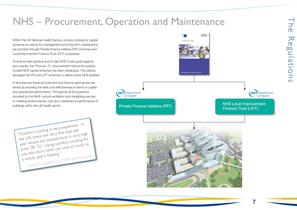
7 NHS – Procurement, Operation and Maintenance The Regulations “Comfort cooling is ver y expensive. In the UK, there are very few days per year where the temperature is very high (over 28 °C). Using comfort cooling for just this short term can cost as much as a whole year’s heating ” Carbon Trust publication CTG005 Technology guide Within the UK National Health Service, primary funding for capital schemes as well as for management and long-term maintenance are primarily through Private Finance Initiative (PFI) schemes and Local Improvement Finance Trust (LIFT) companies. To ensure best practice...
Open the catalog to page 7
8 The Fromeside medium secure mental health unit at Blackberry Hill Hospital in Bristol formed part of a major investment scheme to provide mental health facilities in Bristol, north Somerset and south Gloucestershire. Commissioned by Avon and Wiltshire Mental Health Partnership NHS Trust with private sector partner Ryhurst First Priorities. The concept design was undertaken by Devereux Architects, with the scheme subsequently run as a design and build contract with Rydon Construction as the contractor, Frederick Gibberd Partnership as the implementation architect and hurleypalmerflatt as the...
Open the catalog to page 8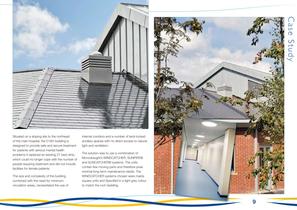
9 Case Study Situated on a sloping site to the northeast of the main hospital, the £19m building is designed to provide safe and secure treatment for patients with serious mental health problems it replaced an existing 27-bed clinic, which could no longer cope with the number of people requiring treatment and did not include facilities for female patients. The size and complexity of the building, combined with the need for minimum circulation areas, necessitated the use of internal corridors and a number of land-Iocked ancillary spaces with no direct access to natural light and ventilation. The...
Open the catalog to page 9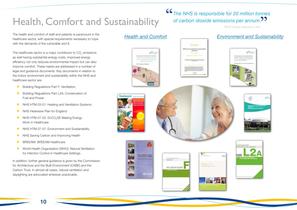
10 Health, Comfort and Sustainability The health and comfort of staff and patients is paramount in the healthcare sector, with special requirements necessary to cope with the demands of the vulnerable and ill. The healthcare sector is a major contributor to CO2 emissions as well having substantial energy costs. Improved energy efficiency not only reduces environmental impact but can also improve comfort. These needs are addressed in a number of legal and guidance documents. Key documents in relation to the indoor environment and sustainability within the NHS and healthcare sector are: zz Building...
Open the catalog to page 10
11 given by the CEN 13779 Classification. It is also the minimum standard required by Part F of the Building Regulations for Offices. The World Health Organisation. Throughout the world, natural ventilation has a vital role to play in healthcare. In its publication “Natural Ventilation for Healthcare Settings”, the WHO states that “Lack of ventilation or low ventilation rates are associated with increased infection rates or outbreaks of airborne diseases” whereas “high ventilation rates could decrease the risk of infection... A higher ventilation rate is able to provide a higher dilution capability...
Open the catalog to page 11All Monodraught catalogs and technical brochures
 natural ventilation
24 Pages
 Building Simulation
5 Pages
 Air-Precision
13 Pages
 iNVent 2
7 Pages
 Monodraught Natural Cooling
11 Pages
 Monodraught Natural Ventilation
15 Pages
 Monodraught Natural Lighting
13 Pages
 Cool-phase
16 Pages
 Windcatcher X-Air
4 Pages
 VENTSAIR
2 Pages
 Sola-boost
4 Pages
 SUNPIPE
2 Pages
 Schools Brochure
40 Pages


- Industrial suspended ceiling
- Ventilation grill
- Metal ventilation grill
- Rectangular ventilation grill
- Metal suspended ceiling
- Industrial air diffuser
- Aluminum ventilation grill
- Square ventilation grill
- Ceiling-mounted air diffuser
- Strip suspended ceiling
- Circular displacement air diffuser
- Steel suspended ceiling
- Square air diffuser
- Interior ventilation grill
- Industrial roof vent
- Ventilation damper
- Linear air diffuser
- Metal ventilation damper
- Slot air diffuser
- Round ventilation grill